Root Cause Analysis Incident Report
Brief
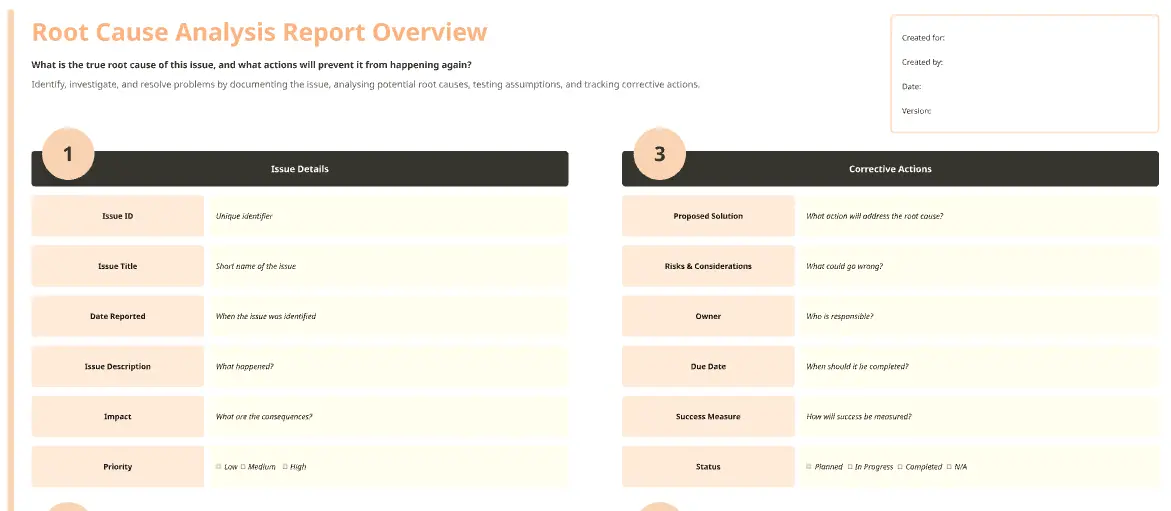
A Root Cause Analysis Incident Report Template is a structured framework for systematically investigating and documenting workplace incidents, product defects, safety events, or operational failures. Its purpose is to move beyond surface-level symptoms and identify the fundamental system or process breakdowns that allowed an incident to occur. This template ensures consistent, thorough investigations by guiding teams through event description, timeline reconstruction, contributing factor analysis, root cause identification, and corrective action planning. The standardized format supports accountability, regulatory compliance, and organizational learning by creating a clear record that can be reviewed, approved, and used to prevent recurrence.
Who Can Use It
This template benefits a wide range of roles and teams across industries:
Quality Assurance and Safety Teams conducting formal incident investigations
Operations and Production Managers responding to process failures or defects
Maintenance and Engineering Teams analyzing equipment breakdowns
Healthcare Professionals investigating adverse events or near-misses
IT and Cybersecurity Teams documenting system outages or security breaches
Compliance and Audit Teams maintaining regulatory documentation
Project Managers analyzing project failures or delays
Manufacturing, Food Safety, Pharmaceutical, and Aviation sectors where rigorous incident reporting is required
How to Use It
Step 1: Capture Incident Metadata
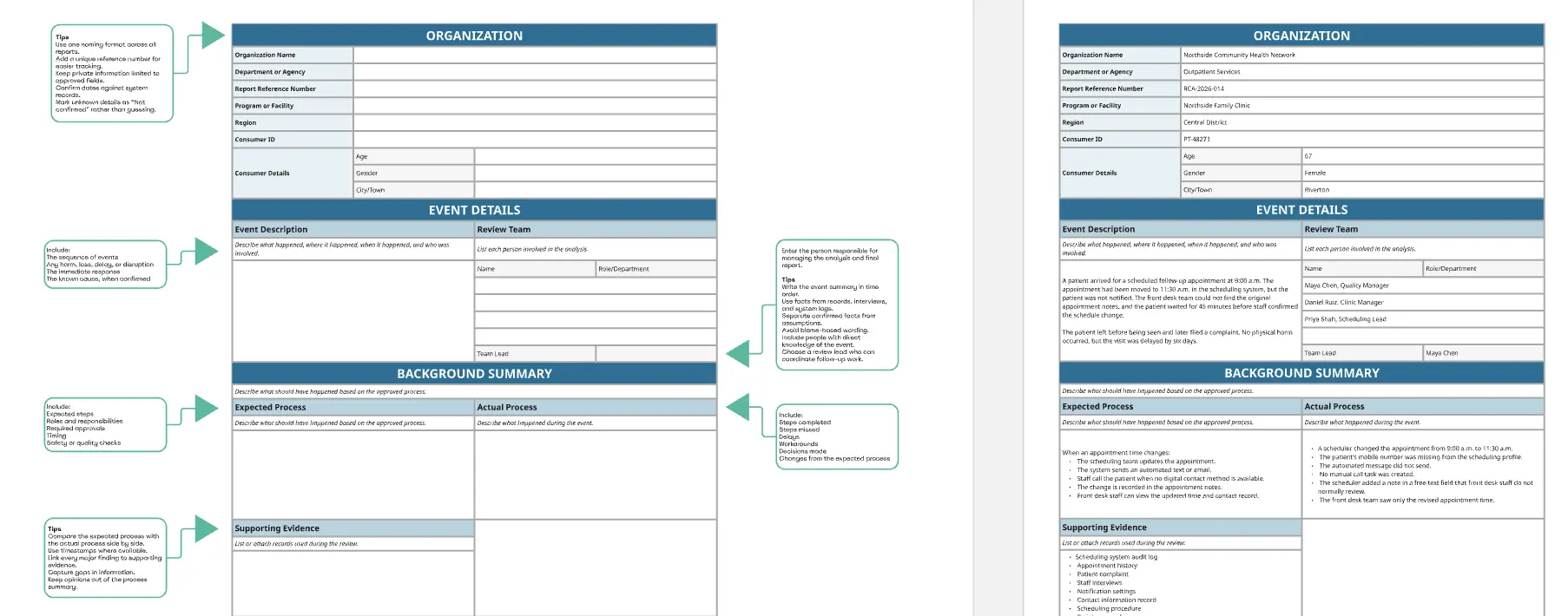
Complete the header fields with Incident Title, ID/Reference, Date and Time of Event, and Report Owner/Investigation Team members.
Step 2: Describe the Event (Section A)
Write a factual narrative covering what happened, where, who was involved, the immediate impact, and how the situation was contained.
Step 3: Build the Timeline (Section B)
Populate the timeline table with time-stamped events and observations, noting the source of each entry (logs, interviews, system records).
Step 4: Identify Contributing Factors (Section C)
Document conditions that enabled the incident—staffing gaps, environmental factors, equipment state, missed checks, or communication breakdowns.
Step 5: Determine Root Cause(s) (Section D)
Identify the fundamental process or system failure and explain how it was validated through data, logs, or interviews.
Step 6: Plan Corrective Actions (Section E)
Complete the action table with specific corrective and preventive measures, assign owners, set due dates, and track status.
Step 7: Review and Approve
Have the preparer and reviewer/approver sign off with names and dates.
About the Example Used
The template includes a worked example from food manufacturing: metal fragments discovered in granola batch 4471 (incident QA-2026-041) on 21 August 2026. The investigation team comprised a QA lead, maintenance engineer, and operations representative. The scenario demonstrates how a worn mixer blade went undetected due to three weeks of skipped preventive-maintenance inspections following a role handover with no formal checklist. The root cause was traced to an undefined ownership structure for preventive maintenance after staffing changes. The example shows realistic timeline entries, contributing factors, validated root cause analysis, and a corrective action plan with tracked responsibilities and deadlines—illustrating how teams should complete each section with precision and evidence.
Cheers!
Khawaja Rizwan