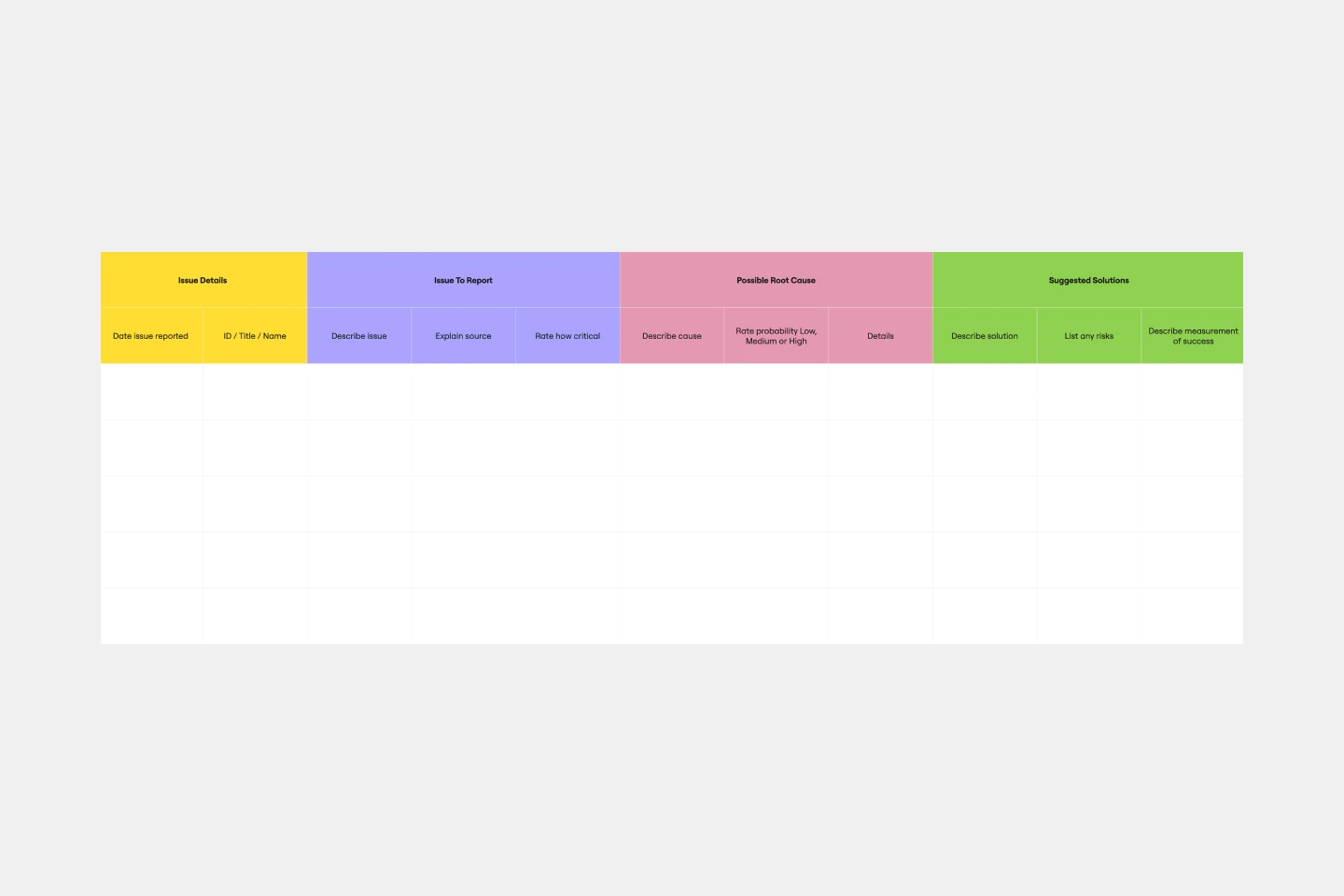
What is the Root Cause Analysis Report Template?
A structured incident review template that helps teams document an event, compare expected and actual processes, identify root causes, record contributing factors, and assign corrective actions. Teams can use it to create a clear report from initial event details through final follow-up.
What problem does the Root Cause Analysis Report Template solve?
Incomplete incident records
Unclear event timelines
Blame-focused reviews
Missing supporting evidence
Weak cause-and-effect analysis
Corrective actions without ownership
Poor follow-up on open issues
How to use the Root Cause Analysis Report Template
Enter the organization and event details.
Describe the event in time order.
List the review team and review lead.
Compare the expected process with what occurred.
Identify any process differences.
Assess whether those differences contributed to the event.
Review policies, procedures, and training.
Document the root cause and contributing factors.
Create corrective actions with owners and due dates.
Complete the final review and follow-up plan.
Common pitfalls
Writing conclusions before collecting evidence
Using vague event descriptions
Treating the nearest person as the root cause
Confusing symptoms with underlying causes
Leaving policy or training gaps unreviewed
Creating actions that do not address the cause
Closing actions without testing results
Ways to avoid mistakes
Use records, interviews, logs, and observations.
Separate facts from assumptions.
Map the event in time order.
Ask why each condition existed.
Review process, technology, staffing, and communication.
Assign one owner to each action.
Use measurable success criteria.
Track open actions through completion.
Miro Features You Can Use
Tables for organization details and action tracking
Sticky notes for facts, assumptions, and causes
Connectors for cause-and-effect links
Comments for evidence and review notes
Tags for priority, status, and owner
Color coding for facts, gaps, causes, and actions
Frames for report sections
Voting to rank corrective actions
FAQs
Q: Who can benefit from this template?
A: Quality teams, compliance teams, healthcare teams, operations leaders, safety teams, program managers, auditors, and incident review groups.
Q: What types of events can this template support?
A: Safety incidents, service failures, process breakdowns, compliance events, customer complaints, system outages, and operational errors.
Q: What is the difference between a root cause and a contributing factor?
A: A root cause is an underlying condition that allowed the event to occur. A contributing factor increased the chance or severity of the event.
Q: How much evidence should be collected?
A: Collect enough evidence to support the timeline, findings, cause analysis, and corrective actions.
Q: Should names be added to the board?
A: Use internal IDs or approved references when the board may be shared broadly.
Q: What will participants leave with?
A: A completed incident report, evidence-backed findings, identified root causes, assigned corrective actions, and a follow-up plan.