Eisenhower Matrix for Product Teams
Brief
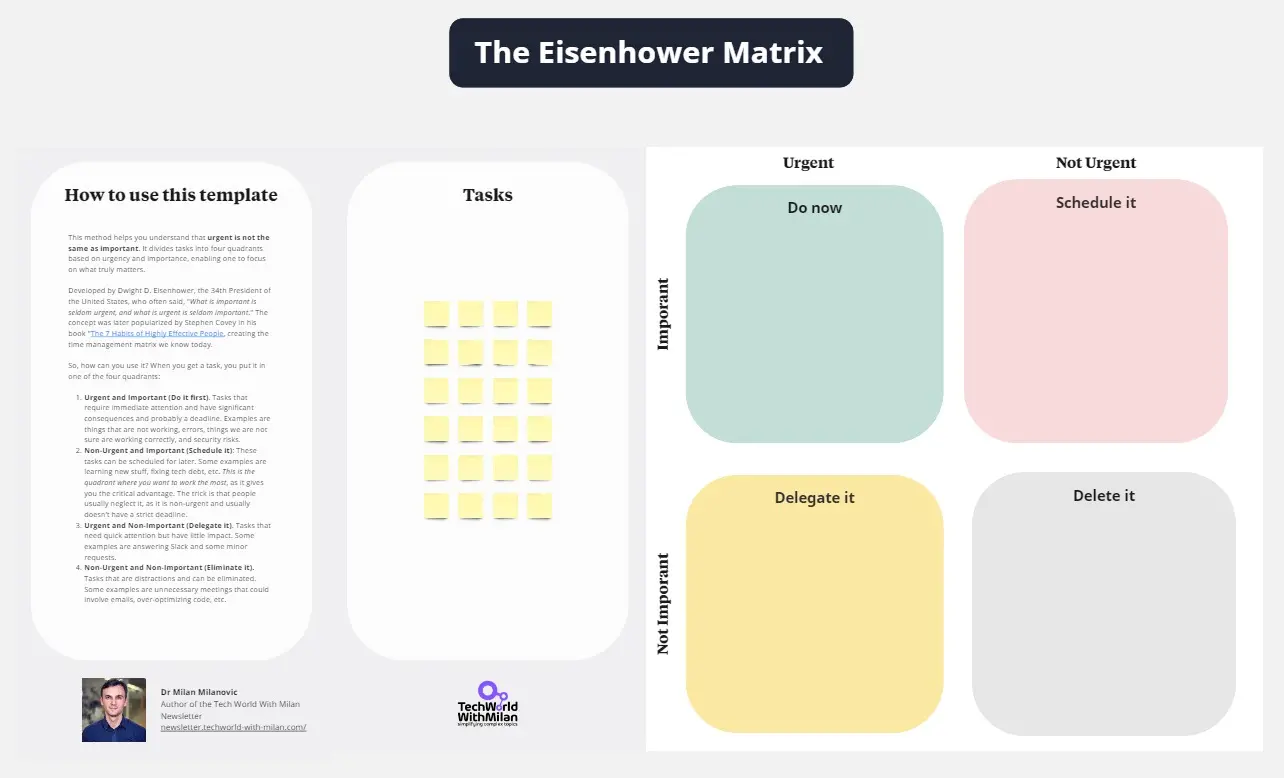
The Eisenhower Matrix for Product Teams is a visual prioritization framework that helps teams cut through backlog noise by sorting tasks across two dimensions—urgency and importance—into four actionable quadrants. Its core purpose is to prevent teams from drowning in firefighting by protecting time for strategic, high-impact work that reduces future crises. By making trade-offs explicit, the matrix enables product teams to allocate capacity intentionally, ensuring that important-but-not-urgent initiatives don't get perpetually displaced by the urgent.
Who Can Use It
This template is designed for product managers, product owners, scrum masters, agile teams, and cross-functional product teams who need to triage backlogs, prioritize sprint work, or decide where to focus team energy during planning sessions and standups.
How to Use It
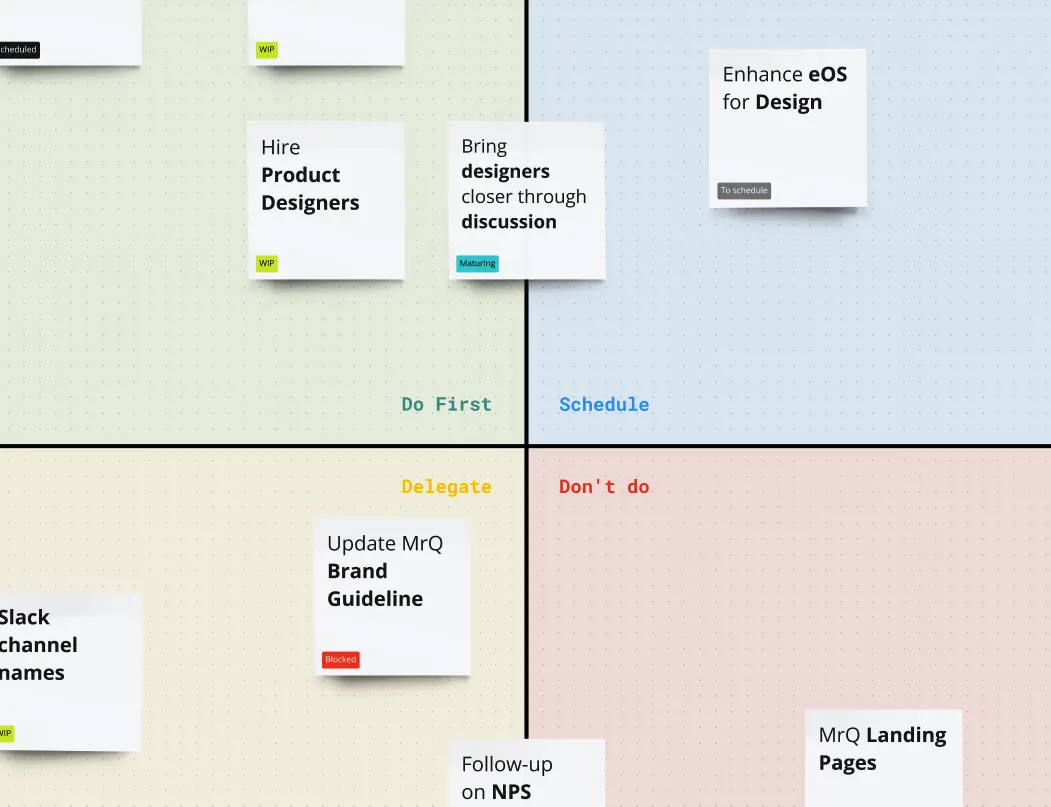
Step 1: Capture all tasks, features, bugs, and initiatives as sticky notes.
Step 2: Sort each item into one of four quadrants:
Quadrant I – Do First (urgent & important): Critical issues that demand immediate action—production bugs, security vulnerabilities, SLA breaches. Act on these now.
Quadrant II – Schedule/Decide (important, not urgent): Strategic work like roadmap planning, user research, technical debt reduction, and process improvements. Protect dedicated time for these; they prevent future Quadrant I fires.
Quadrant III – Delegate (urgent, not important): Tasks that need to happen soon but don't require your team's core expertise—release notes, meeting prep, routine QA triage. Hand these off to the right people.
Quadrant IV – Eliminate/Delete (neither urgent nor important): Low-value work like vanity metrics, redundant meetings, and stale experiments. Remove them from your backlog entirely.
Step 3: Review the matrix at daily standups or during backlog grooming. Reserve 20-30% of sprint capacity explicitly for Quadrant II work—this is the only way to sustainably shrink Quadrant I over time.
Example Use
During sprint planning, a product team uses the matrix to triage 24 backlog items. They place a critical checkout bug, a customer SLA escalation, and a security hotfix in Do First to handle immediately. Roadmap drafting, user interviews on onboarding drop-off, and an authentication service refactor RFC go into Schedule/Decide, with 30% of the sprint reserved for this work. Release notes, sprint demo preparation, and bug triage queue management are assigned to Delegate with clear owners. Finally, they move a vanity dashboard, speculative feature specs, and four stale A/B experiments to Eliminate/Delete, freeing up mental bandwidth for what matters.