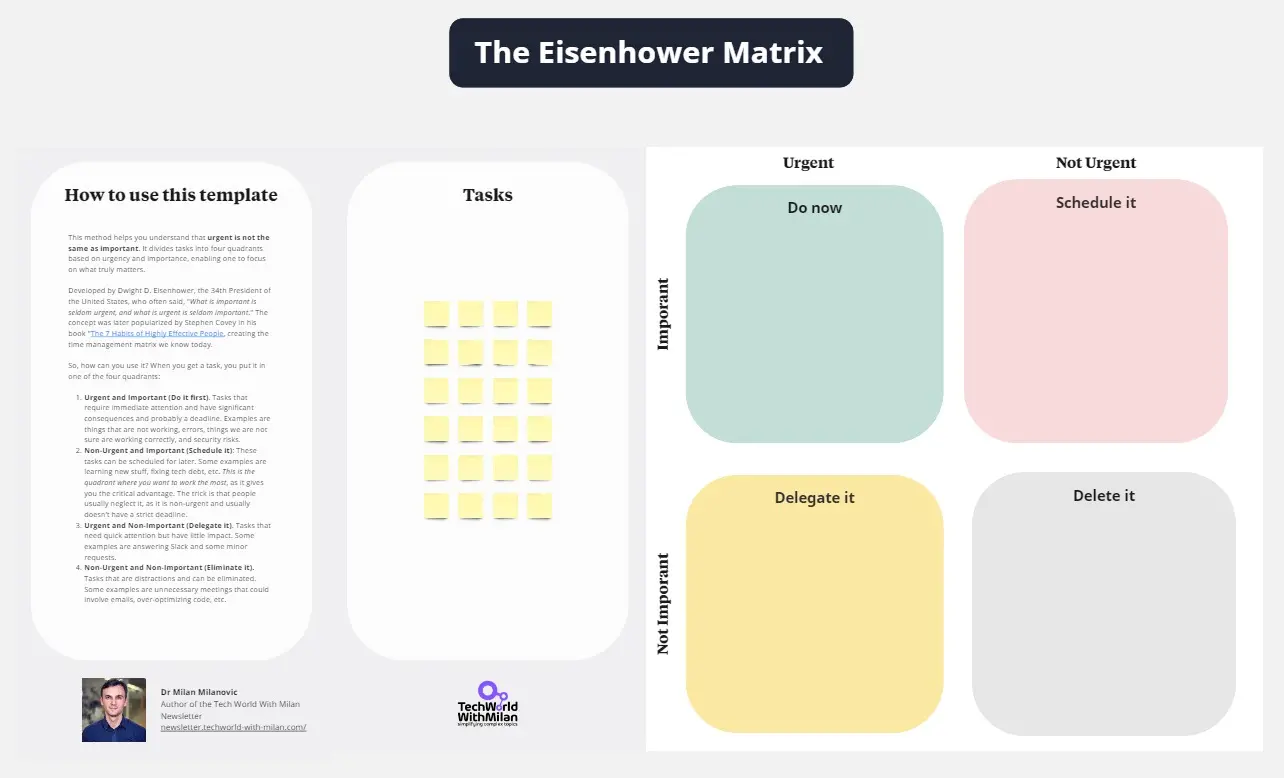
The Eisenhower matrix for prioritization helps consultants and project managers distinguish between urgent and important tasks, enabling strategic resource allocation and deadline management. This decision-making framework organizes work into four quadrants based on urgency and importance, helping you focus on high-impact activities while delegating or eliminating low-value tasks.
What is an Eisenhower matrix for prioritization for consultants and project managers?
An Eisenhower matrix for prioritization is a time management tool that categorizes tasks across two dimensions: urgency and importance. Consultants use this framework to balance client deliverables with business development, while project managers apply it to distinguish critical path activities from administrative overhead.
What problems does the Eisenhower matrix for prioritization solve?
The Eisenhower matrix for prioritization addresses common workflow challenges:
Reactive work patterns that prioritize urgency over strategic value
Unclear task ownership across project teams
Burnout from constant firefighting
Misaligned resource allocation on consulting engagements
How to use the Eisenhower matrix for prioritization template
List all tasks, deliverables and commitments
Plot each item by urgency (deadline-driven) and importance (goal alignment)
Apply decision rules: Do (urgent/important), Schedule (important/not urgent), Delegate (urgent/not important), Delete (neither)
Review weekly with stakeholders to recalibrate priorities
Eisenhower matrix for prioritization FAQs
When should project managers use an Eisenhower matrix for prioritization?
Use this template during sprint planning, project kickoffs, resource allocation reviews and when managing competing stakeholder demands.
How does the Eisenhower matrix for prioritization differ from other frameworks?
Unlike backlog prioritization or RICE scoring, the Eisenhower matrix emphasizes time sensitivity alongside strategic importance, making it ideal for operational decision-making.