1likes
8uses
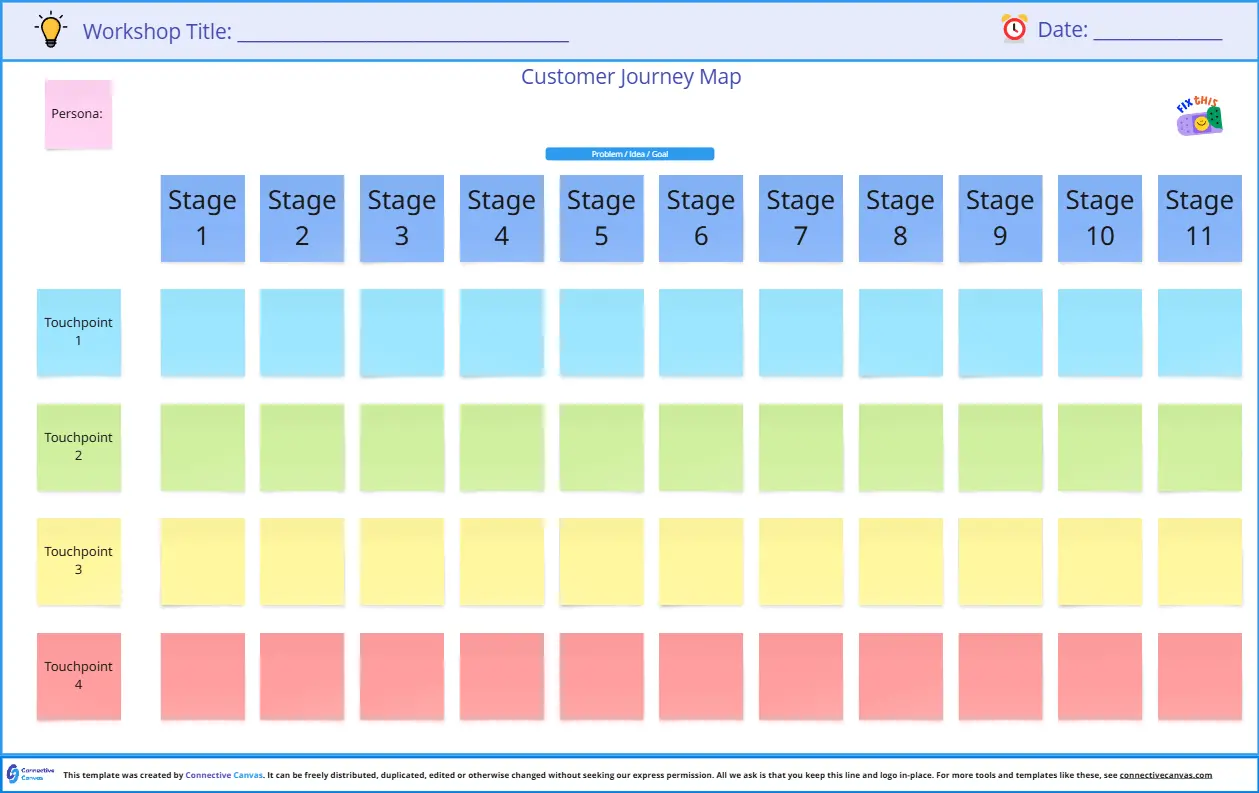
Discover where customers struggle and uncover opportunities to improve their experience. This collaborative customer journey mapping workshop helps startup founders and product teams identify friction points, align on customer needs, and prioritize actionable improvements.
Where are customers getting stuck, frustrated, or abandoning your product?
The Customer Journey Friction Map template helps startup founders and product software teams visualize the customer experience, uncover obstacles, and identify opportunities to make their products easier and more valuable to use.
Customers experience your product differently than the people building it. What feels intuitive to your team may create confusion, unnecessary effort, or frustration for someone using your product for the first time.
Through collaborative journey mapping, customer evidence analysis, and opportunity prioritization, participants explore what customers are doing, thinking, and experiencing across key interactions.
Rather than relying on internal assumptions, this workshop encourages teams to connect their observations to customer interviews, support feedback, usability findings, and product analytics.
Designed for small teams, this template works for both virtual and in-person workshops.
Startup founders looking to better understand their customers
Product managers identifying gaps in the customer experience
UX/UI designers uncovering usability and interaction challenges
Software development teams aligning on customer pain points
Customer success teams sharing customer feedback and recurring challenges
Workshop duration: 60 minutes
Recommended participants: 3–8
Facilitator: Product manager, UX researcher, UX designer, or workshop facilitator
Start by selecting a customer persona and one specific journey to explore.
Define the customer's goal, where the journey begins, and what successful completion looks like.
Ask participants to independently describe what they believe the customer is trying to accomplish. Share responses and agree on a single journey statement.
Example: "A first-time customer wants to create their first project and begin collaborating with their team without assistance."
Output: A clearly defined customer journey, goal, and scope.
Ask participants to independently identify the actions customers take to achieve their goal.
Write each action on a separate sticky note and arrange the notes chronologically on the journey map.
Review the sequence together, resolve differences, and organize the actions into five to seven meaningful stages.
Example: Sign up → Verify email → Create workspace → Invite teammate → Start first project.
Use customer research and product data to distinguish observed actions from assumptions.
Output: A shared visual map of the customer's current journey.
Examine each stage of the journey to understand what customers expect, experience, and potentially struggle with.
Ask participants to identify:
What is the customer trying to accomplish?
Where might the customer experience confusion or unnecessary effort?
What positive experiences help the customer move forward?
What customer evidence supports these observations?
Which questions remain unanswered?
Use different colored sticky notes to distinguish positive experiences, friction points, and unknowns.
Example: Customers hesitate when inviting teammates since the interface does not clearly explain whether invitations affect subscription pricing.
Output: A customer journey map highlighting friction, positive interactions, and research gaps.
Review the friction points identified across the journey.
Turn each meaningful issue into an opportunity statement using the "How Might We" format.
Example: "How might we help customers confidently invite teammates without uncertainty about pricing?"
Give each participant three voting dots to identify the issues they believe have the greatest customer impact.
Discuss the results, review supporting evidence, and select three opportunities to investigate or address.
Output: Three prioritized customer experience opportunities.
Translate the prioritized opportunities into practical next steps.
For each opportunity, identify:
The problem to investigate or improve
The next action or experiment
A responsible team member
A target completion date
A measurable success indicator
Example: "The product designer will test revised teammate invitation messaging with five representative customers to evaluate pricing comprehension."
Capture unanswered questions that require further customer research.
Output: An actionable improvement plan with team ownership and measurable next steps.
By completing this template, your team will have:
A shared understanding of one customer journey
A visual map of customer actions and key interactions
Identified friction points, positive experiences, and customer expectations
A clear distinction between customer evidence and team assumptions
Three prioritized customer experience opportunities
An actionable improvement plan with owners, target dates, and success measures
Start with one clearly defined customer journey rather than attempting to map the entire customer lifecycle. A focused journey makes it easier to uncover meaningful problems and agree on practical improvements.
Encourage participants to document their observations independently before group discussion. This gives everyone an opportunity to contribute and helps expose different assumptions.
Challenge opinions with customer evidence. When someone identifies a friction point, ask what customer interviews, support requests, usability findings, or analytics support that observation.
Avoid turning the workshop into a feature brainstorming session too early. Focus on understanding the customer's problem before discussing solutions.
Revisit the journey map as new customer insights emerge. Your map should remain a useful reference for product decisions rather than becoming a document that gets forgotten after the workshop.
The goal isn't just to understand the customer journey. It's to discover where your product can create a better customer experience.

Deanne Watt
Product Strategy @ MiNDPOPGroup.com
My approach to product is to get to the heart of what drives a company. I am passionate about the entire end-to-end process and making it more efficient, collaborative as well as aligning teams and improving communication. We have built about 200 Miro boards so far that cover ideation, strategy, design, engineering, and even marketing promotion.