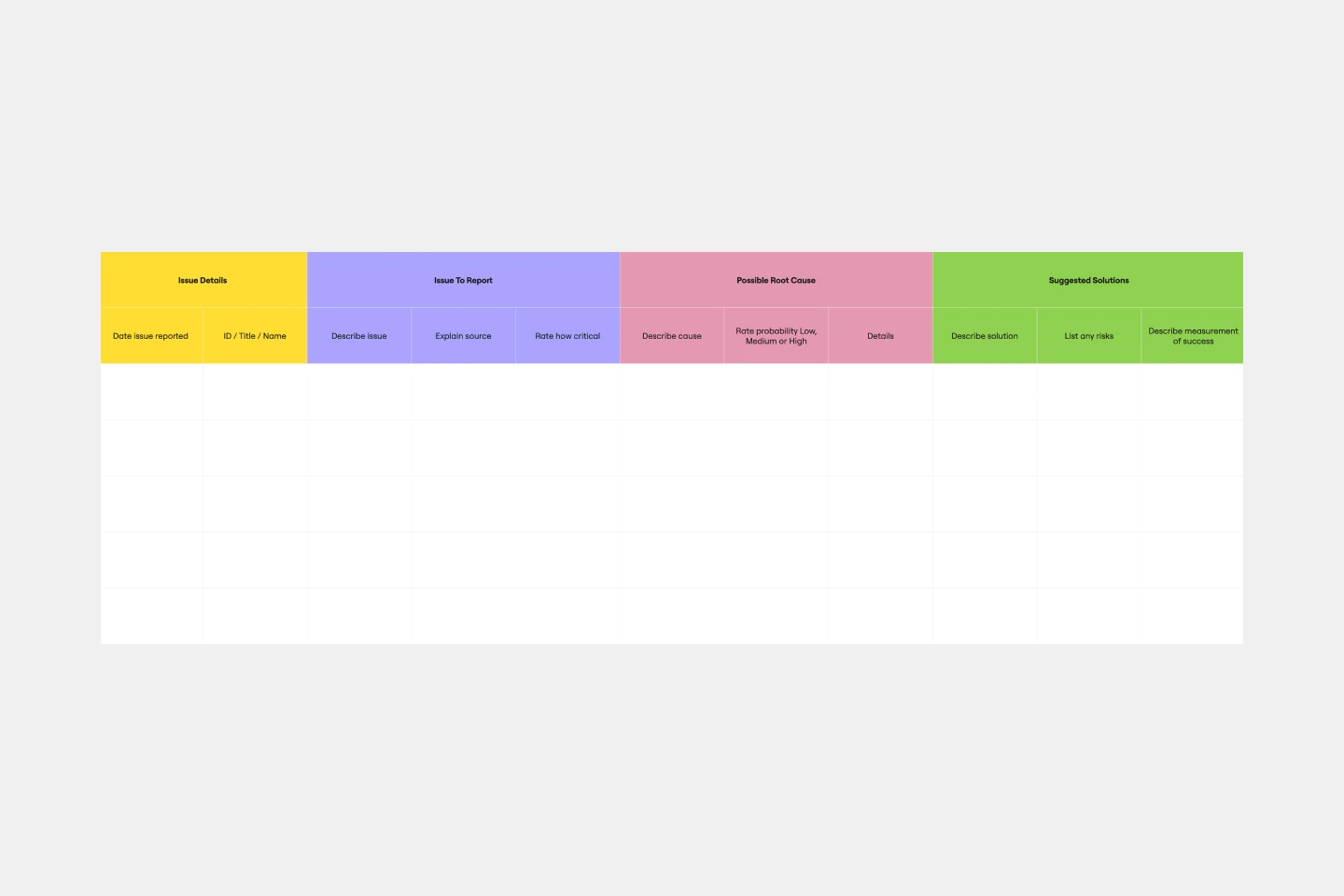
What is the Root Cause Analysis Workshop Template?
A guided problem-solving template that helps teams move from a clearly defined issue to possible causes, root cause identification, and an action plan. The workshop uses a four-step flow so participants can investigate the problem together and finish with clear corrective actions.
What problem does the Root Cause Analysis Workshop Template solve?
Unclear problem definitions
Teams jumping to solutions too quickly
Too many possible causes
Assumptions without team discussion
Recurring problems
Corrective actions without ownership
How to use the Root Cause Analysis Workshop Template
Start by reviewing the workshop overview, agenda, preparation, facilitator, attendees, and timing.
Define the problem the team wants to investigate.
Identify possible causes using individual and team brainstorming.
Review the possible causes and identify the strongest root cause candidates.
Agree on the root cause that best explains the problem.
Create an action plan with tasks, owners, deadlines, priority, and completion status.
Common pitfalls
Starting with a problem statement that is too broad
Discussing solutions before identifying causes
Treating assumptions as confirmed causes
Allowing one participant to dominate the analysis
Selecting a root cause without reviewing the evidence
Creating actions without clear ownership
Ways to avoid mistakes
Keep the problem statement focused.
Give participants time to add possible causes independently.
Group similar ideas before discussing them.
Review the strongest causes together.
Use evidence and team knowledge to select the root cause.
Give every corrective action an owner and due date.
Miro Features You Can Use
Sticky notes for possible causes
Frames for each workshop stage
Timer for individual brainstorming
Voting to prioritize likely causes
Comments for questions and supporting evidence
Color coding for causes and themes
Tables for the final action plan
Tags for priority and status
FAQs
Q: Who can benefit from this template?
A: Product teams, operations teams, engineering teams, support teams, project teams, quality teams, and cross-functional groups investigating recurring problems.
Q: What are the four main stages?
A: Define the problem, identify possible causes, identify the root cause, and create an action plan.
Q: Can participants brainstorm individually?
A: Yes. The template supports individual idea generation before the team reviews and groups possible causes together.
Q: How should the root cause be selected?
A: Review the strongest cause candidates, discuss the evidence available, and select the cause that best explains why the problem occurred.
Q: What should the action plan include?
A: Tasks, action owners, deadlines, priority, and a way to track completion.
Q: What will participants leave with?
A: A defined problem, a set of possible causes, an agreed root cause, and a corrective action plan with ownership and deadlines.