Circular Product & Service Roadmap
Turn circular ideas into a practical product and service plan.
Explore how to meet customer needs while designing for longer product life, responsible material use, repair, return, and reuse. This template helps you connect circular product design with the customer experience, operations, partnerships, and economics needed to deliver it.
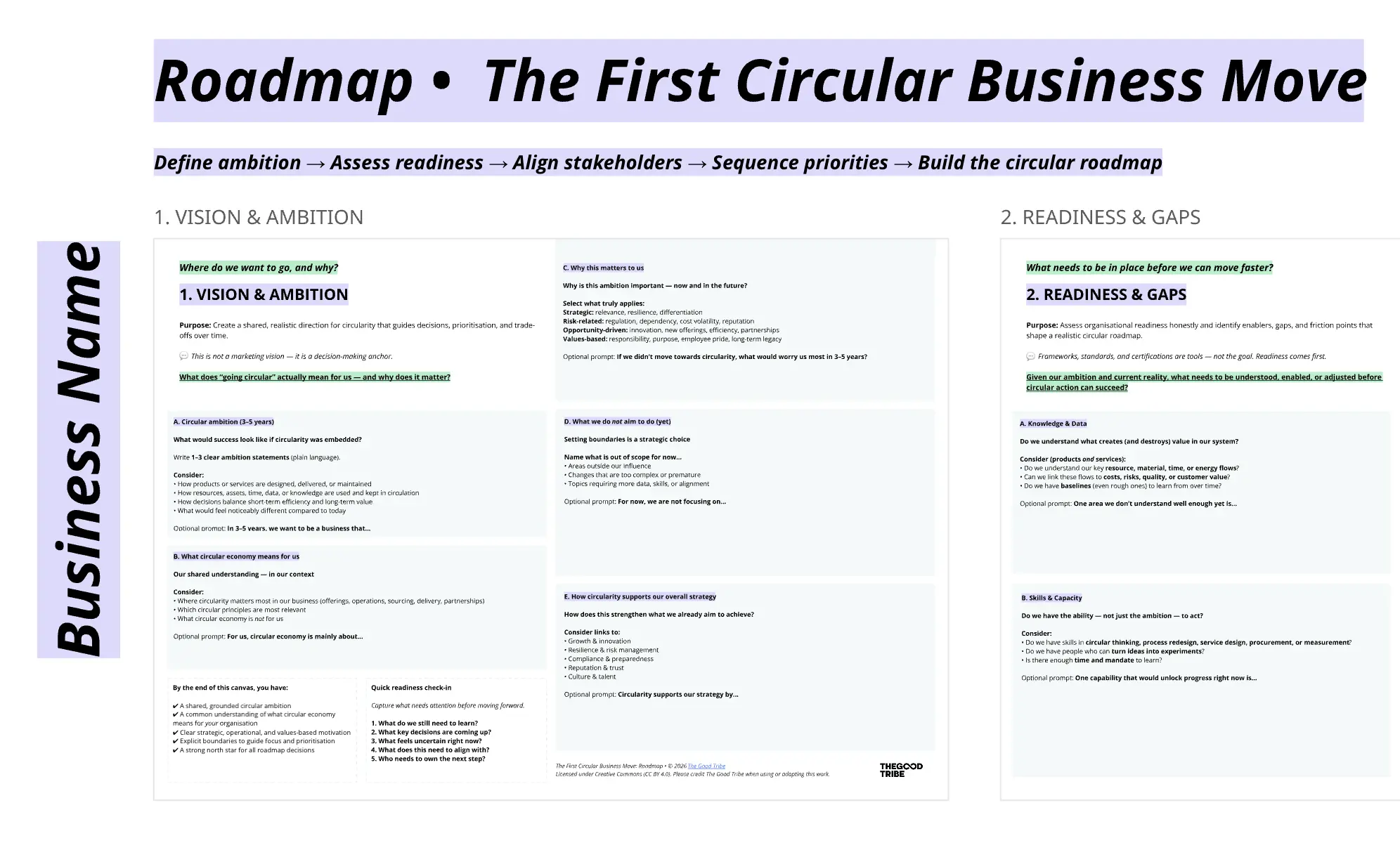
Five guided brainstorming sections take you from setting an ambition to shaping an offer and planning how it will work. Use them to explore Product-as-a-Service models—such as rental, leasing, subscriptions, sharing, and managed services—or strengthen the circularity of an existing offer.
Who is this template for?
Product and service designers, entrepreneurs, innovation teams, sustainability practitioners, and colleagues working in procurement, operations, logistics, customer service, and finance.
It is useful when developing a circular business model, redesigning an existing product or service, or bringing partners together to scope a pilot. Work through it individually to develop an initial concept, or use it with a team to connect different perspectives and responsibilities.
Before you begin
Choose one product, service, or customer need to focus on. Gather any available customer insights, product specifications, material information, service data, costs, and return or repair figures. Record missing information as questions to investigate.
For a first team session, allow approximately two to three hours with four to ten participants. This is a suggested starting point: complex offers may need several sessions and further research. Include people who understand both the customer experience and the practical work of delivering, maintaining, and recovering products.
How to use the Circular Product & Service Roadmap
1. Set the ambition
Define the customer outcome and the circular opportunity. Could you meet the need through access, performance, or a service rather than ownership? Agree on the environmental, social, and business outcomes you want to explore, alongside relevant requirements and safeguards.
Capture a draft vision, target customers, measurable goals, and a business-model hypothesis.
2. Map the system and redesign the offer
Trace the product and service journey from sourcing through use, maintenance, return, recovery, and next use. Identify impact hotspots, costs, risks, and places where value is lost.
Use these insights to sketch a future offer and identify the partners, capabilities, and customer touchpoints it would require.
3. Design for long life and responsible materials
Explore durability, repairability, upgrades, spare parts, and support. Challenge material choices: could you use less, simplify the material mix, or introduce suitable reused or recovered inputs?
Record design requirements, supplier expectations, and questions that need technical investigation.
4. Deliver, return, and keep value in circulation
Plan how the service would operate, including delivery, maintenance, collection, and redeployment. Consider what would make returns convenient and worthwhile for customers.
Define preferred routes for returned products and components, along with the information needed to track their condition and service history.
5. Make it viable, measure it, and improve
Examine investment, pricing, utilisation, return rates, and lifetime costs. Explore risks and agree which customer, environmental, social, and financial outcomes would indicate progress.
Select priorities for further development, assign owners, and define what you need to test next.
Facilitation tips
Start each section with quiet individual brainstorming, then share and group related sticky notes. Distinguish evidence from assumptions and ideas.
Keep connections visible: a repairable design needs repair capacity, and a return promise needs workable collection logistics. Test whether a proposed service model could reduce material demand and extend product life; access-based models do not guarantee those outcomes.
Finish by choosing up to three next steps. Give each an owner, a deadline, and a clear learning goal.
What will you leave with?
A shared circular product and service concept, a map of the system needed to support it, and an initial set of design and operational requirements. You’ll also have business assumptions, proposed metrics, and prioritised next steps to guide research, partner discussions, or a pilot.