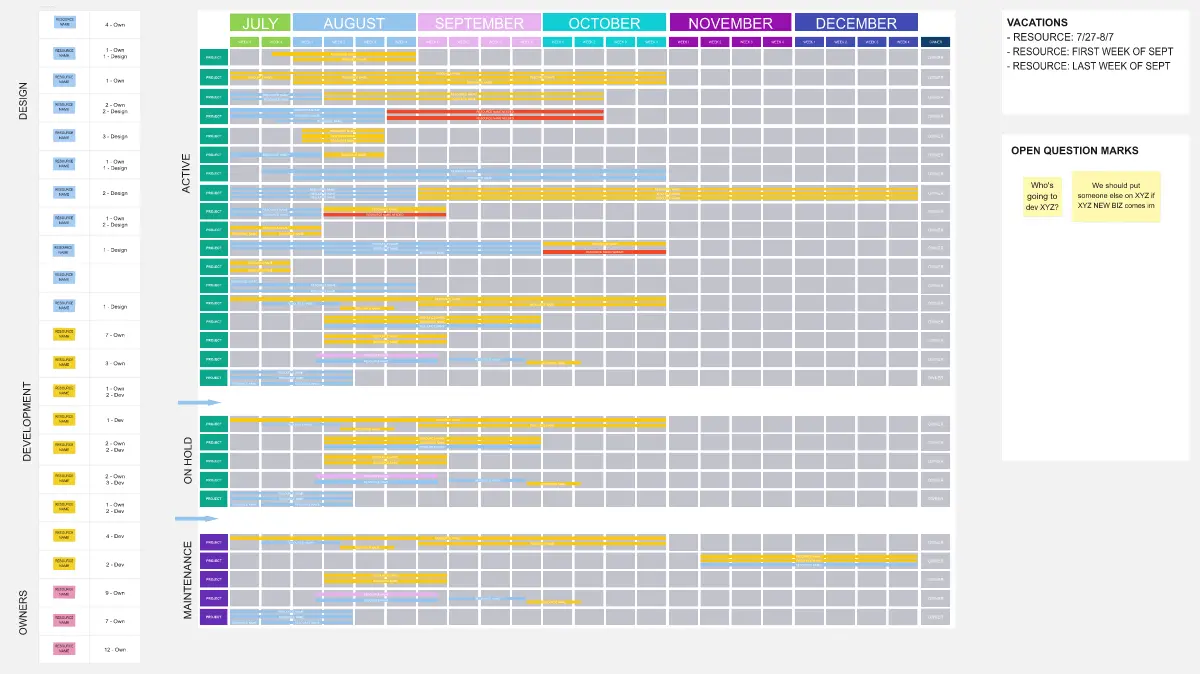
Circular Materials Resource Planner
Plan the right materials, in the right quantities—and keep their value in circulation.
Bring design, sourcing, production, and recovery decisions into one shared conversation. The Circular Materials Resource Planner helps teams explore how to reduce material demand, strengthen supply resilience, prevent waste, and plan for materials beyond their first use.
Five guided sections connect demand forecasting with material selection, supply coordination, manufacturing, and recovery. Dedicated brainstorming spaces, example notes, and suggested participants help teams identify problems, test assumptions, and agree on practical actions. A closing feedback loop brings lessons from recovery into the next planning cycle.
Who is this template for?
Designers, product managers, production managers, procurement and sourcing teams, supply-chain and logistics professionals, engineers, quality specialists, finance teams, and sustainability leads. Suppliers, recovery partners, and manufacturing partners can also contribute.
Use it when planning a product or production cycle, reviewing material costs and waste, exploring alternative inputs, addressing supply risks, or developing a material-recovery pilot.
Before you begin
Choose a manageable focus: one product, material group, production line, or packaging system. Agree on the planning period and the decisions you want the session to support.
Gather available demand forecasts, material specifications, purchasing volumes, supplier information, inventory records, production-waste data, and recovery figures. Mark missing information as a gap to investigate.
For an initial workshop, allow approximately two to three hours with five to ten participants. These are suggested starting points; complex material flows may need separate sessions. Use the “In the room” prompts to involve relevant colleagues and partners at each stage.
How to use the Circular Materials Resource Planner
1. Forecast demand and reduce material need
Clarify what you plan to make, how much is needed, and over what timeframe. Explore opportunities to reduce material use through design, specifications, packaging, and production planning.
Identify high-volume, high-cost, or high-waste materials. Record assumptions behind order quantities and opportunities to avoid unnecessary purchases.
2. Choose responsible and resilient materials
Compare material options against product requirements, durability, safety, traceability, and potential environmental and social impacts.
Explore suitable recycled, renewable, reclaimed, or reused inputs. Identify evidence and testing needed before changing specifications, including possible effects on quality, performance, and end-of-life options.
3. Secure supply and coordinate the flow
Map exposure to disruption, price changes, long lead times, and dependence on individual suppliers.
Explore alternatives and ways to improve coordination between procurement, production, warehousing, and logistics. Capture actions to reduce obsolete inventory, unnecessary transport, and poorly timed deliveries.
4. Prevent waste in production
Identify where offcuts, defects, spoilage, overproduction, and packaging waste occur. Examine the processes behind these losses and opportunities to improve material yield.
Explore internal reuse and potential uses for by-products or rejected stock. Record the data, trials, and process changes needed to assess each opportunity.
5. Recover materials and continuously improve
Plan what happens to surplus materials, returned products, components, and packaging. Identify feasible routes for reuse, repair, redistribution, refurbishment, remanufacturing, or recycling.
Agree which partners, collection systems, sorting processes, and metrics are needed. Feed the lessons back into demand forecasts, material choices, and the next production cycle.
Facilitation tips
Begin each section with individual sticky notes, then share and group related ideas. Use Problem, Question/test, and Action labels to distinguish issues from assumptions and proposed solutions.
Compare ideas across stages. A material substitution may affect production yield, supplier risk, and recovery options, so involve the people who can assess those consequences.
Finish by selecting a manageable set of priorities. Give each an owner, deadline, and test or evidence requirement. Record proposed changes separately from approved specifications and purchasing decisions.
What will you leave with?
An initial view of material demand, preferred-material requirements, supply risks, production-waste hotspots, and recovery opportunities.
You’ll also have prioritised actions, evidence gaps, partner needs, and proposed metrics to guide further analysis or a pilot. Use the completed planner to coordinate decisions and improve the next design, sourcing, and production cycle.