35likes
119uses

Build a business model that connects customer value to sustainable revenue. This collaborative workshop helps startup founders and product teams explore pricing, balance human work with software and AI, estimate delivery costs, and design a repeatable growth model.
Can your business deliver meaningful customer value and remain profitable as it grows?
The Business Model Value Engine template helps startup founders and product software teams explore how customer value becomes revenue, how that value is delivered, and what it costs to serve customers.
Building a successful product requires more than finding customers willing to use it. Teams need to understand what customers value enough to pay for, how the business delivers that value, and whether the economics support sustainable growth.
AI creates new opportunities to automate workflows, improve customer experiences, and introduce new revenue models. It can introduce costs through model usage, infrastructure, human oversight, and ongoing maintenance.
This workshop takes a different approach from traditional business model canvases.
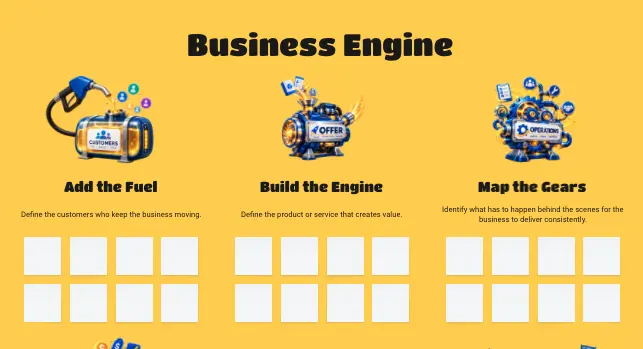
Instead of completing a standard nine-block framework, participants follow customer value through five connected sections:
Value Moment — What outcome makes the product worth paying for?
Payment Trigger — When and why does the customer pay?
Delivery Mix — What work should be handled by people, software, or AI?
Cost to Serve — What does delivering customer value actually cost?
Growth Loop — What encourages customers to return, expand their use, or recommend the product?
Through collaborative discussion, delivery mapping, and basic financial modeling, teams identify potential weaknesses and opportunities within their business model.
The workshop concludes with a connected Value Engine and a practical experiment to test an important business assumption.
Designed for small teams, this template works for virtual and in-person workshops without breakout groups.
Startup founders developing or refining a business model
Product managers connecting customer value to product strategy
SaaS teams evaluating subscription and usage-based revenue
Software engineers investigating AI-assisted service delivery
UX/UI designers identifying valuable customer outcomes
Operations teams reviewing delivery processes and costs
Finance and strategy teams exploring unit economics
Early-stage startups testing new business opportunities
Workshop duration: 75 minutes
Recommended participants: 3–8
Facilitator: Startup founder, product strategist, product manager, or business model advisor
Select one customer segment and one product or service offering to evaluate.
Gather any available information about:
The customer's primary problem or desired outcome
Current customer feedback and research
Existing or proposed pricing
Revenue per customer or transaction
How the product or service is delivered
Human support and operational activities
Software infrastructure and AI usage costs
Customer engagement, retention, or repeat purchases
Financial estimates are acceptable when reliable figures are unavailable. Clearly identify assumptions that require validation.
Prepare the five Value Engine sections and a simple financial worksheet.
For virtual workshops: Use Miro sticky notes, editable cards, calculation fields, and a shared board.
For in-person workshops: Use printed templates, sticky notes, markers, and a calculator. Transfer the final business model into Miro after the session.
Start by identifying the customer outcome that makes your product or service valuable.
Ask participants to independently complete:
"Our customer gets meaningful value when they can…"
Use the Value Moment section to explore three questions.
Who?
Which customer experiences the value?
What?
What meaningful outcome can they achieve?
Why?
Why does that outcome matter to them?
Share the responses and agree on one clearly defined customer outcome.
Focus on the result customers experience rather than the features your product provides.
Example:
Who: Agency managers
What: Create accurate client project updates in minutes
Why: Spend less time preparing reports and more time working with clients
Agreed Value Moment: "Agency managers can create accurate client updates in minutes instead of preparing them manually."
AI Alternative
Use AI to explore potential customer outcomes and identify assumptions.
Example prompt:
"Given this customer segment and product description, suggest five concrete customer outcomes that might create willingness to pay. Distinguish observable benefits from assumptions requiring customer validation: [insert customer and product details]."
Output: One clearly defined customer Value Moment.
Review the Value Moment and discuss when customers recognize enough value to pay for the product.
Use the Payment Trigger section to compare three potential revenue approaches.
Subscription
Customers pay for continuing access to the product or service.
Example: A monthly subscription for a project reporting platform.
Usage-Based
Customers pay according to how much they use a service or capability.
Example: A fee for each AI-generated project report.
Outcome-Based
Customers pay when an agreed result is achieved.
Example: A fee connected to completing a defined service outcome.
Discuss which approach best matches how customers experience and perceive value.
A combination of models may be appropriate.
Choose one proposed revenue mechanism and identify the biggest assumption about customer willingness to pay.
Example:
Proposed Revenue Model: Monthly subscription with a usage allowance for AI-generated client reports.
Assumption to Validate: Customers will pay more for higher reporting volume.
AI Alternative
Use AI to compare pricing approaches.
Example prompt:
"Compare subscription, usage-based, and outcome-based pricing for this customer value proposition: [insert Value Moment]. Explain the potential benefits, customer objections, operational considerations, and assumptions that need validation for each approach."
Output: A proposed payment trigger and one willingness-to-pay assumption requiring investigation.
Identify the activities required to deliver the agreed customer outcome.
Use the Delivery Mix section to organize these activities into three categories.
People — Human Expertise and Judgment
Work requiring human decisions, customer interaction, quality review, or specialized expertise.
Example: Reviewing and approving client-facing reports.
Software — Repeatable Processes
Tasks handled through conventional software, rules, integrations, or established workflows.
Example: Collecting project information from connected systems.
AI — Intelligent Assistance
Tasks where AI may support generation, analysis, summarization, or automation.
Example: Creating an initial draft of a project status report.
Ask participants to independently list delivery activities before organizing them into the three categories.
Review the activities together and identify important handoffs.
Discuss where human oversight, quality checks, and data protection may be required.
Example Delivery Flow:
Software collects project information → AI drafts a status report → A person reviews and approves the final content.
AI Alternative
Use AI to suggest a delivery workflow.
Example prompt:
"Break this customer outcome into the activities required to deliver it: [insert Value Moment]. Suggest which activities should be handled by people, conventional software, or AI. Identify potential risks, handoffs, and activities that require human review."
Output: A Delivery Mix showing how people, software, and AI contribute to the customer outcome.
Use the Cost-to-Serve section to estimate the revenue and variable expenses associated with delivering value.
Start by choosing a consistent unit of measurement.
For a SaaS product, this might be one paying customer per month.
For a transaction-based business, it might be one completed transaction.
Capture four financial inputs:
1. Revenue
How much revenue does the business earn per selected unit?
2. AI and Infrastructure Costs
What variable AI model usage, processing, infrastructure, or delivery expenses are associated with that unit?
3. Human Review and Support
What variable labor or support expenses are incurred when serving that unit?
4. Other Variable Costs
What additional expenses increase with customer usage or transactions?
Calculate the contribution remaining after variable costs.
Contribution = Revenue − Variable Costs
Then estimate the contribution margin:
Contribution Margin = (Contribution ÷ Revenue) × 100
Use the worksheet to discuss whether the proposed model can support sustainable operations.
Example: Monthly Estimates per Customer
Financial ComponentAmountMonthly revenue$100AI and infrastructure$12Human review and support$15Other variable costs$8Total variable costs$35Contribution per customer$65Contribution margin65%
Ask participants to explore one simple cost scenario.
Example: If AI usage costs doubled from $12 to $24, variable costs would increase to $47 and contribution would decrease to $53.
Discuss what assumptions need verification before making business decisions.
The contribution estimate does not represent net profit. Fixed expenses, acquisition costs, and other financial obligations require separate consideration.
AI Alternative
Use AI to review calculations and identify missing cost categories.
Example prompt:
"Review these revenue and variable cost estimates for one customer per month: [insert estimates]. Calculate contribution and contribution margin, identify possible missing variable costs, and show how the results change if AI usage expenses double."
Output: An initial unit-economics snapshot with documented financial assumptions and cost sensitivities.
Review how customers receive value from the product.
Discuss what could encourage them to continue using it, increase their use, renew, or recommend it.
Use the Growth Loop to map four connected stages.
First Value
The customer experiences the initial meaningful outcome.
Example: Creates their first accurate client report.
Repeat Use
The customer returns to the product to receive the benefit again.
Example: Generates weekly client updates.
Retention
The continuing value supports an ongoing customer relationship.
Example: Renews the monthly subscription.
More Value
Broader adoption or deeper use creates opportunities for continued engagement.
Example: Expands reporting across more projects or client accounts.
Connect the stages to form a repeatable loop.
Then identify the weakest assumption in the completed Value Engine and design one practical experiment.
Example:
Hypothesis: Customers who regularly generate project reports are more likely to renew their subscriptions.
Experiment: Track weekly reporting activity and subsequent subscription renewals.
Success Signal: Evidence of repeat usage and stronger retention among customers who use reporting regularly.
Owner: Product Manager
Review Date: 30 days
AI Alternative
Use AI to generate possible retention mechanisms and validation methods.
Example prompt:
"Suggest three plausible customer retention or growth loops for this business model: [insert business model details]. Identify the assumptions behind each and recommend one low-cost experiment with a measurable success indicator."
Output: A Growth Loop connected to customer behavior and one experiment for testing an important business assumption.
By completing this template, your team will have:
A clearly defined customer Value Moment
A proposed payment trigger aligned with customer value
A Delivery Mix identifying the roles of people, software, and AI
An initial Cost-to-Serve calculation
An estimate of contribution per customer or transaction
A basic scenario showing how changing costs affect the business
A Growth Loop connecting customer value to repeat usage and retention
One prioritized business assumption requiring validation
A practical experiment with a success measure, owner, and review date
Focus on one customer segment. Different customer groups may experience value differently and require separate revenue models.
Start with customer outcomes. Describe the result customers want rather than listing product features.
Connect pricing to value. Ask what customers recognize as valuable and whether the payment structure matches how they receive that benefit.
Challenge willingness-to-pay assumptions. Customer interest doesn't automatically translate into purchasing behavior.
Keep the Delivery Mix practical. Use AI where it provides a meaningful benefit and evaluate reliability, oversight, and implementation requirements.
Account for human work. Automated delivery may still require review, support, monitoring, or exception handling.
Use consistent financial units. Compare revenue and costs for the same customer, transaction, or usage period.
Label financial estimates clearly. Distinguish known costs from assumptions and update figures when more reliable information becomes available.
Test sensitivity to changing AI costs. Usage patterns, model pricing, and infrastructure requirements can influence delivery economics.
Don't confuse contribution with profit. The simplified worksheet examines variable economics, not the complete financial performance of the business.
Make growth mechanisms observable. Identify the customer behaviors that indicate repeat value rather than assuming continued usage.
Finish with one experiment. Focus on the assumption that could most strongly influence whether the proposed business model works.
The goal isn't to create a perfect financial forecast. It's to understand how your business creates value, captures revenue, and delivers that value at a sustainable cost.
Business Model Value Engine is a collaborative workshop that helps teams connect customer value, pricing, delivery methods, costs, and repeatable growth.
It uses five connected sections to examine how a product or service can create and capture value sustainably.
Traditional business model canvases describe multiple elements of how a business operates.
Business Model Value Engine follows the relationship between a customer outcome, the payment it supports, the work required to deliver it, the associated costs, and the mechanisms encouraging repeat value.
The five sections are:
Value Moment: The customer outcome worth paying for
Payment Trigger: When and why customers pay
Delivery Mix: The roles of people, software, and AI
Cost to Serve: Revenue and variable delivery expenses
Growth Loop: Behaviors supporting repeat usage, retention, or expansion
No.
Early-stage startups can use customer research, proposed pricing, and estimated delivery costs.
Clearly label assumptions and use the resulting experiment to gather evidence before investing further.
A Value Moment is the point at which a customer experiences a meaningful benefit from the product.
It should describe an observable outcome rather than simply naming a feature.
For example, producing an accurate client report in minutes is an outcome. An AI report generator is a feature.
Consider how customers receive value, their willingness to pay, and the economics of delivering the service.
Subscriptions, usage-based pricing, outcome-based pricing, or combinations may be appropriate depending on the offering.
Validate the proposed approach through customer research and pricing experiments.
Map the point at which customers first experience value and when payment is requested.
For a free trial or freemium product, the Value Moment may occur before the Payment Trigger.
The workshop can help identify what motivates customers to move from free usage to a paid relationship.
No.
The Delivery Mix helps teams decide which activities belong with people, conventional software, or AI.
AI should be evaluated based on its contribution to customer value, delivery performance, reliability, and cost.
Consider using AI to assist rather than fully automate the activity.
Include human review, testing, monitoring, or other appropriate controls within the Delivery Mix.
Cost to Serve refers to the expenses associated with delivering the product or service to a customer or completing a defined transaction.
This template focuses on costs that vary with the selected customer or usage unit.
Contribution margin measures the revenue remaining after variable costs.
It helps teams understand how much revenue is available to contribute toward fixed expenses and potential profit.
The calculation does not replace a complete financial model.
Start with documented estimates based on expected usage and available technical information.
Test the assumptions through small pilots, usage monitoring, or prototype experiments.
Update the worksheet as actual cost information becomes available.
Scenario testing helps teams understand whether their proposed business model is sensitive to changes in usage or delivery expenses.
Doubling AI costs is one simple teaching scenario, not a prediction.
Teams can explore other realistic changes relevant to their product.
A Growth Loop describes how customers experience value repeatedly and how that behavior may support retention, expansion, or referrals.
The template uses First Value, Repeat Use, Retention, and More Value to visualize this relationship.
No.
A funnel typically describes a progression toward an event such as signup or purchase.
A Growth Loop examines how customer behavior and recurring value may support continued engagement or growth over time.
Yes.
The workshop is designed for three to eight participants.
Participants contribute ideas independently and then collaborate as one group to develop each section of the Value Engine.
Yes.
AI can help generate potential customer outcomes, compare revenue approaches, organize delivery activities, review financial calculations, and suggest validation experiments.
Check AI-generated content against customer evidence and reliable financial information.
Review the most uncertain assumptions identified during the session.
Run the selected experiment, collect evidence, and update the business model based on the findings.
Revisit the Value Engine when pricing, delivery methods, customer behavior, or operating costs change.
Use Business Model Value Engine when your team needs to understand how customer value connects to revenue, delivery decisions, and sustainable growth.
The completed template provides a practical view of the business model's economics and identifies which assumptions deserve validation before additional investment.
Create meaningful value. Capture sustainable revenue. Build a repeatable growth engine.

Deanne Watt
Product Strategy @ MiNDPOPGroup.com
My approach to product is to get to the heart of what drives a company. I am passionate about the entire end-to-end process and making it more efficient, collaborative as well as aligning teams and improving communication. We have built about 200 Miro boards so far that cover ideation, strategy, design, engineering, and even marketing promotion.