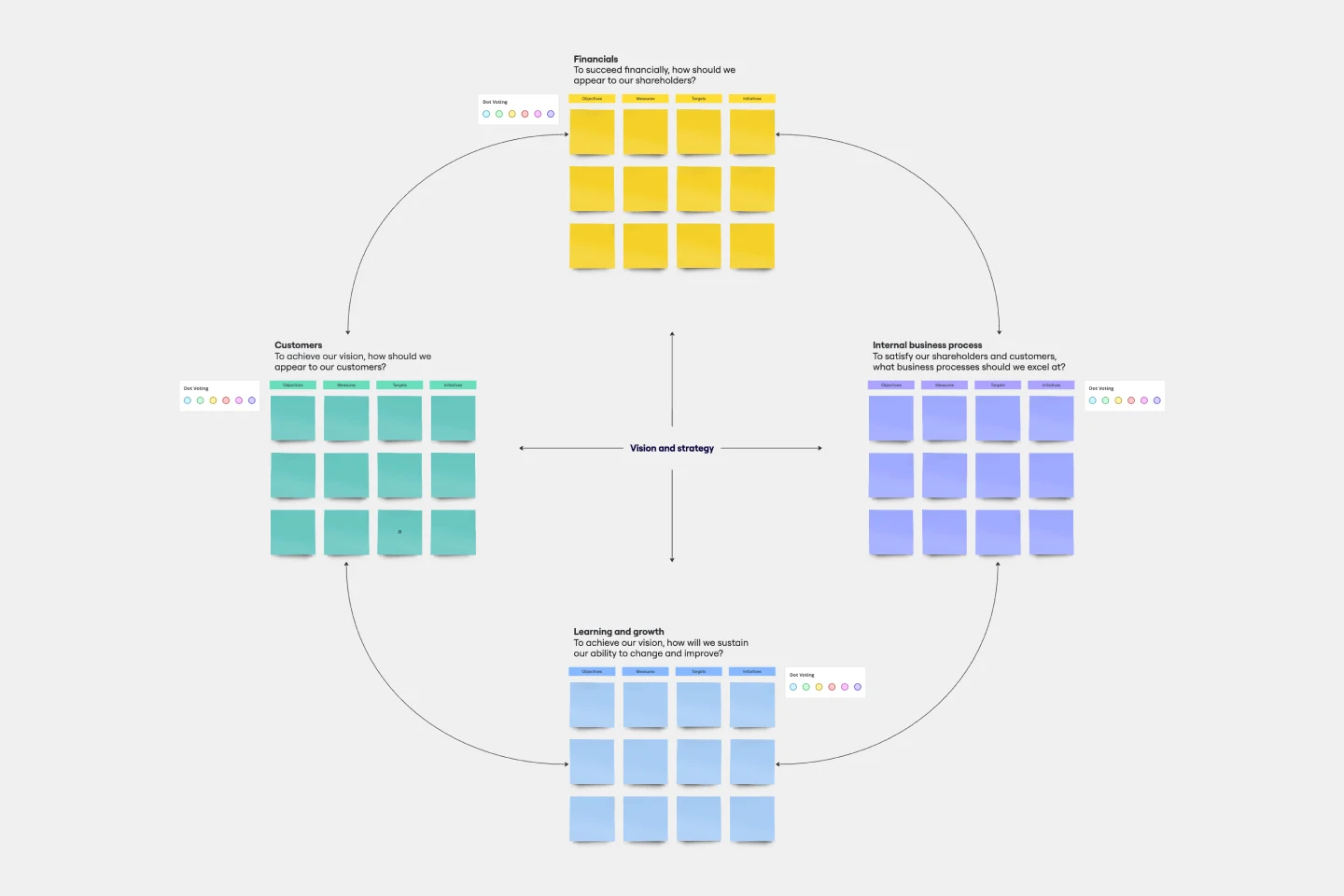
What it is for: A balanced scorecard is a management method that tracks a small set of measures across four perspectives: financial or mission outcomes, customers, internal operations, and learning and capability. You leave with a draft scorecard of objectives and 12 to 16 measures across four perspectives, with baselines, targets, owners, a review rhythm and a simple map of how they connect.
Who it helps: Leaders who track many figures but cannot see which drive results, or who need a regular check on whether an agreed strategy works.
When to use it
When leaders track many figures but cannot see which ones drive results.
When an organisation measures money or volume closely but knows little about customers or staff capability.
When a strategy has been agreed and needs a regular way to check whether it is working.
How to use it
Put the agreed strategy on the wall.
Write two or three objectives for each of the four perspectives.
Choose one measure per objective, staying under 12 to 16 in total.
Draw arrows to test how the perspectives support each other.
Set baselines, targets, owners and a monthly or quarterly review.
Tip: Keep the scorecard small. Twelve measures that people discuss are worth more than forty that nobody reads.
Credits and sources: Original Tiremesù worksheet and wording. Method credit: Robert S. Kaplan and David P. Norton. Further reading: Balanced Scorecard Institute https://balancedscorecard.org/bsc-basics-overview/
Full guide and film:https://www.tiremesu.com/guides/balanced-scorecard