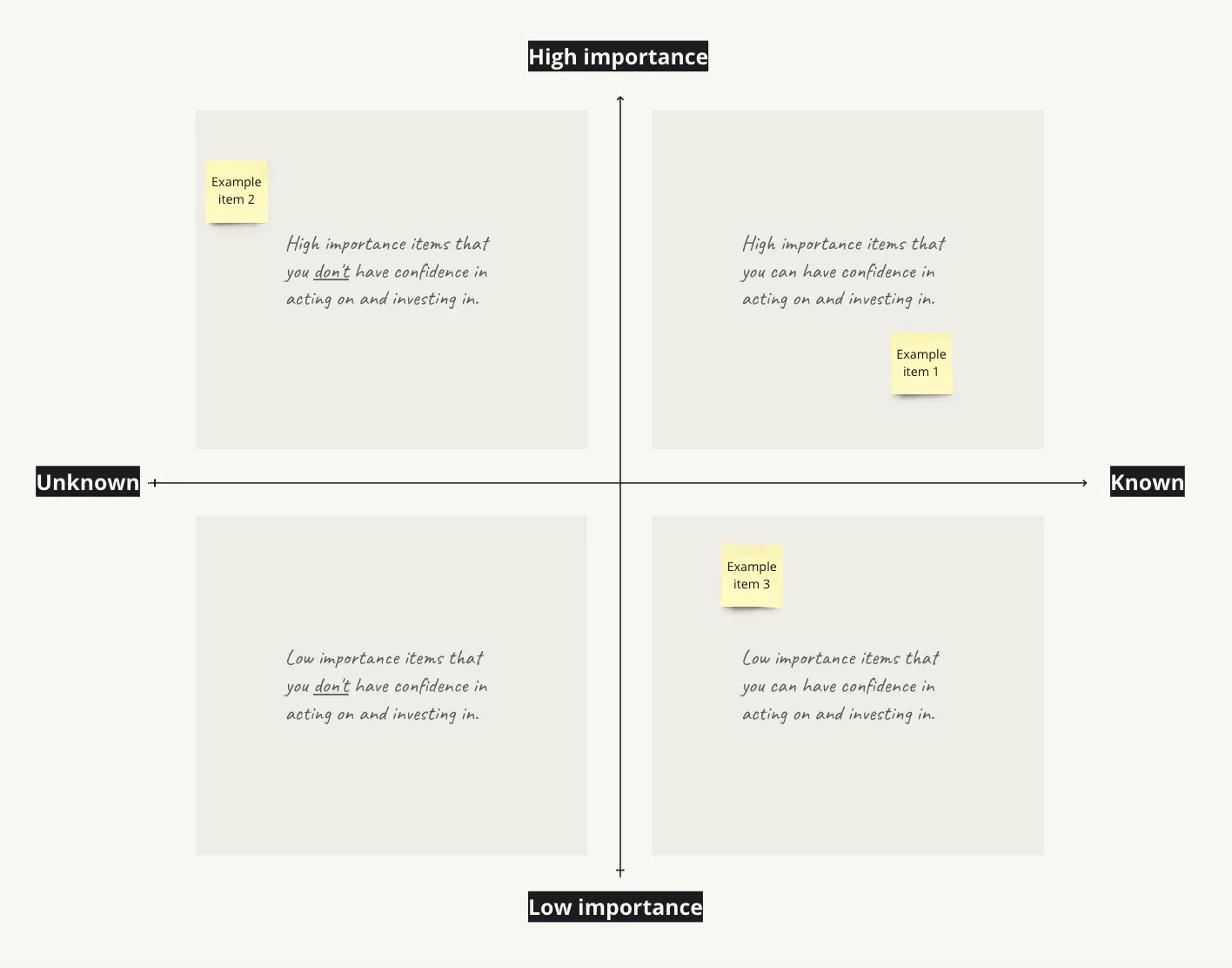
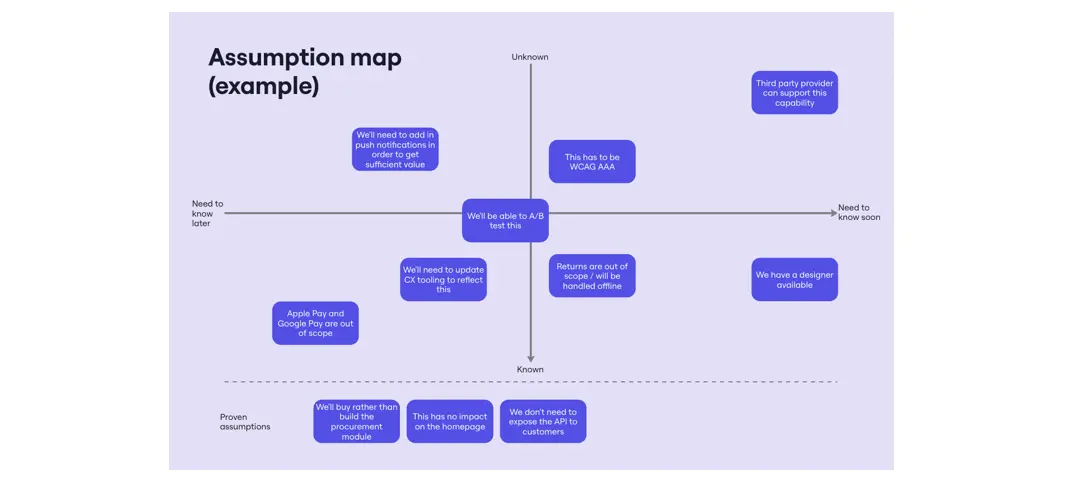
What it is for: Assumption mapping is a team exercise that lists everything that must be true for an idea or plan to succeed, then places each assumption on a grid of importance against strength of evidence. You leave with a visible map of what your plan depends on, a short list of two or three risky assumptions, and a concrete test planned for each with an owner and a date.
Who it helps: Product, policy and innovation teams about to ask for budget or time, and leaders who disagree on what a plan depends on.
When to use it
You have a promising concept and are about to ask for budget or time to build it.
A plan feels confident but nobody can say what it depends on.
Different leaders disagree about a project and you want to find the real point of disagreement.
How to use it
Describe the idea in three lines: who it is for, what it does, how it is delivered.
Give everyone eight minutes to write what must be true, one assumption per note.
Merge duplicates and rewrite each note so it could be proven wrong.
Sort by importance, then by evidence, moving a note right only for real evidence.
Pick the two or three riskiest assumptions and plan a small test for each.
Tip: Write assumptions as statements that could turn out false. Questions and topics are hard to place.
Credits and sources: Original Tiremesù worksheet and wording. Method credit: David J. Bland. Further reading: Strategyzer https://www.strategyzer.com/library/how-assumptions-mapping-can-focus-your-teams-on-running-experiments-that-matter
Full guide and film:https://www.tiremesu.com/guides/assumption-mapping