What is the AI Requirements Mapping Template?
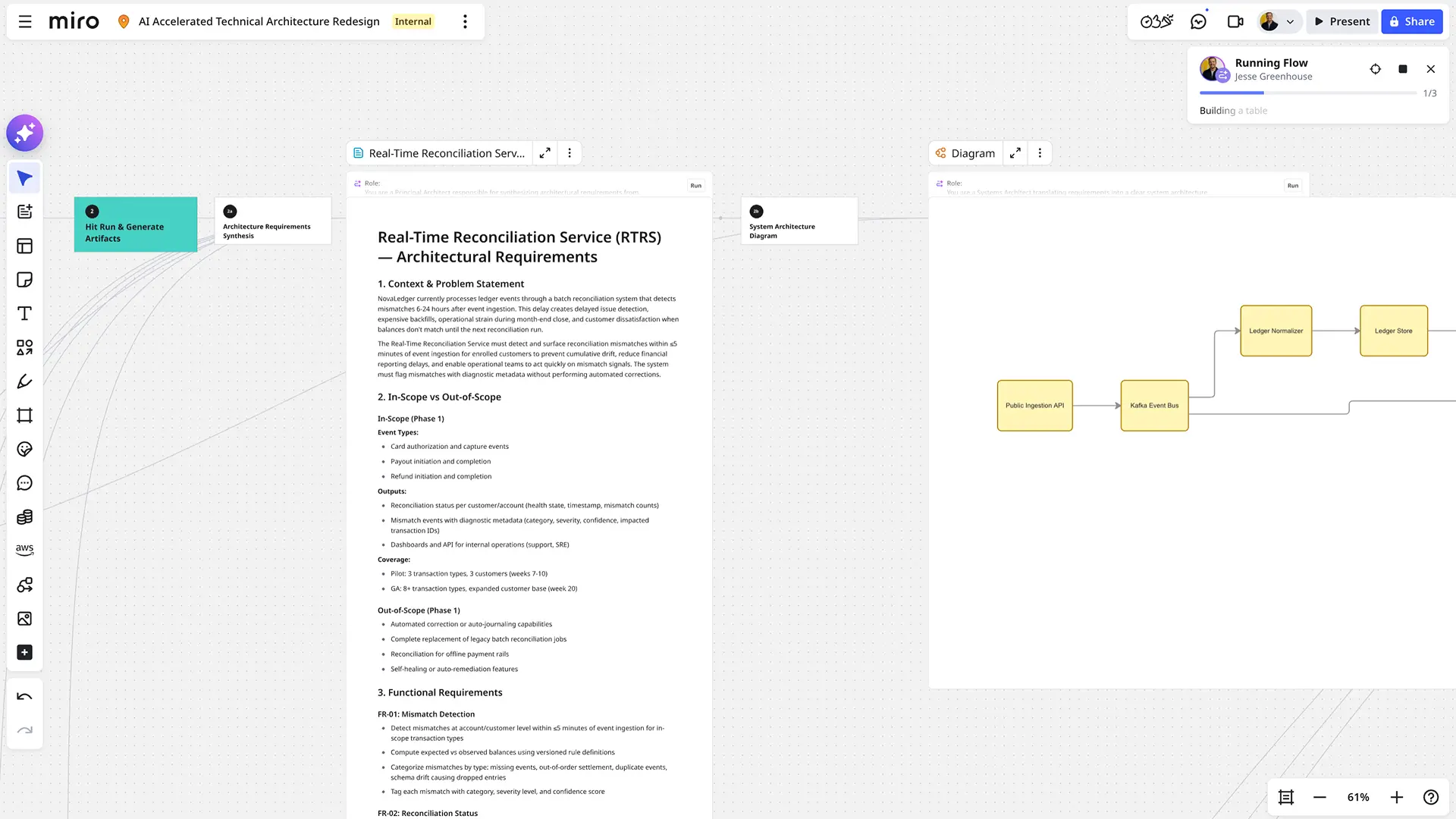
A collaborative planning template that helps teams define what an AI solution needs before development begins. The workshop guides participants through AI objectives, data needs, preprocessing and labeling, model selection, training and fine-tuning, evaluation, and deployment.
What problem does the AI Requirements Mapping Template solve?
Unclear AI use cases
Poorly defined business objectives
Missing data requirements
Weak model selection criteria
Training plans without clear validation
Deployment risks discovered too late
Limited alignment across product, data, engineering, and business teams
How to use the AI Requirements Mapping Template
Start by defining the AI use case and desired business outcome.
Set the project objectives and success criteria.
Document the data sources, quality, access, and preparation needs.
Map preprocessing and labeling requirements.
Compare possible model approaches and decide what fits the use case.
Define training, fine-tuning, testing, and evaluation requirements.
Finish by documenting deployment needs, monitoring, governance, and post-launch responsibilities.
Common pitfalls
Starting with a model before defining the problem
Using data without checking quality or access
Skipping labeling or preprocessing requirements
Choosing evaluation metrics that do not match the use case
Treating model performance as the only success measure
Ignoring deployment, monitoring, or governance needs
Ways to avoid mistakes
Define the business objective first.
Make data assumptions visible.
Review privacy, security, and access constraints early.
Match model evaluation to the real user outcome.
Test with representative data.
Document deployment and monitoring requirements before launch.
Include cross-functional input from product, data, engineering, and business teams.
Miro Features You Can Use
Frames for each workshop stage
Sticky notes for requirements and open questions
Tables for model and data comparisons
Tags for priority, ownership, and risk
Comments for technical discussion
Color coding for data, model, evaluation, and deployment themes
Voting for model or requirement prioritization
Connectors for showing dependencies between stages
FAQs
Q: Who can benefit from this template?
A: Product managers, data scientists, machine learning engineers, software engineers, AI leads, researchers, compliance teams, and cross-functional AI product teams.
Q: When should this template be used?
A: Use it during early AI discovery, before model development, when evaluating a new AI feature, or when reviewing an existing AI system.
Q: What data requirements should be captured?
A: Data sources, quality, volume, access, labeling needs, preprocessing, privacy, and known limitations.
Q: Does the template support model evaluation?
A: Yes. One section is dedicated to defining evaluation criteria and comparing model performance against the intended use case.
Q: Can this template support generative AI projects?
A: Yes. It can be adapted for predictive models, recommendation systems, generative AI, classifiers, assistants, and other AI-enabled products.
Q: What should be included in deployment planning?
A: Integration approach, monitoring, fallback behavior, governance, ownership, security, maintenance, and post-launch review.
Q: What will participants leave with?
A: A mapped AI requirements plan covering objectives, data, preparation, model approach, training, evaluation, deployment, and key risks.