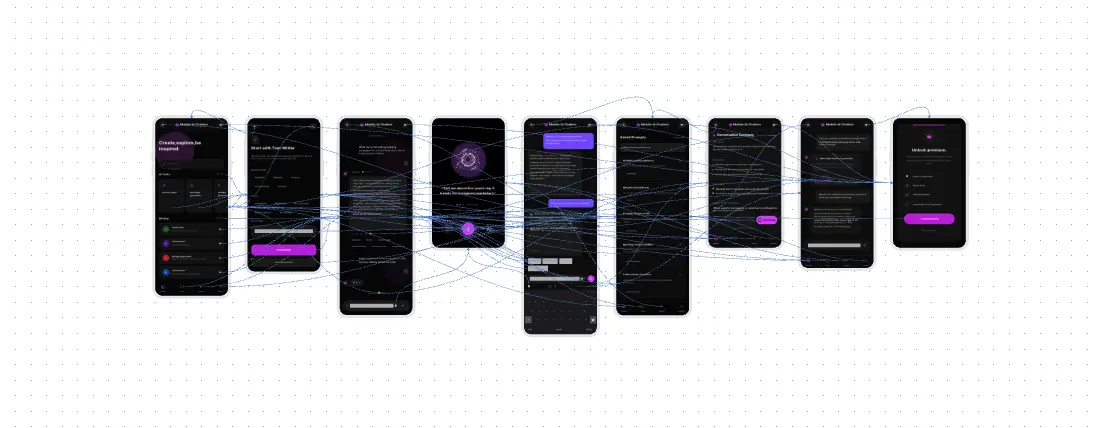
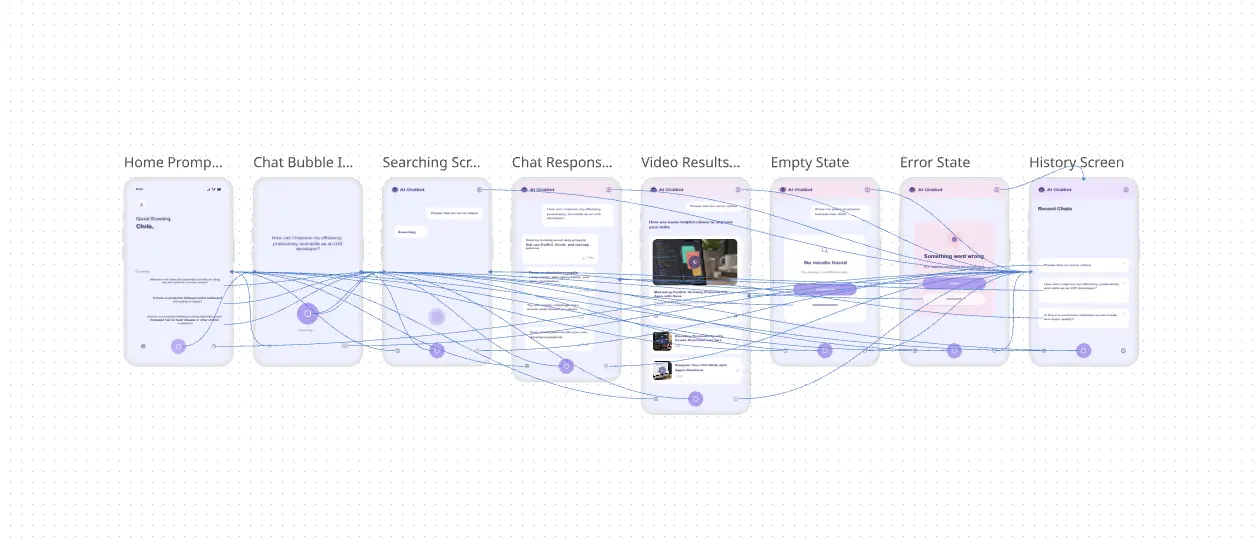
Use this editable decision map to plan how an AI chatbot answers a customer, attempts an authorized action and passes an unresolved request to a person. It helps support, operations and product teams find gaps before using a chatbot with real customers. The workshop focuses on evidence at each decision point, especially when an action may have succeeded but its result is unknown.
The board contains four frames, a connected decision map, blank customer and support handoff cards, and an editable gap table. Start with a fictional or redacted request. Keep private customer records, credentials and transcripts off any shared copy. The included address-change timeout is a fictional exercise, not a report of a production incident.
1. Define the customer outcome. Fill the four notes with the customer goal, authoritative source, permitted action and human decision owner. Be specific about what success would mean for the customer. A useful answer and a completed action are different outcomes. Decide which sources the chatbot may rely on and which actions it may attempt before tracing the flow.
2. Trace the decision. Begin by asking whether an approved source establishes the answer. If it does not, ask one clarification that could resolve the gap or hand off with the missing information identified. If the source does establish an answer, include the relevant conditions. Then decide whether an action is required and whether it is authorized for this customer and within the configured scope.
After an action attempt, distinguish confirmed, rejected and unknown results. Report a confirmed outcome precisely. Give a recovery path for a rejection. When the result is unknown, preserve the operation reference and reconcile or hand off before repeating the action. A timeout alone does not prove that the destination did nothing.
3. Design the handoff. Complete both blank cards. The customer card records what was sent, where it went, the expectation you can truthfully set and what the customer can do if delivery is unconfirmed. The support card records the goal, relevant context, attempted actions, confirmed and unknown outcomes, an authorized conversation reference and the next decision. Keep delivery to a channel separate from a person accepting responsibility.
4. Run a 20-minute workshop. Spend the first five minutes choosing a request and tracing the happy path. Spend five minutes removing the answer from the sources. Spend five minutes making an action time out after possible acceptance. Use the final five minutes to assign owners to the gaps you found.
Add rows to the gap table for observed behavior, desired behavior, evidence to collect, an owner and a review trigger. Label hypothetical gaps as design questions. Do not present them as measured failures. Revisit the map when a source, permission, integration or handoff process changes.
The exercise is complete when every endpoint gives the customer a truthful next step, each human handoff has an owner and an unknown outcome cannot silently become a duplicate action. The map is a reasoning and testing method. It does not certify compliance or imply that any particular chatbot supports every action shown.
Created by Agentkit with AI assistance. Adapt the editable elements to your own workflow and review every branch with the people responsible for it.