Table of contents
Table of contents
What are SMART goals? Examples and templates
Summary
In this guide, you’ll learn:
- The SMART goals meaning and what the acronym stands for
- What makes a goal SMART
- Why SMART goals are important for teams and individuals
- How to write SMART goals step-by-step
- Examples of SMART goals you can adapt quickly
- Templates you can use in Miro to set and track SMART goals
What are SMART goals?
Teams don’t fail because they lack talent or ideas. They fail because “success” isn’t clearly defined or consistently checked. When goals are vague, everyone fills in the gaps differently—product sees one outcome, design another, leadership something else. Work keeps moving, but alignment quietly slips. That’s where SMART goals come in.
SMART is a simple framework that creates a shared definition of success before the work gets messy. It gives product managers, designers, engineers, researchers, and agile teams a common language to agree on what they’re building, how success will be measured, and when it should be achieved. Built around five criteria—specific, measurable, achievable, relevant, and time-bound—SMART goals focus on what you will accomplish and how you’ll know you’ve done it. That clarity is why they work so well in fast-moving teams. When goals are SMART, teams don’t just move faster—they move in the same direction, toward outcomes they can ship, test, and improve.
Collaborative AI Workflows
Join thousands of teams using Miro to build the right thing, faster.
What does SMART stand for?
If you’ve ever searched “what does SMART goals stand for?” The answer is simple: SMART is an acronym that breaks down five characteristics of effective goals. When combined, these characteristics allow teams to set goals that are easy to understand and measure.
Specific
A goal should specify what needs to happen and who’s involved. This eliminates ambiguity and ensures that everyone has the same aim in mind.
Measurable
A goal requires a method of measuring progress. Success becomes something measurable, rather than something to be argued over.
Achievable
A goal should challenge the team without disregarding actual limitations. This is where achievability comes in, keeping the team’s motivation high and its expectations realistic.
Relevant
A goal should relate to something that truly matters. Relevance helps protect a focus from getting diluted by activity that lacks an impact.
Time-bound
A goal should have a specific timeframe. This will give the person deadlines, which will help them prioritize their work and measure their progress.
What do SMART goals do?
SMART goals turn ambition into something teams can actually work with. They eliminate the guesswork by turning vague language and ideas into something an actionable plan. Instead of trying to figure out what a goal really means, teams can see it, measure it, and plan around it.
With clear milestones and timeframes, progress is also visible. Teams can see when things are moving forward and when they’re not. This makes it easier to adjust early, rather than discovering problems at the finish line.
Why are SMART goals important?
Teams often fall short not because they lack effort, but because they don’t agree on what success actually looks like. Miro’s Momentum at Work research shows that modern work is already slowed by silos, miscommunication, and maintenance tasks. Without a shared goal, the lack of momentum will only continue to build.
Everyone can nod their head in agreement during a meeting, but when it’s time to deliver, each person has a slightly different picture in mind. One team thinks that “done” means it’s shipped. Another thinks it means it’s tested. Stakeholders think it means it’ll impact revenue. Everyone is working hard, but not necessarily in the same direction.
That’s why creating SMART goals matter. With it, teams can link strategy planning to execution. SMART is more than just setting a target; it reaches a consensus around it. When a goal is specific, measurable, achievable, relevant, and time-bound, it provides a roadmap for success.
Benefits of SMART goals
- Clear ownership and scope. Everyone understands what the goal includes, what it doesn’t, and who’s responsible for it.
- Trackable progress. Metrics and milestones provide a definition of progress that makes it trackable. This allows teams to see what’s moving, what’s stalled, and what needs to be addressed.
- Realistic execution. Goals are measured against real-world resources, timelines, and constraints. That reality check prevents teams from committing to something that can’t be realistically accomplished.
- Better prioritization. When relevance is built in, it becomes possible to link goals to outcomes that have relevance. And it becomes easier to say no to distractions.
- Fewer “set it and forget it” goals. Timeframes keep goals alive. Deadlines build urgency and promote frequent check-ins rather than last-minute surprises.
- Earlier risk detection. When progress can be measured, teams notice problems earlier - before it’s too late to make changes
- Higher team alignment. When the goal is the same, there is less chance of miscommunication, and cross-functional teams stay focused in the same direction.
How to write SMART goals
A SMART goal doesn’t begin SMART. It starts broad and develops through each stage of the framework. Most goals begin as general objectives, like “improve adoption of a new feature.” It’s not wrong, but it is unfinished.
Writing SMART goals means refining it by asking:
- What exactly needs to change?
- How will we measure success?
- Is this realistic with our time and resources?
- Why does this matter right now?
- When will we review the result?
Each question helps to refine the objective. Collectively, they help to transform a general concept into a specific plan.
Writing SMART goals step-by-step (SMART framework)
To put this into practice, we’ll walk through a real-world example of a SMART goal. We’ll explore each part of the SMART goal framework, just like teams do in planning meetings, sprint kickoffs and roadmap reviews.
A product manager at a SaaS company called Cloudloop has been tasked to improve user activation for a newly launched feature. The initial objective looks like this: “Improve adoption of the new feature.”
The team is not yet in a position to plan for it, measure it, or define success. Now let’s break down this same objective using each component of the SMART criteria.
S - Specific
Specific means that the goal clearly articulates what will happen, who it belongs to, and how the results will be impacted.
To make a goal specific, ask:
- What needs to be accomplished?
- Who owns it?
- What actions will we take to achieve it?
Answering these questions is helpful in transitioning from intention to direction.
For example, Cloudloop’s goal of “improve adoption of the new feature” is too vague. The product manager narrows down the goal in this way:
Increase adoption of the new feature among existing customers by improving onboarding guidance and in-product prompts.
Now the goal is more clear. The team understands what’s being changed and how they’ll impact behavior.
M - Measurable
Measurable means the goal has a clear success signal; a number, threshold, or milestone that makes “done” unambiguous. Including a goal that can be measured takes away any ambiguity.
Ask questions like:
- What metric will change?
- By how much?
- How will we track it?
In the case of Cloudloop, the product team is trying to improve adoption of a new feature. But what does “improve” actually mean? Is it one more user? A hundred? A thousand? Without a metric or benchmark, it’s impossible to measure success. To make the goal measurable, the product manager adds clear benchmarks.
With measurement added, the Cloudloop goal becomes:
Increase adoption of the new feature from 30% to 50% of active users by improving onboarding guidance and in-product prompts.
At this stage, “done” becomes an objective term. The team understands what success means and how far off they’re from achieving it.
A - Achievable
Achievable means that the goal is possible with existing capacity and constraints; ambitious, but not disconnected from people, time, budget, or technical complexity.
Ask:
- Can we realistically do this with current people, time, and budget?
- What would need to change to make this achievable?
The product manager at Cloudloop considers the target of 50% along with team capacity, delivery times, and existing priorities. After this, it’s now realized that the original target is too aggressive for the current quarter. The goal is adjusted according to the actual delivery conditions.
The Cloudloop goal now becomes:
Increase adoption rate of the new feature from 30% to 40% among active users by improving onboarding guidance and in-product messaging.
Flagging constraints early protects both the quality of delivery and the trust of the team.
R - Relevant
The goal has to have relevance to a strategic outcome, customer value, or a business objective. It answers the question: why does setting this goal matter? Without relevance, even well-written goals can become busywork. Ask yourself:
- Why does this matter now?
- What outcome does it support?
At Cloudloop, the product manager notices that customers who use this feature are highly likely to be retained in the long run. This information changes the objective.
With this context in mind, the goal becomes:
Increase adoption of the new feature from 30% to 40% of active users to improve retention among mid-tier customers, who show higher lifetime value when this feature is used.
It’s no longer just about usage, but is directly related to the value of the customer and revenue impact.
T - Time-bound
Time-bound means the goal has a specific timeframe, deadline and, preferably a few checkpoints to ensure progress is tracked (and not noticed too late).
Without a timeframe, the sense of urgency fades and the process of review becomes inconsistent. In this step, ask:
- What’s the deadline?
- When do we start?
- What milestones will we review along the way?
In the case of Cloudloop, the product manager aligns the goal with the upcoming quarterly planning cycle and release schedule. The final SMART goal is:
Increase adoption of the new feature from 30% to 40% of active users within three months to improve retention among mid-tier customers, by improving onboarding guidance and in-product prompts. Progress will be reviewed bi-weekly using product analytics and customer feedback.
Using a SMART goal template
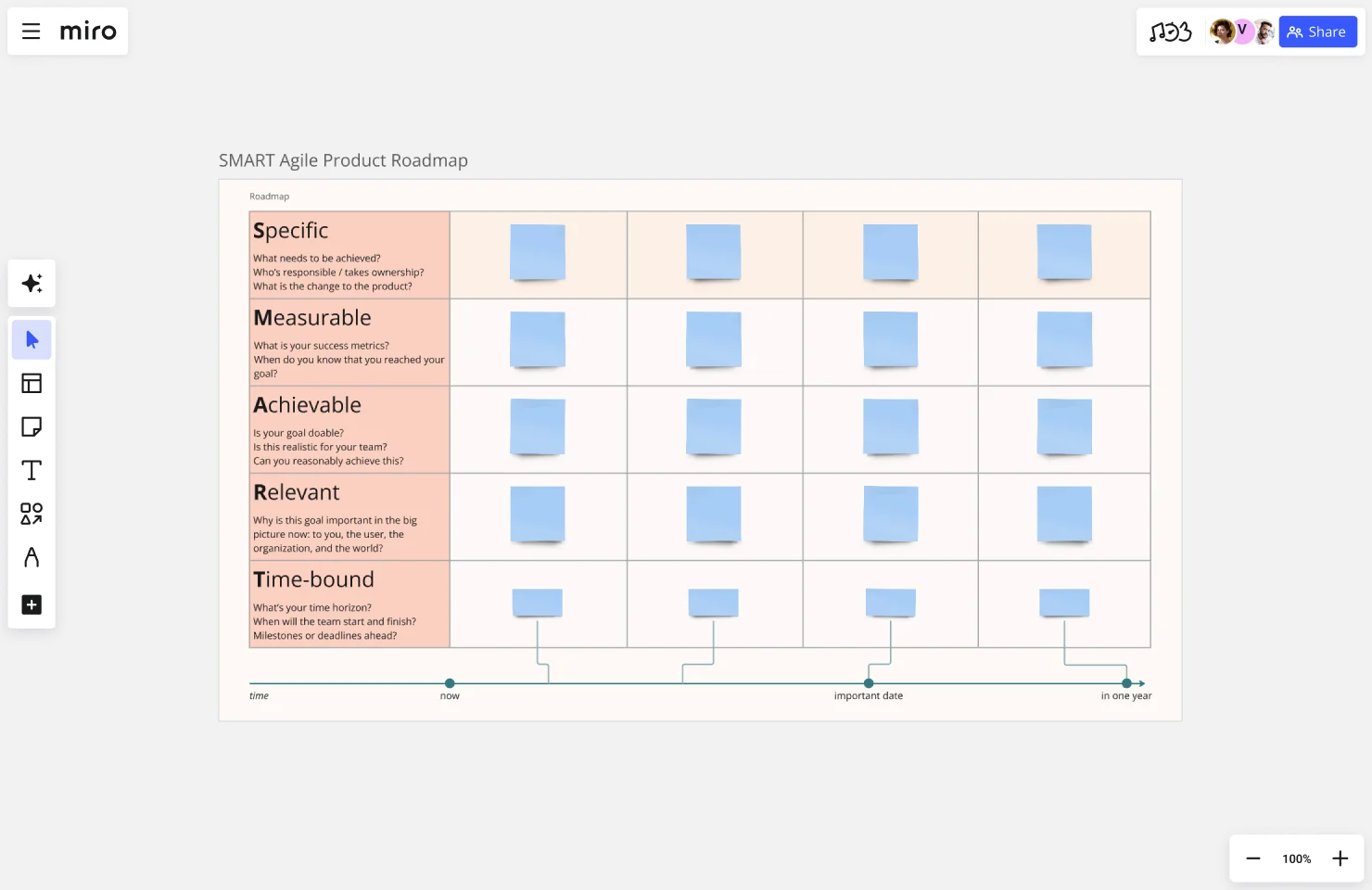
The SMART framework is most effective when used together by teams. Miro’s SMART goal template is intended to keep the entire goal-setting process within one shared innovation space where discussion, decision-making, and alignment occur in real-time.
Teams can use the template to move through each part of the framework together. Research, product concepts, delivery strategies, and goals are kept related rather than siloed across different tools.
This kind of shared goal alignment is exactly how CD PROJEKT RED transformed its milestone planning process. When goals live in the same space as the work, they stop being static statements and start becoming guides teams actually use.
With 27 teams across multiple global studios, the game development company needed a way to align hundreds of designers, developers, writers, and producers around the same goals. By moving milestone planning into Miro, they created a structured, collaborative process that improved visibility, reduced planning time, and strengthened alignment across every development cycle.
As Damian Milczarek, Agile Coach and Scrum Master at CD PROJEKT RED, explains:
“Miro makes it easier to effectively coordinate and align the work of many departments and product areas toward the same goal.”
How to set and achieve SMART goals
To keep goals progressing from intention to outcome:
- Confirm ownership and dependencies. It’s important to confirm who the owner of the goal is and on which teams or systems the goal depends.
- Set a check-in cadence. Check in weekly or bi-weekly to keep goals from being forgotten.
- Track leading indicators. Don’t wait for the final result. Monitor early signals that show whether you’re going in the right direction.
- Keep the goal visible. Keep it in sight so it remains part of the decision-making process.
- Adjust scope when constraints change. Be ready to change what you’re trying to do.
- Document decisions and learnings. Record why changes were made to continue staying aligned
- Celebrate progress, not just completion. Milestone recognition helps keep the momentum going and keeps teams engaged.
SMART goals examples you can copy
Sometimes, the easiest way to set a SMART goal is to see what a good one looks like. Below are a few SMART goal examples, each with a clear outcome, metric, and deadline to help guide your own.
Career or professional development
Strengthen my role in project management by leading two cross-team initiatives by the end of Q3. Own all planning and communication to build confidence and leadership skills.
Marketing campaign
Generate 1,500 qualified leads from a product launch campaign by September 30. Use paid social ads and email nurturing to grow the sales pipeline.
Product adoption
Increase the number of weekly active users of the new dashboard feature from 20% to 40% within 10 weeks by improving onboarding tools.
Customer support or service quality
Reduce average first-response time from 6 hours to 3 hours by the end of Q2 by optimizing workflows.
Project delivery
Launch the redesigned checkout flow by July 15, with fewer than five critical bugs reported in the first two weeks after release.
SMART goals best practices
- Keep the metric close to the outcome you care about. Select your metrics to measure impact, not just activity.
- Make “achievable” explicit. Point out the limitations of time, people, or budget to keep the goal realistic.
- Use one primary metric per goal. Using multiple metrics confuses and can make success harder to judge.
- Define milestones early. Divide the goal into milestones or checkpoints to prevent last-minute stress.
- Write goals in plain language. A goal should be able to be understood by anyone without any explanation.
- Review goals in context. Always relate the goal to the work and decisions it impacts.
- Update goals when reality changes. Keep goals SMART by improving them, not abandoning them.
Common mistakes when creating SMART goals
- Calling a goal measurable without agreeing on the data source. Teams define a metric but don’t agree on where it comes from or who owns it.
- Skipping the achievability check. The goals are determined by ambition rather than ability and gradually become unrealistic.
- Forgetting relevance. The goal seems organized but isn’t connected to any kind of meaningful result, so it becomes mere busywork.
- Using vague timeframes. “Soon,” “next quarter,” or “ASAP” are used instead of specific deadlines.
- Setting too many goals at once. There is no focus, and it becomes difficult to choose what to do first.
- Writing goals to sound good, not to be used. They’re polished for slides but not helpful for day-to-day decisions.
- Never revisiting the goal. It gets written, approved, and then simply forgotten.
The video below shows how the platform helps teams turn high-level strategy into clear, measurable outcomes. It walks through how organisations can map their vision, define structured goals, and align projects and teams within a shared workspace. The demo highlights collaborative planning features, visual goal tracking, and real-time alignment tools designed to keep everyone focused on measurable results and business impact
Using Miro to write and align on SMART goals
The effectiveness of SMART goals is only as good as the conversations that are happening behind them. And Miro provides a place for teams to have those conversations. Rather than handing off goals from one tool to another, teams can collaborate on building goals in context, and see how each choice relates to research, priorities, and delivery plans.
You can run SMART goal workshops on one board, use shared templates so everyone’s on the same page, and keep goals and the work they support in view. No handoffs. No lost context. No “which version are we using?”
You can even use Miro AI to support the process. Refine your goals without losing speed by summarizing conversations, identifying key takeaways, and recommended wording for goals. Rather than starting over, teams leverage AI to enhance, test, and optimize what they’ve built.
When you’re ready to turn intention into outcomes, start building your SMART goals in Miro. With better defined goals, higher levels of ownership, and less disconnect between planning and execution - your goals are tied to the work that makes them real.
SMART goals FAQs
Are SMART goals only for businesses? No. SMART goals can be used in personal development, education, health, career planning, project management, and virtually any area where structured progress matters.
Can SMART goals be used for long-term objectives? Yes. Long-term goals can be broken down into smaller SMART milestones. This makes larger ambitions more manageable and easier to track over time.
Are SMART goals flexible? Yes. While they are structured, SMART goals can be adjusted if circumstances change. Reviewing and refining goals is part of maintaining effectiveness.
Can individuals use Miro for personal SMART goals? Yes. While often used by teams, individuals can use Miro boards for personal planning, habit tracking, or career development using SMART goal frameworks.
Author: Miro Team
Last update: February 20, 2026
Read more
Join our 100M+ users today


