Table of contents
Table of contents
By signing up, you agree to Miro's Terms of Service and Privacy Policy.
How to prioritize user stories in agile
Summary
In this guide, you’ll learn:
- Why user story prioritization matters in agile teams
- What to prioritize user stories on
- A simple step-by-step process to prioritize a backlog
- Which user story prioritization techniques to use and when
- How to run your prioritization sessions in Miro
Collaborative AI Workflows
Join thousands of teams using Miro to build the right thing, faster.
User story prioritization in agile is the exercise of keeping your backlog in order, so that your team is always working on the most valuable and pressing items first. When it’s done well, teams are capable of delivering more, with greater predictability and less risk.
Start prioritizing faster in Miro
Why user story prioritization matters in agile
When working in Agile, teams are often faced with uncertainty and significant constraints on their capacity, meaning not everything can be built simultaneously. User story prioritization is the key activity in helping teams focus on the work that will deliver the most value first. In addition, by taking on the most time-sensitive tasks and dependencies sooner, it reduces the overall risk to delivery.
By regularly undertaking user story prioritization sessions, projects can move forward with:
- A clearer roadmap
- More lessons learnt from what gets shipped
- More reliable sprint planning
- Fewer unexpected, disruptive requests popping up mid-sprint
What should user stories be prioritized on?
Three core criteria are used to prioritize user stories, which are layered with a few considerations to make sure the exercise is adjusted to your team’s workflows and deliverables.
- Value: Prioritize based on the impact on users and the business. Consider whether the story removes a key pain point, encourages adoption, reduces support demand, shields revenue, or drives a KPI.
- Urgency: Prioritize based on which stories are more time-constrained or are actively blocking other deliverables. Consider its impact on deadlines, release targets, compliance needs, and whether a delay or setback will increase risk or cost down the road.
- Effort: Prioritize based on the complexity and the expected number of story points. Targeting smaller stories can provide teams with faster learning and squeeze out workflow inefficiencies sooner. On the other hand, focusing on larger stories may need to be split out before their effort can be accurately understood.
How to prioritize user stories in agile
1. Get the stories ready
Prepare each story so that its key details, intent, and acceptance criteria have been clearly outlined. This will give your team a backlog of stories that can be compared with one another.
2. Assign scoring
Give each story a score for its value, urgency, and effort. You may also want to consider adding a score for risk if uncertainty is particularly high.
3. Estimate tradeoffs
Use a simple framework like a value vs effort matrix or a ranked list to see which user stories are rising to the top. This will give you your first draft on what tasks are looking like they’ll need to be prioritized.
4. Resolve dependencies and constraints
Adjust your draft list to account for your project’s prerequisites, release targets, and technical constraints. This will make sure that your plan and deliverables are feasible and won’t be hampered by bottlenecks.
5. Validate with stakeholders
Do a quick review with your stakeholders to confirm assumptions and agree on the next deliverables in the upcoming sprints - this will outline the top slice and your ‘later’ bucket.
The most common prioritization techniques in Agile
There are many effective ways to prioritise work in Agile, and teams can choose the method that best fits their context. Some of the most flexible and reliable techniques include MoSCoW, the Kano Model, Value vs Effort, Opportunity Scoring, the 100-Point Method, RICE Scoring, User Story Mapping, and WSJF (Weighted Shortest Job First). You can explore and start using these prioritisation frameworks right away for free with ready-to-use templates in Miro from general Agile templates to specific prioritisation boards to help your team align, visualise, and make better decisions together.
Here are some of the most flexible and reliable techniques for prioritizing in Agile.
MoSCoW
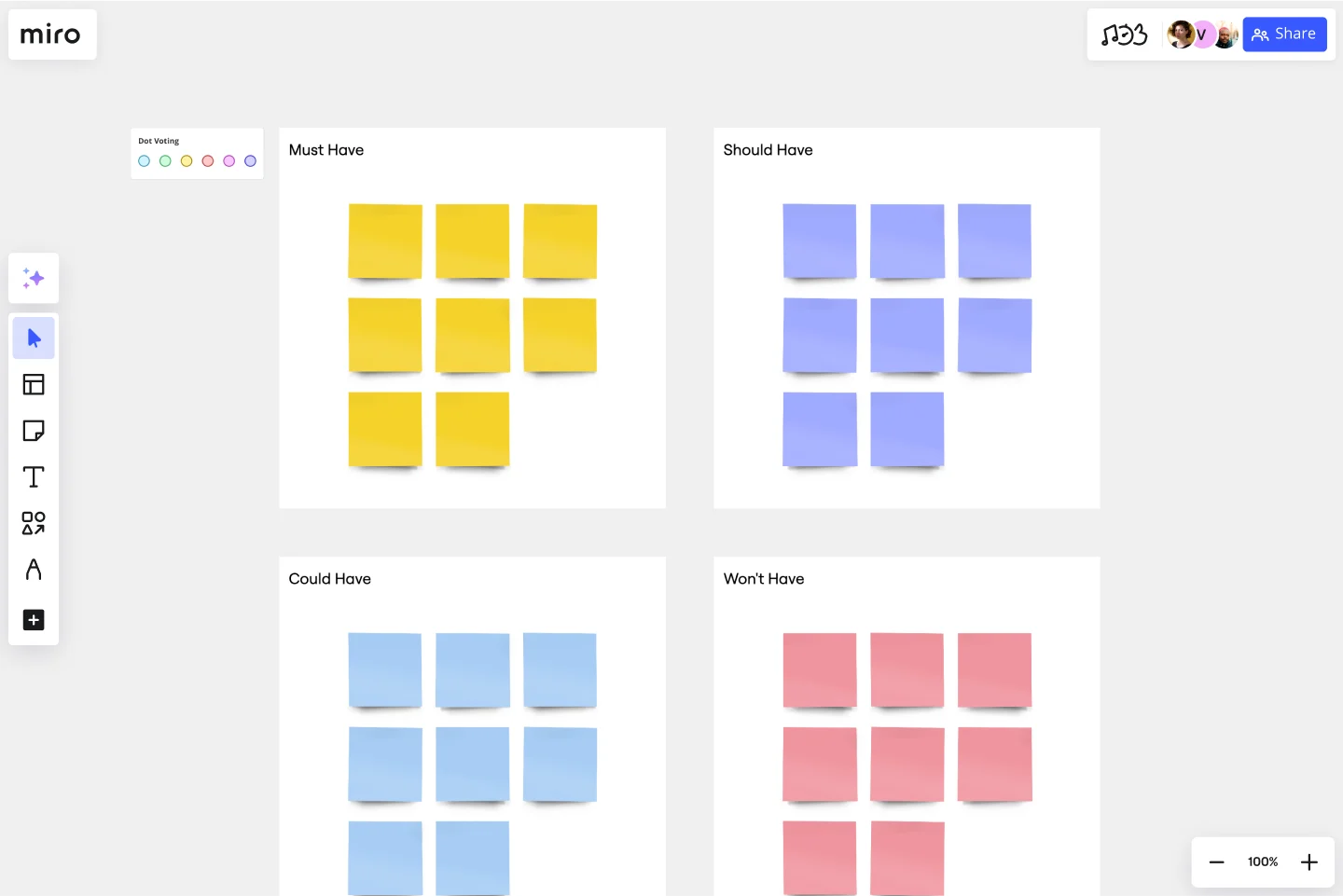
MoSCoW groups stories into Must have, Should have, Could have, and Won’t have based on their scope. It’s important to remember that when using this framework, “Won’t have” is often meant as “won’t have this time” - it manages expectations on what’s feasible right now, instead of dismissing deliverables entirely.
When using DSDM (Dynamic Systems Development Method), teams will try to keep ‘Must haves’ to around 60% of their capacity. This leaves room for any uncertainty and potential changes in scope.
Kano Model
The Kano model helps you prioritize based on customer satisfaction impact by separating basic expectations, performance features, and delighters. In more rigorous use, Kano classification is driven by a paired questionnaire that reveals how users feel if a feature exists vs doesn’t - instead of purely subjective judgment.
It also encourages revisiting as features can shift categories over time, with today’s delighter becoming tomorrow’s user expectation.
Value vs effort
A value vs effort approach makes trade-offs explicit by placing stories on a simple 2×2. It is one of the fastest prioritization methods for clarity, as high-value/low-effort items emerge as your quick wins, while low-value/high-effort items become clear targets for de-prioritization.
It will also highlight which high-value/high-effort items require greater evidence for justification, or should simply be split into smaller tasks before any resources are committed.
Opportunity scoring
Opportunity scoring prioritizes what matters most and is currently underserved. A common framing is to score outcomes on importance and current satisfaction, then calculate opportunity as Importance + (Importance − Satisfaction).
This leads to stories that are important but unsatisfying, rising to the top of the priority list. It’s an approach that’s especially effective when you have user input at scale and want to avoid prioritizing based on internal assumptions alone.
100-point method
The 100-point method - also known as the 100-Dollar Test or cumulative voting - prioritizes by forcing explicit trade-offs by giving each participant a fixed “budget” to distribute across stories. It works best when the user stories are clearly defined and comparable.
It’s especially valuable if stakeholder alignment is an essential consideration for your project, as it surfaces where priorities converge - or diverge - before there’s any commitment to a sprint or release plan.
RICE scoring
RICE is useful when you have lots of backlog items and need a consistent way to rank them. It scores each story by Reach, Impact, Confidence, and Effort, then uses a simple formula to create a comparable score - normally (Reach x Impact x Confidence)/Effort. It’s especially helpful when stakeholders need to see why something is ranked higher, not just the final order.
You can also build and visualise your RICE prioritisation framework directly in Miro, making it easy for product teams to collaborate, adjust scoring in real time, and keep all prioritisation decisions in one shared space. Using a ready-made template helps teams get started quickly and standardise how ideas are evaluated across projects.
User story mapping
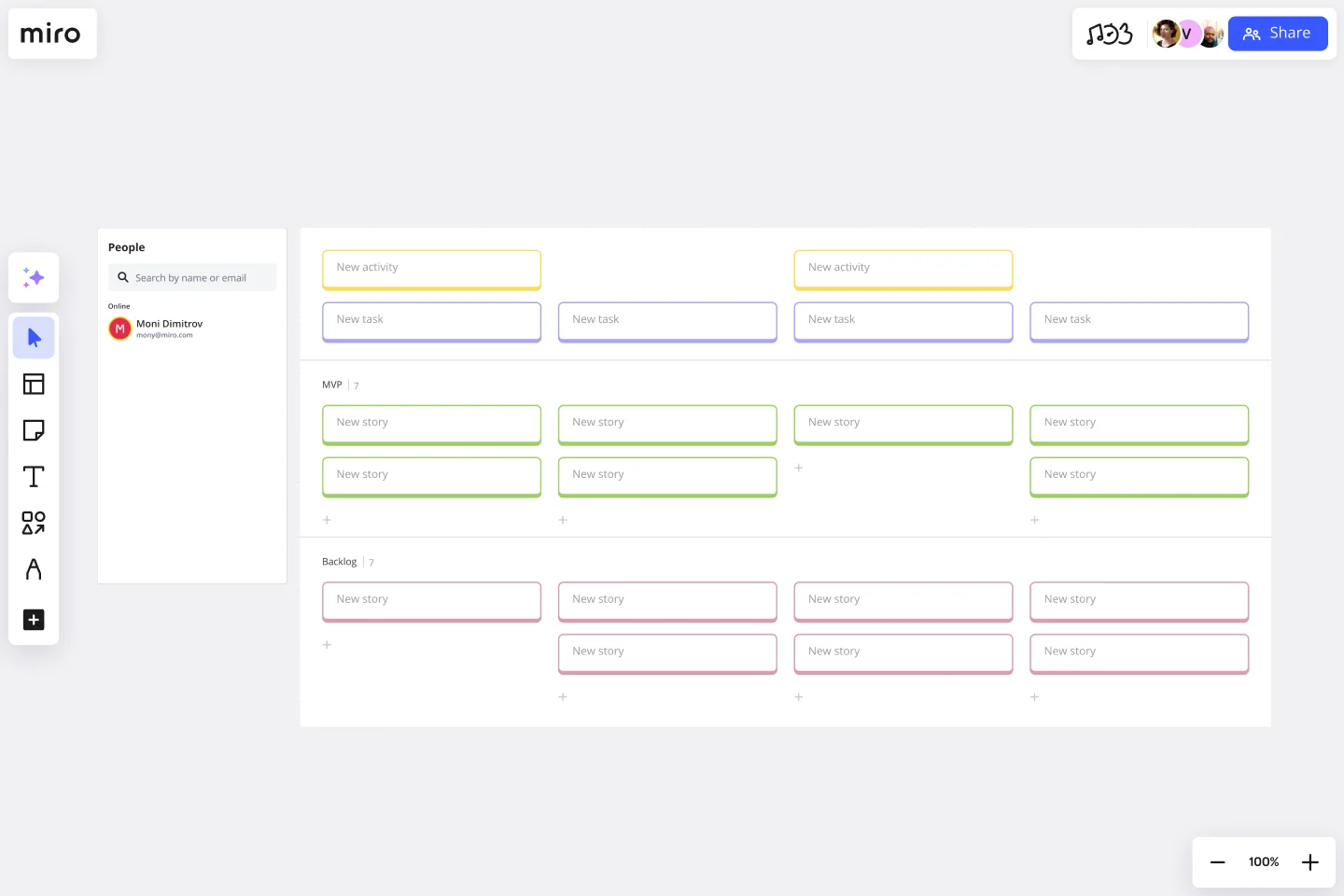
User story mapping is less focused on scoring and is more concerned with organizing and slicing work around the user journey. It helps teams see the end-to-end flow, spot gaps, and then “slice” a coherent Minimum Viable Product across the journey - instead of shipping disconnected features.
WSJF
WSJF (Weighted Shortest Job First) is best when sequencing work has real economic trade-offs, or when delay has a cost. It ranks items by comparing the cost of doing it later against how long it will take, so work that’s expensive to delay and relatively quick to deliver rises to the top. A practical way to estimate “cost of delay” is to consider business impact, time criticality, and risk reduction, then divide that by the item’s size or effort.
You can also map and calculate WSJF visually in Miro, helping teams collaborate on prioritisation, align on scoring assumptions, and quickly re-rank work as priorities change. A template makes it easier to standardise the approach across teams and keep discussions transparent.
Our customer’s story
At ASOS, teams use Miro to run product planning and prioritization in a shared visual workspace - bringing backlog items, dependencies, and stakeholder input into one place.
After adopting Miro for planning, ASOS reduced time spent on product planning by ~50% and reported 71% more effective meetings. This helped their teams move faster on high-impact initiatives while improving alignment between teams and leadership.
“Being able to bring everyone together to plan in Miro ultimately means that the most impactful initiatives will happen at the right time – and customers will get the functionality they want.”
Lucy Starling, Product Operations Lead at ASOS
Run your user story prioritization in Miro
User story prioritization works best when the backlog, the criteria, and the trade-offs are visible to everyone. In Miro, teams can bring user stories onto a shared board, score them quickly, and visualize decisions using methods like value vs effort matrices, MoSCoW buckets, or story maps.
Sign up for Miro to run fast prioritization workshops, capture stakeholder input without side conversations, and leave with a clear, agreed sprint planned - alongside a transparent record of what was deferred and why.
Frequently asked questions
How often should user stories be prioritized in Agile?
User stories should be reviewed and reprioritized at least once per sprint.
However, priorities may need to change sooner if there is new customer feedback, shifting business goals, or unexpected technical constraints. Regular review ensures the backlog reflects current realities.
Who is responsible for prioritizing user stories?
The Product Owner is typically accountable for backlog prioritization.
That said, prioritization is most effective when it includes input from the delivery team and relevant stakeholders. Collaborative input improves decision quality and increases alignment.
What is the difference between backlog refinement and prioritization?
Backlog refinement focuses on preparing user stories. This includes clarifying requirements, defining acceptance criteria, and estimating effort.
Prioritization determines the order in which those stories should be delivered.
Refinement improves quality. Prioritization determines sequence.
What should we do if all user stories seem equally important?
When everything appears high priority, introduce clearer evaluation criteria.
Frameworks such as value vs effort, RICE, or WSJF help teams compare items objectively. Forcing trade-offs exposes differences in impact, urgency, and effort that may not be obvious at first.
Should technical work be prioritized differently from feature work?
Technical stories - such as refactoring, infrastructure, or risk reduction - should be prioritized using the same core criteria: value, urgency, and effort.
While they may not directly deliver visible user value, they often reduce future risk, enable scalability, or prevent delivery delays. These outcomes should be factored into prioritization decisions.
Author: Danielle Caldas, Organic Growth Manager @ Miro Last updated: April 16, 2026
Read more
Join our 100M+ users today


