1likes
7uses
Clarify who contributes, advises, approves, and communicates important decisions. This collaborative stakeholder analysis workshop helps startup founders and product teams map decision responsibilities, identify approval bottlenecks, and create a practical decision action plan.
Does your team know who needs to contribute to a decision, who has the final say, and who needs to hear the outcome?
The Stakeholder Analysis: Decision Path template helps startup founders and product software teams clarify stakeholder responsibilities and reduce confusion around important decisions.
I've seen product initiatives lose momentum when teams wait for approvals, involve stakeholders too late, or revisit decisions that should have been resolved earlier.
This workshop provides a simple approach to decision ownership without requiring a complicated governance framework.
Instead of a traditional stakeholder matrix or detailed RACI chart, participants map one important decision through four roles:
Propose: Who prepares the recommendation?
Advise: Whose expertise or input is needed?
Decide: Who has final decision-making authority?
Inform: Who needs to know the outcome?
The team then identifies potential delays, missing information, and unclear responsibilities before creating a short decision action record.
By the end of the workshop, you'll know who needs to be involved, when they should contribute, and what needs to happen before a decision can be made.
Designed for small teams, this template works for both virtual and in-person workshops without breakout groups.
Startup founders clarifying important business decisions
Product managers coordinating product approvals
UX/UI designers navigating design reviews
Software development teams managing technical decisions
Project leads resolving approval delays
Operations teams improving decision workflows
Cross-functional teams introducing new products, processes, or AI capabilities
Workshop duration: 50 minutes
Recommended participants: 3–8
Facilitator: Product manager, startup founder, project lead, or workshop facilitator
Choose one meaningful upcoming decision.
Gather available information about:
The decision's purpose and expected outcome
Known stakeholders and their responsibilities
Existing approval requirements
Relevant technical, financial, or customer information
Outstanding questions or unresolved decisions
The target decision date
Invite the person with final decision authority when practical. If they cannot attend, confirm their authority and availability before finalizing the pathway.
Prepare five workshop sections:
Define the Decision
Identify Decision Stakeholders
Build the Decision Path
Find Decision Bottlenecks
Confirm the Decision Route
For virtual workshops: Use Miro sticky notes, editable stakeholder cards, and the Decision Path board.
For in-person workshops: Use a whiteboard, printed role cards, markers, and sticky notes. Transfer the completed pathway and action record into Miro afterward.
Begin by identifying the decision your team needs to make.
Use the three question cards to guide the discussion.
What?
What needs to be decided?
Why Now?
Why is this decision important at this point?
By When?
When is a decision required?
Ask participants to share their understanding of the decision.
Agree on one specific question with a clear scope and deadline.
Example:
What: Approve a limited AI customer support pilot.
Why Now: The team needs approval before preparing the pilot launch.
By When: Thursday.
Agreed Decision Question: "Should we launch an AI-powered customer support assistant to a limited customer pilot next month?"
AI Alternative
Use AI to refine the decision statement.
Example prompt:
"Rewrite this product decision as one clear question with a defined scope, intended outcome, and decision deadline. Identify missing information that needs clarification: [insert decision]."
Output: One agreed decision question with a target date.
Ask participants to independently identify the people or groups who need to contribute to the decision or understand its outcome.
Capture one stakeholder per sticky note.
Organize the notes into two categories.
Internal Stakeholders
People or groups within your organization.
Examples:
Product Manager
Engineering Lead
Security Representative
Support Lead
Product Lead
External Stakeholders
People or groups outside your organization.
Examples:
Pilot Customers
Technology Partners
Customer Administrators
Review the collected notes and combine duplicates.
Discuss which stakeholders need to propose, advise, decide, or receive information.
Keep the final list focused on people directly relevant to the decision.
AI Alternative
Use AI to identify potentially overlooked stakeholder roles.
Example prompt:
"For this startup product decision, suggest relevant internal and external stakeholders who may need to prepare a recommendation, provide input, make the final decision, or receive the outcome. Identify assumptions requiring confirmation: [insert decision]."
Output: An organized shortlist of decision stakeholders.
Use the Decision Path to organize stakeholder responsibilities into four connected sections.
PROPOSE — Who Prepares the Recommendation?
Identify the person responsible for developing the recommendation.
This person gathers relevant information and presents the proposed course of action.
Example: Product Manager prepares the AI support pilot proposal.
ADVISE — Whose Input Is Needed?
Identify stakeholders whose expertise, feedback, or operational responsibilities should inform the decision.
Example: Engineering, Security, and Support provide feasibility, privacy, and workflow feedback.
DECIDE — Who Has Final Authority?
Identify one accountable decision owner.
Confirm that this person has the authority to make the decision within its defined scope.
Example: Product Lead approves or rejects the limited pilot.
INFORM — Who Needs the Outcome?
Identify stakeholders who need to understand the final decision and its implications.
Example: Customer support employees and pilot customers receive the launch decision and relevant details.
Move stakeholder cards into the appropriate sections.
One person may contribute in more than one role.
Keep the final decision owner clearly identified and respect any required formal approvals.
AI Alternative
Use AI to draft a preliminary role assignment.
Example prompt:
"Organize these stakeholders into Propose, Advise, Decide, and Inform roles for this decision: [insert decision and stakeholder list]. Flag unclear decision authority, potentially missing expertise, and unnecessary approval layers. Do not assume final decision rights without confirmation."
Output: A completed Decision Path showing stakeholder roles and decision ownership.
Review the completed Decision Path.
Identify issues that could delay the decision or create confusion.
Use the three diagnostic categories.
Unclear Authority
Is it clear who has the final say?
Example: Two team leaders believe they are responsible for approving the pilot.
Missing Input
Is the team waiting for information required to make an informed decision?
Example: Security needs a data-flow diagram before reviewing the pilot.
Too Many Handoffs
Are unnecessary reviews or sequential approvals slowing progress?
Example: Teams wait for each review to finish when some input could be gathered at the same time.
Ask participants to identify potential bottlenecks individually before discussing them together.
Select up to two issues that need attention before the decision deadline.
Agree on a practical response for each.
AI Alternative
Use AI to identify weaknesses in the decision route.
Example prompt:
"Review this decision pathway and identify potential delays involving unclear authority, missing information, or unnecessary handoffs. Recommend the two most important bottlenecks to address and suggest practical corrective actions: [insert pathway]."
Output: Two priority decision bottlenecks and proposed corrective actions.
Use the Decision Action Record to confirm what needs to happen before, during, and after the decision.
Complete the following fields:
Decision Question
What needs to be decided?
Required Action
What information, review, or activity must be completed?
Owner
Who is responsible for the action?
Due Date
When should the action be completed?
Final Decision Owner
Who has authority to make the decision?
Decision Deadline
When will the final decision be made?
Communication
Who needs to know the outcome, and how will it be shared?
Review the proposed actions and confirm ownership.
Example Decision Record:
Required ActionOwnerDueProvide data-flow diagramEngineering LeadTuesdayReview privacy requirementsSecurity RepresentativeWednesdayMake pilot decisionProduct LeadThursdayCommunicate the outcomeProduct ManagerFriday
Final Decision Owner: Product Lead
Decision Deadline: Thursday
After the decision has been made, record the outcome, reasoning, and any conditions affecting implementation.
AI Alternative
Use AI to organize the completed pathway into a concise decision action record.
Example prompt:
"Create a simple decision action record using this stakeholder pathway: [insert pathway]. Include required actions, accountable owners, target dates, the final decision owner, decision deadline, and communication responsibilities. Flag missing information."
Output: A completed decision action record with clear responsibilities and next steps.
By completing this template, your team will have:
One clearly defined decision
An organized list of relevant stakeholders
A completed Propose–Advise–Decide–Inform pathway
A confirmed final decision owner
Clear stakeholder responsibilities
Identified decision dependencies
Up to two priority bottlenecks
Corrective actions for addressing delays
A decision action record with owners and deadlines
A plan for communicating the final outcome
Focus on one real decision. A specific decision produces more useful results than a broad discussion about organizational responsibilities.
Keep the stakeholder list manageable. Identify people who directly contribute to the decision or need its outcome.
Distinguish advice from approval. Providing input does not automatically give someone final decision-making authority.
Confirm the final decision owner. The person assigned to Decide must have appropriate authority.
Invite the decision owner. Their participation can help resolve uncertainty about responsibilities and deadlines.
Keep required approvals visible. Security, legal, regulatory, or organizational requirements still apply.
Avoid unnecessary handoffs. Identify where relevant advice can be collected without creating additional delays.
Encourage independent contributions. Give participants time to identify stakeholders and possible bottlenecks before group discussion.
Make every bottleneck actionable. Document the missing information, next action, accountable owner, and due date.
Record the decision after it's made. Capture the outcome and reasoning so the team can reference it later.
Communicate decisions clearly. Stakeholders should understand the result, relevant conditions, and any actions affecting them.
The goal isn't to add approval steps. It's to make decision responsibilities clear so teams can move forward with confidence.
It's a collaborative stakeholder analysis workshop that helps teams clarify who proposes, advises, decides, and receives information about an important decision.
The workshop produces a visual decision pathway and a practical action record.
Traditional stakeholder matrices often assess power and interest.
Decision Path focuses on how stakeholders participate in a specific decision, where authority sits, and what might delay the outcome.
Propose: Develops the recommendation.
Advise: Provides relevant information or expertise.
Decide: Makes the final decision within their authority.
Inform: Receives the outcome and any relevant implications.
RACI is commonly used to clarify responsibility, accountability, consultation, and information sharing across tasks or activities.
Decision Path focuses on the movement of one specific decision from recommendation through consultation, approval, and communication.
Yes.
For example, a product manager may prepare the recommendation and communicate the decision afterward.
Clearly identify the final decision owner even when one person performs several roles.
Some decisions require multiple formal approvals.
Record these requirements and clarify who has responsibility for coordinating the final decision.
Do not use the template to bypass mandatory approval processes.
Mark the decision owner as unconfirmed.
Assign an action to clarify the authority before proceeding.
Avoid treating an assumed decision owner as an approved assignment.
Include stakeholders whose expertise, customer knowledge, technical responsibilities, or risk considerations are needed for an informed decision.
Keep consultation focused on relevant input.
Not necessarily.
Customers may provide research insights, participate in testing, or need the final outcome communicated.
Their role should reflect the decision's scope and the product relationship.
Record significant concerns and communicate the reasoning behind the outcome.
Where appropriate, explain how concerns were assessed and what conditions or follow-up actions apply.
Follow established escalation procedures when required.
A decision bottleneck is a problem that prevents or delays a decision.
Examples include unclear authority, missing information, unresolved approvals, or unnecessary handoffs.
Limiting the exercise to two significant issues keeps the workshop manageable.
The team can address additional concerns after resolving the most immediate obstacles.
Yes.
It can support decisions about AI pilots, automation, product releases, data handling, and implementation approaches.
Relevant technical, privacy, and operational expertise should be included when appropriate.
Yes.
Participants identify stakeholders and potential bottlenecks independently before collaborating as one group to complete the pathway.
Yes.
AI can help draft decision statements, identify potentially overlooked stakeholders, organize notes, suggest role assignments, and prepare action records.
Verify responsibilities and decision authority with the actual stakeholders.
Clarify the revised scope and revisit the stakeholder roles.
A significant change may affect whose input is needed and who has authority to decide.
Review it when the decision scope changes, new stakeholders become relevant, approval requirements shift, or the decision is delayed.
The pathway can be updated without repeating the entire workshop.
Complete the required actions, gather outstanding stakeholder input, and make the decision through the agreed route.
Record the final outcome and communicate it to relevant stakeholders.
Use Stakeholder Analysis: Decision Path when your team needs clarity around who contributes to important decisions, who has authority, and what needs to happen before moving forward.
The completed template helps reduce avoidable delays, improve accountability, and make decision responsibilities visible.
Clarify the decision. Identify the roles. Move forward.

Deanne Watt
Product Strategy @ MiNDPOPGroup.com
My approach to product is to get to the heart of what drives a company. I am passionate about the entire end-to-end process and making it more efficient, collaborative as well as aligning teams and improving communication. We have built about 200 Miro boards so far that cover ideation, strategy, design, engineering, and even marketing promotion.
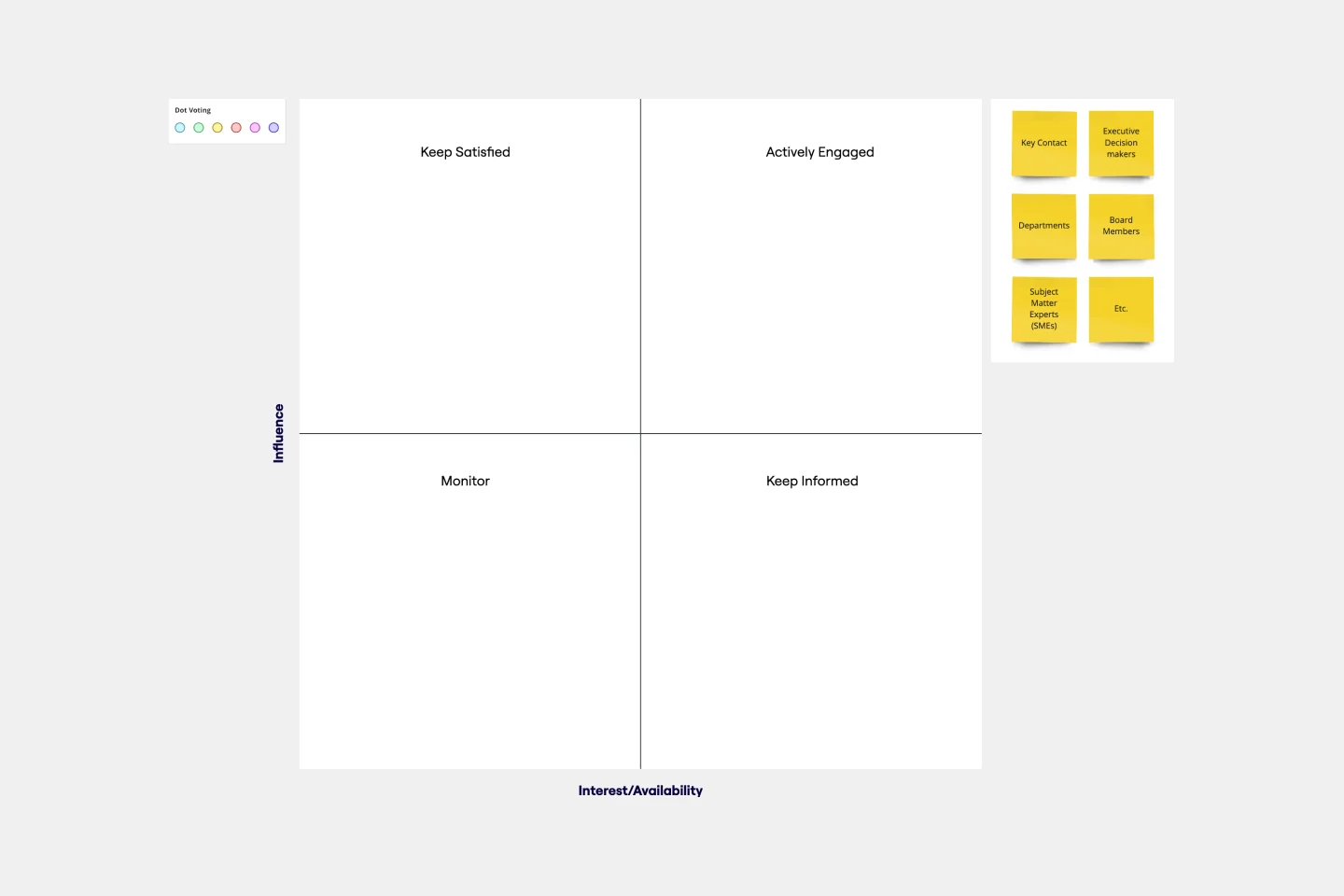
Stakeholder Analysis Template
Managing stakeholders is integral to completing a project on time and meeting expectations, so here’s how to use a stakeholder analysis to help. A stakeholder analysis empowers you to meet expectations and complete projects on time by identifying individuals, groups, and organizations with a vested interest in a program or process. In a typical stakeholder analysis, you’ll prioritize stakeholders based on their influence on a project and seek to understand how best to interface with them throughout the course of the project.