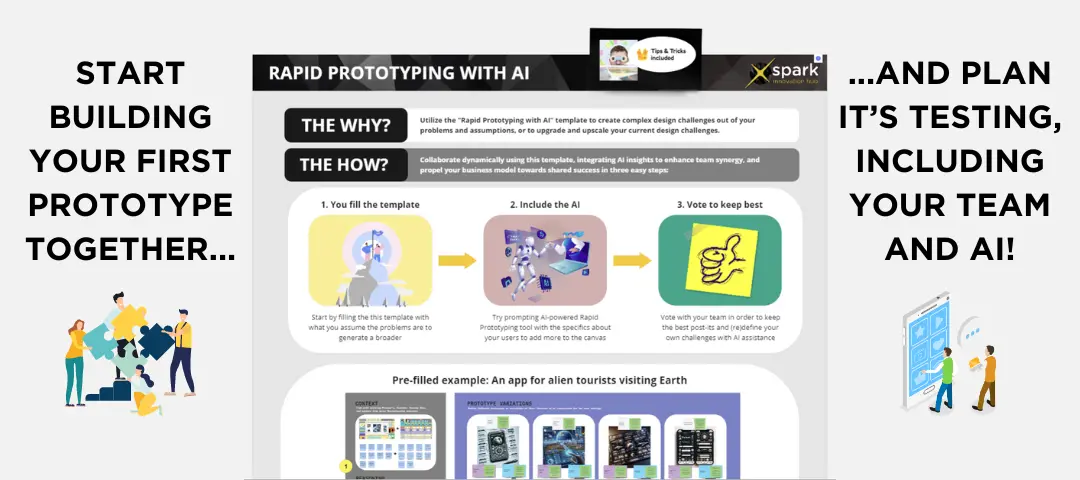
What do you need to learn? Start there.
Choose a practical way to test your idea before investing in further development. The Prototype Planner Matrix helps you explore four approaches to prototyping based on how closely the prototype represents the final experience and how much technical skill it requires.
Move from possible prototypes to one focused test, with a clear learning question, participants, owner and deadline.
Who is this template for?
Product teams, designers, founders, project leads and workshop facilitators deciding how to explore an idea. The plain-language prompts make it accessible to teams with different levels of prototyping experience.
When should you use it?
Use it after brainstorming, before building a prototype or when your team needs to agree on what to test next. It’s useful for discussing whether you need a simple sketch, an interactive experience, a technical model or a small working pilot.
How to use this template
Define what you need to learn. Add your project details and discuss the question your prototype should help answer.
Explore the four boxes. Use the prompts to consider different approaches:
Explore the idea: Use a sketch or storyboard to check whether people understand the concept.
Try the experience: Use a clickable mock-up to observe how people complete a task.
Check if it works: Build a basic technical model to test one essential function.
Test it in practice: Run a small pilot to observe everyday use and gather feedback.
Add possible prototypes. Place your options in the boxes, considering the detail and technical skills each would require.
Plan your next test. Choose one option and complete “Our next test.” Record what you need to learn, what you’ll make or try, who will test it and what you’ll look for. Assign an owner and deadline.
Tip: Start with the question, then choose the prototype. A rough sketch may be enough to explore understanding, while testing a technical function may require a working model.
What you’ll leave with
A shared view of possible prototyping approaches.
One prototype selected for a specific learning goal.
A practical test plan with participants and observations to collect.
Clear ownership and timing.
The positions are starting points, not fixed rules. The skills and detail needed depend on your idea and tools. Choose the simplest prototype that can answer your question.