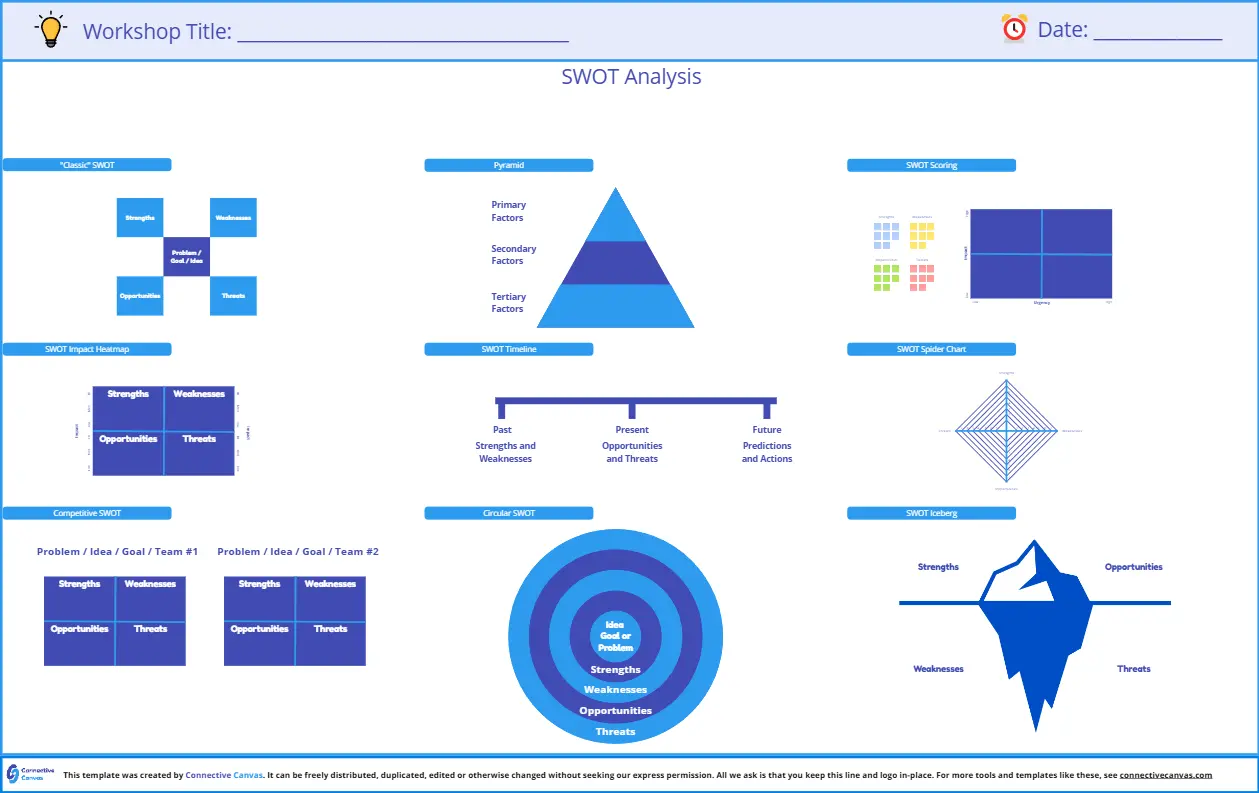
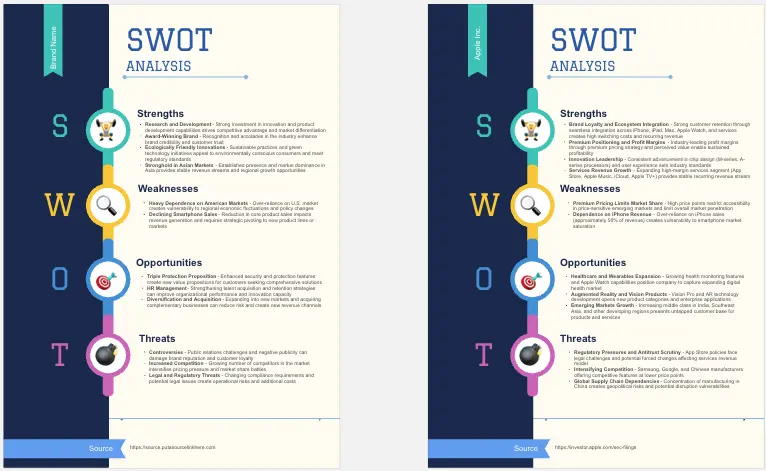
A colourful, two-worksheet board for evaluating a potential new market before you commit significant time, budget, or resources. It combines a classic SWOT analysis with a sustainability lens, helping teams consider business potential alongside the impacts and expectations connected to people, planet, and governance.
What is it for?
Use this template to build a balanced picture of a new market, whether you are expanding into a new country, region, customer segment, or industry. It helps you identify:
Internal strengths you can build on, such as expertise, partnerships, product fit, or supply-chain capability.
Internal weaknesses that need attention before launch, such as missing local knowledge, language support, or operational capacity.
External opportunities, including customer demand, market gaps, partnerships, public incentives, and circular-economy potential.
External threats, such as competition, economic uncertainty, climate exposure, regulation, supply-chain risks, and reputational concerns.
The second worksheet adds a sustainability lens, so teams can check whether their plans create fair outcomes for communities and workers, reduce environmental impacts, and meet expectations for ethical, transparent governance.
Who is it for?
This board is useful for founders, strategy and innovation teams, market-entry leads, product managers, sales and marketing teams, sustainability professionals, consultants, and cross-functional project groups. Use it early in market exploration, during business-case development, or when preparing a go/no-go recommendation.
How to use it
Begin in the SWOT worksheet. Add one idea per sticky note, using the prompts to explore internal capabilities and external market conditions.
Place each note in the relevant quadrant: Strengths, Weaknesses, Opportunities, or Threats.
Discuss the ideas as a group. Combine duplicates, challenge assumptions, and add evidence or sources where possible.
Move to the Sustainability lens worksheet. Tag relevant SWOT notes against People, Planet, or Governance.
Consider regulation, customer expectations, and local context. Ask which sustainability requirements could create an advantage and which could create cost, delay, or risk.
Vote on the factors with the greatest impact on the market-entry decision.
Turn the highest-priority findings into clear next steps: validate an assumption, reduce a risk, build a capability, form a partnership, or adjust the entry plan.