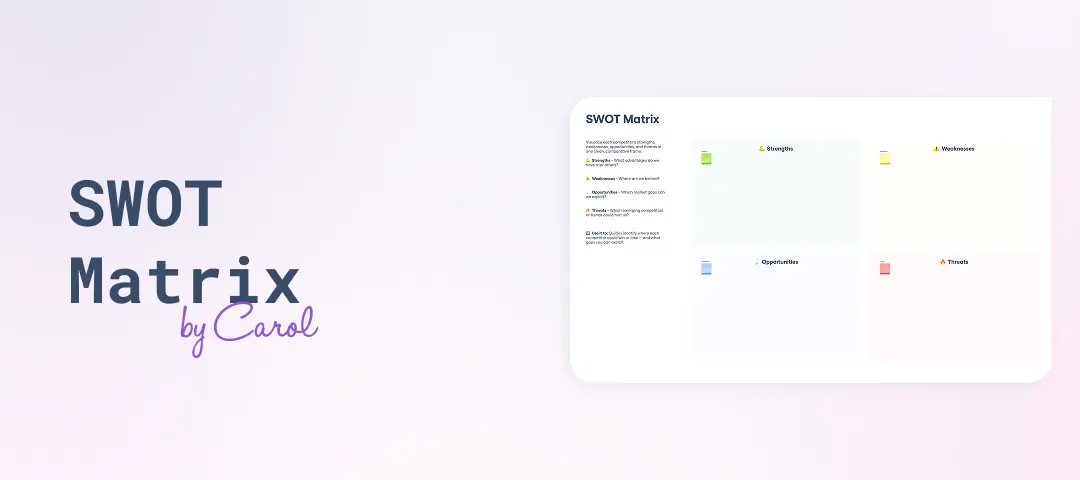
The Better SWOT Canvas is a visual and strategic tool that turns a classic SWOT into something scoreable, taggable, and ready for a real decision.
What's inside this template
An introduction explaining why standard SWOTs produce generic results, and what a scored, tagged version changes.
A guided 5 step canvas layout, from a classic four quadrant SWOT grid to a fully scored and tagged SWOT 2.0.
A worked example that shows generic statements rewritten as specific, evidence based items, then scored, colored, and tagged.
What this template helps you accomplish
Separate generation from evaluation, so nobody self censors while brainstorming and nobody rushes a judgment while still generating ideas.
Isolate the MOAT strengths worth defending and the KEEP weaknesses too structural to fix this quarter.
Separate the WINDOW opportunities actionable now and the FUSE threats already lit from what belongs on the horizon.
Read the grid as clusters by theme instead of 24 isolated notes.
Turn a wall of post its into a tool for real priority, deciding what deserves a plan instead of documenting opinions everyone already agreed on.
Who can use this template
This canvas is especially useful for:
Consultants and facilitators running strategy workshops who need more than four empty boxes.
Leadership teams preparing a business plan, a budget cycle, or a board update who need to justify which weaknesses they're consciously choosing not to fix yet.
Agile coaches and Lean practitioners already comfortable with scoring and prioritization tools.
Anyone who has run a SWOT, gotten "motivated team" and "strong competition" as answers, and wanted something more useful out of it.
Tips and best practices
Keep step 1 (generation) and step 2 (evidence rewriting) as separate sessions if possible, ideas flow differently when nobody is scoring yet.
Score honestly rather than optimistically: a Weakness scored as easily fixable when it isn't will undermine the whole prioritization.
Use the theme tags to spot blind spots, an empty column is often where the real analysis was hiding.