
Table of contents
Table of contents
Product roadmap alignment: How to stop building the wrong things
Summary
In this article, you'll learn:
- Why roadmap misalignment is so costly and so common
- How to standardize product discovery across teams
- How to de-risk big bets before engineering sprints begin
- How real teams use shared context to connect strategy to delivery
- How Miro helps teams align faster and ship with more confidence
This article draws on insights from the How We Work podcast, featuring Łukasz Sągol, Head of Engineering for Intelligent Workflows at Miro. In the episode, Sągol shares how his team thinks about product delivery, cross-functional collaboration, and the role of AI in connecting strategy to execution.
Collaborative AI Workflows
Join thousands of teams using Miro to build the right thing, faster.
Here’s a scenario that plays out on product teams every day: engineering is three sprints deep into a feature when someone in a stakeholder review asks, “Wait, is this still the right thing to build?”
The room goes quiet. The answer, often, is: nobody’s totally sure.
That moment is what roadmap misalignment looks like in practice. Not a dramatic blowup, but a quiet drift between what was planned and what’s actually being built. Requirements shift between discovery and delivery. Assumptions from the kickoff never get tested. Engineering moves forward without full context, and rework quietly becomes part of the process.
The good news? This isn’t a people problem. It’s a process problem. And process problems are solvable.
The real cost of misaligned roadmaps
Misalignment rarely announces itself. It shows up as rework after a sprint review, as an engineer pinging a PM for the third time to clarify a requirement, or as a feature that ships on time but lands flat with users.
According to Miro’s research, 71% of cross-functional product leaders say switching between tools causes friction and interrupts workflows. And 76% agree that most AI tools focus on individual productivity rather than team productivity, which means people are moving faster in isolation, but not necessarily in the same direction.
Łukasz Sągol, Head of Engineering for Intelligent Workflows at Miro, has seen this pattern up close. He’s spent years thinking about how teams get from idea to shipped product, and where they lose momentum along the way.
“I’m really allergic to people having beliefs that they have never had a chance to test or validate,” Sągol said. “I don’t like when we make decisions just because we assume that something is happening.”
That allergy to unvalidated assumptions is at the heart of what good roadmap alignment looks like: a process that surfaces disagreement early, validates direction before committing resources, and keeps everyone, engineering, product, and design, working from the same shared understanding.
Why discovery is where alignment breaks down
Most teams treat discovery as a phase that happens before the “real work” starts. But that framing is the problem. Discovery isn’t upstream of alignment: it is alignment.
Emma Craig, Head of UXR & Content Design at Miro, writes that while 88% of engineering, product, and design leaders say prioritizing the right problems is critical to achieving business goals, only 19% give their companies top marks when it comes to turning customer insights into actionable product recommendations. The gap between knowing what matters and acting on it is where alignment breaks down.
Craig points to three common culprits:
- Fragmented data: Research sits in one tool, feedback in another, plans in yet another, creating massive blind spots.
- Exploration bottlenecks: Design resources are stretched thin, and some teams skip validation entirely, building features directly into production and hoping for the best.
- Cross-functional misalignment: Product, design, and engineering teams are moving faster than ever but operating on their own assumptions, creating friction and rework.
The result, as she puts it, is that “when insight is scattered across tools and teams, the customer’s voice fades into the background.”
How teams lose alignment before a single sprint begins
When discovery is rushed, siloed, or inconsistent across teams, you get roadmaps built on shaky ground. Engineers inherit requirements without context. Designers build on assumptions no one has validated. PMs make prioritization calls without full visibility into technical constraints.
Sągol describes the early stages of a product cycle as a critical window that too many teams race through:
“It’s very difficult to disagree with something when the team has already spent six months building it. And this is the right time. If you’re getting to a kickoff, it should be a fairly quick activity of describing what we believe is the value we can deliver and what the opportunity is.”
His team at Miro runs a step called a “brain dump” before any kickoff: a structured conversation with the people most likely to have useful context on a given problem. It’s not a formal approval meeting. It’s a way of internalizing user research and organizational knowledge before the team even frames the opportunity.
In one case, that single session, talking to Miro’s CEO and CPTO, helped his team narrow the scope of an MCP server project from a potential 12-month effort to a focused two-to-three-month build. The scope got tighter because they surfaced what customers actually cared about: using MCP with Miro to help engineering teams deliver software.
The lesson: before you align on a roadmap, you need to align on the problem. That requires a repeatable, collaborative discovery process, not a one-time kick-off meeting.
Standardizing discovery across teams
When discovery is ad hoc, alignment is accidental. When it’s standardized, alignment becomes something you can build toward deliberately.
Standardizing discovery doesn’t mean making it bureaucratic. It means giving every team a consistent set of touchpoints: moments where assumptions get surfaced, priorities get validated, and the right people weigh in before the work begins.
Sągol’s team at Miro runs discovery through a structured product delivery lifecycle with named stages: brain dump, kickoff, solution review, pre-release, and post-launch review. Each stage has a clear purpose, and crucially, many of them happen asynchronously.
“A lot of those steps for most projects actually end up being shared asynchronously on Slack and then reviewed that way,” he said. “If it’s okay, we just carry on. We don’t wait until we found a space in a calendar to schedule and then probably reschedule because someone had to cancel.”
This matters more than it might seem. Async-first discovery removes calendar bottlenecks, creates a written record of decisions, and makes it easier for distributed or hybrid teams to stay in sync without burning hours in status meetings.
The key is that the process still creates genuine alignment, not just a paper trail. When anyone disagrees, there’s a clear mechanism to flag it. When everyone’s quiet, the team can move forward with confidence.
Putting this into practice with Miro
Miro’s innovation workspace makes it easy to run discovery asynchronously without losing the visual context that makes collaboration meaningful. Teams can use a product roadmap template to map out their thinking, share it across stakeholders for async input, and use Miro AI (via Create with AI) to synthesize sticky notes, workshop outputs, and research insights into structured summaries, turning hours of post-session cleanup into minutes.
GitHub's real success story
GitHub’s product team does exactly this. As part of their “AI for Everyone” initiative, they run strategy workshops in Miro early in the product development lifecycle, mapping personas, synthesizing insights, and defining requirements on the canvas. Miro AI then turns piles of stickies into themed summaries and concise workshop readouts in minutes, work that historically took hours after a session. Those summaries go directly into GitHub Copilot to generate a structured backlog, meaning the path from ideation to prioritized backlog now takes under a day instead of weeks.
De-risking the roadmap before engineering sprints begin
Even with a strong discovery process, teams often hit the same wall: they commit to engineering sprints before they’ve truly validated the solution. The assumption is that design has figured it out. But design assumptions and engineering reality don’t always match, and the gap shows up mid-sprint.
De-risking the roadmap means validating your biggest bets before they go into the sprint queue. That means prototyping earlier, testing assumptions with real users, and creating enough shared context that engineers can hit the ground running rather than asking clarifying questions three weeks in.
Sągol is direct about where this context usually gets lost:
“How can I as an engineer not have to go to my product manager and ask for clarification again? How can I just query that content that’s already been created? How can I be sure that this is the final version of a prototype?”
The problem he’s describing is a common one: discovery generates a lot of useful content, research quotes, sketches, early prototypes, decision logs, but that content gets siloed in different tools and doesn’t make it into the hands of the people building the product.
The solution isn’t more documentation. It’s better shared context. When the same canvas that holds your discovery artifacts becomes the place where you prototype, review, and align, nothing gets lost in translation.
Where Miro Prototypes comes in
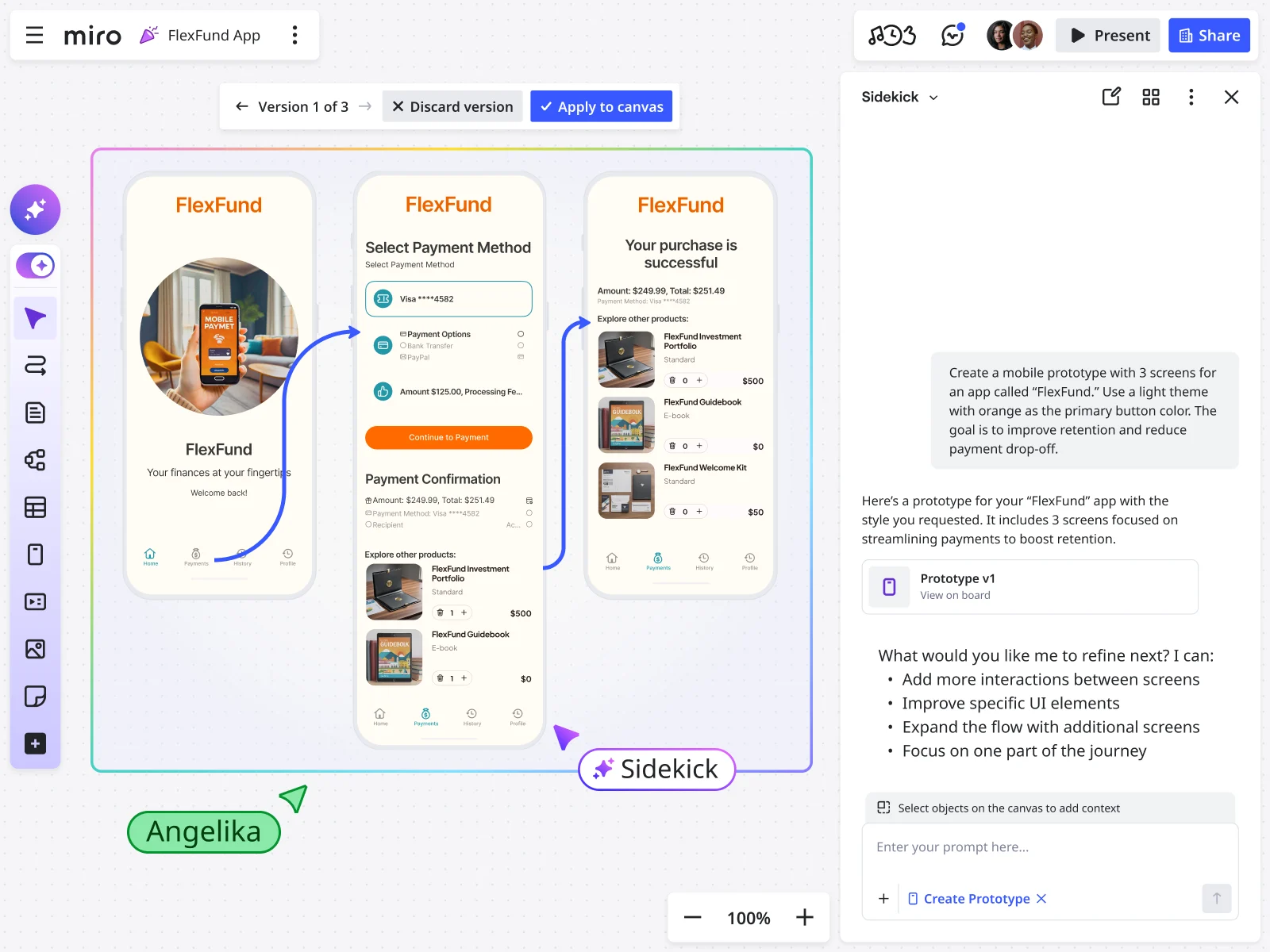
Miro Prototypes (Beta) lets teams create interactive interfaces for apps, websites, and landing pages directly on the Miro canvas, in the same space where discovery happened and where the team already has shared context. Instead of handing off a static spec to engineering, product and design can build a working prototype, gather stakeholder feedback, and iterate, all before a single sprint begins.
This is exactly how Lufthansa Group’s Miles & More program worked. Using Miro Prototypes, the team created, validated, and aligned on the right solution in less than one day.
“I’m way more confident that the things we are implementing for the product are the right things,” said Björn Ehrlinspiel, Product Owner at Miles & More. “Miro Prototypes helps me show my vision to the management team of the product.”
That confidence, knowing you’re building the right thing before engineering commits, is the entire point of de-risking your roadmap.
Connecting strategy to delivery with shared context
One of the hardest things for cross-functional teams to maintain is a clear line from the strategic “why” to the tactical “what.” The roadmap says one thing. The sprint backlog says something slightly different. By the time a feature ships, the original intent can feel miles away.
Sągol sees this as a structural problem: the narrow pipe that all discovery context has to flow through is human-to-human conversation, which doesn’t scale.
“We have all this content that we created, we narrow it down to the right solution, and then we have this very small pipe that all of that needs to flow through, which is the human-to-human interaction, the conversation.”
The answer isn’t to eliminate that conversation. It’s to make sure the artifacts from discovery are available, searchable, and connected to what engineering is actually building.
Red Hat has taken this seriously at scale. With more than 30,000 employees, they needed AI and cross-functional collaboration to become part of how the whole company works, not a pilot that lived in one corner of the org. They use Miro’s collaborative canvas to visualize how their data architecture would unify sources and give AI models consistent, high-quality inputs, bringing stakeholders from design to engineering together before development begins.
The results are tangible: Red Hat consolidated data pipelines from more than 2,000 to just 200, and cut privacy review timelines from weeks or months to days. When strategy and execution live in the same shared space, teams stop asking “what were we trying to build?” and start asking “how do we build it better?”
What aligned roadmap execution actually looks like
Pull all of this together and a clear picture emerges. Roadmap alignment isn’t a one-time meeting or a sign-off ritual. It’s an ongoing process that runs from discovery through delivery, and it depends on teams having a shared space where context doesn’t get lost.
Craig frames it well: “The winners in this new era will be those who use AI and shared context to discover and validate what matters most to customers, and then accelerate the work that brings those ideas to market.” That means combining unified customer insight, early visual exploration, and continuous alignment across the product lifecycle, not just at kickoff.
Here’s what that process looks like in practice:
1. Run a structured brain dump before kickoff
Bring in the people with the most relevant context, technical leads, design, customer-facing teams, before you frame the opportunity. Use a Miro board to capture their input visually and make it available to the whole team.
2. Validate the opportunity before committing to a solution
Use your kickoff to align on why you’re building something, not just what you’re building. Keep it async where possible: share a written summary and give stakeholders a window to flag disagreements.
3. Prototype early and in context
Use Miro Prototypes to build interactive concepts before engineering sprints begin. Gather feedback from stakeholders and real users while it’s still cheap to change direction.
4. Use AI to turn discovery artifacts into usable outputs
Miro AI can synthesize workshop outputs, cluster themes from user research, and generate structured summaries that seed your backlog, so discovery context flows into delivery rather than getting buried in a doc nobody reads.
5. Connect post-launch learning back to the roadmap
Sągol’s team runs a post-launch review on every project: did they validate what they set out to learn? What’s the next investment decision? This closes the loop and makes the whole process smarter over time.
Stop guessing. Start shipping with confidence.
The teams that ship great products aren’t the ones who plan the most. They’re the ones who validate the fastest and keep everyone working from the same shared understanding.
Roadmap alignment isn’t about getting everyone into a room and getting sign-off. It’s about building a process where the right questions get asked early, assumptions get tested before they get expensive, and engineering has everything it needs to build the right thing the first time.
Miro’s innovation workspace is built for exactly this kind of work, connecting discovery to delivery on a shared, AI-powered visual canvas where context doesn’t get lost and teams can move from idea to impact, fast.
Start for free and build your first aligned roadmap in Miro.
Check the full episode below 👇:
Frequently asked questions
What is product roadmap alignment and why does it matter?
Product roadmap alignment is the process of ensuring that engineering, product, and design teams share a common understanding of what to build, why, and in what order. It matters because misalignment between teams is one of the most common causes of rework, missed deadlines, and features that land flat with users. When everyone works from the same shared context, from discovery through delivery, teams spend less time course-correcting and more time shipping things customers actually care about.
What causes roadmap misalignment in cross-functional teams?
Roadmap misalignment usually comes down to three things: discovery that happens in silos, assumptions that never get validated before engineering begins, and context that gets lost as work moves between tools and teams. Research sits in one place, feedback in another, and prototypes somewhere else entirely. By the time a feature reaches engineering, the original intent is often unclear or out of date. Standardizing discovery and keeping all context in a shared workspace helps prevent this drift before it becomes expensive.
How do you validate a product roadmap before committing to engineering sprints?
The most effective way to validate a roadmap is to prototype early and test assumptions with real users before any sprint begins. This means building lightweight, interactive concepts that stakeholders and customers can react to, gathering feedback while changes are still cheap, and using that input to refine priorities. Teams that skip this step often discover problems mid-sprint, when the cost of changing direction is much higher. Tools like Miro Prototypes make it possible to go from concept to clickable prototype in minutes, directly on the same canvas where discovery happened.
How can teams standardize product discovery across different squads?
Standardizing discovery means giving every team a consistent set of checkpoints, not a rigid process that slows them down. That might include a structured brain dump before kickoff, an async alignment step where stakeholders can flag disagreements, a solution review before committing resources, and a post-launch review to close the learning loop. Running these steps asynchronously, with a shared visual workspace as the record of truth, makes it easier for distributed teams to stay in sync without adding unnecessary meetings.
How does Miro support product roadmap alignment?
Miro brings the entire product development process onto a single shared canvas, from early discovery and research synthesis through prototyping, stakeholder alignment, and delivery planning. Create with AI helps teams turn workshop outputs and research insights into structured summaries and backlog-ready content. Miro Prototypes lets teams validate ideas interactively before engineering sprints begin. And product roadmap templates give teams a visual starting point for mapping priorities and communicating direction across the organization. Because everything lives in one place, context doesn't get lost as work moves from discovery to delivery.
Does Miro integrate with other product development tools?
Yes. Miro integrates with a wide range of tools used across engineering, product, and design workflows, including Jira, Azure DevOps, GitHub, Figma, Slack, and more. This means teams can connect their Miro boards to the tools where execution happens, keeping strategy and delivery in sync without duplicating work across systems. Enterprise customers also have access to advanced security and compliance integrations. You can explore the full list of integrations at miro.com/integrations.
Is Miro suitable for enterprise product teams?
Yes. Miro is built for teams of all sizes, including large enterprise organizations with complex cross-functional needs. It offers enterprise-grade security and compliance features, including SSO, two-factor authentication, data residency options, and role-based access controls. Over 250,000 enterprises worldwide use Miro to manage everything from product discovery to delivery. For teams with more advanced data security requirements, Miro Enterprise Guard provides additional governance and classification capabilities.
Author: Miro team
Last update: March 11, 2026
Read more
Join our 100M+ users today


