




Andrey
See collaborative AI in action — straight from the Canvas 26 keynote.
Jeff

Process mapping for financial services teams

Map your audit trails, approval flows, and compliance handoffs in one shared canvas. Skip the static PDFs that go stale the moment the process changes.

Miro board displaying a swimlane flowchart titled 'Credit application review process' with three horizontal lanes for Representative, Manager, and Risk department, featuring blue rectangular process steps, yellow diamond decision nodes, and black circular start/end terminators connected by arrows.

What experts say

  • Process mapping gives organizations a start-to-finish look at their workflows, making it easier to grasp how everything works behind the scenes.

    ABBYY Content Team

    Marketing and Product Specialists · ABBYY

    Practitioner
  • Process mapping allows businesses to identify dependencies and touchpoints between different processes and departments.

    VisionEdge Marketing Team

    Marketing Analysts · VisionEdge Marketing

    Keynote Speaker

The research on process mapping

  • 30-50%

    Business Process Management (including process mapping) delivers 30-50% productivity gains

    Source: Forrester

  • 20%

    Process mapping reduced non-value-adding activities by 20%

    Source: Hospital Material Management Quarterly (Savory & Olson)

See process mapping in action

Related templates for financial services teams

We have 168 templates in our library for Process Mapping.

Why financial services teams choose Miro for process mapping

  • Audit prep that's always ready

    Controllers and risk officers spend audit cycles chasing documentation scattered across shared drives and outdated diagram files. Map your month-end close, variance review, and reconciliation workflows in Miro's Diagramming Mode, then export to PDF or Markdown for the auditor handoff in one click. The map stays live and accurate between cycles, whether you're a five-person accounting team or a 500-person compliance org.
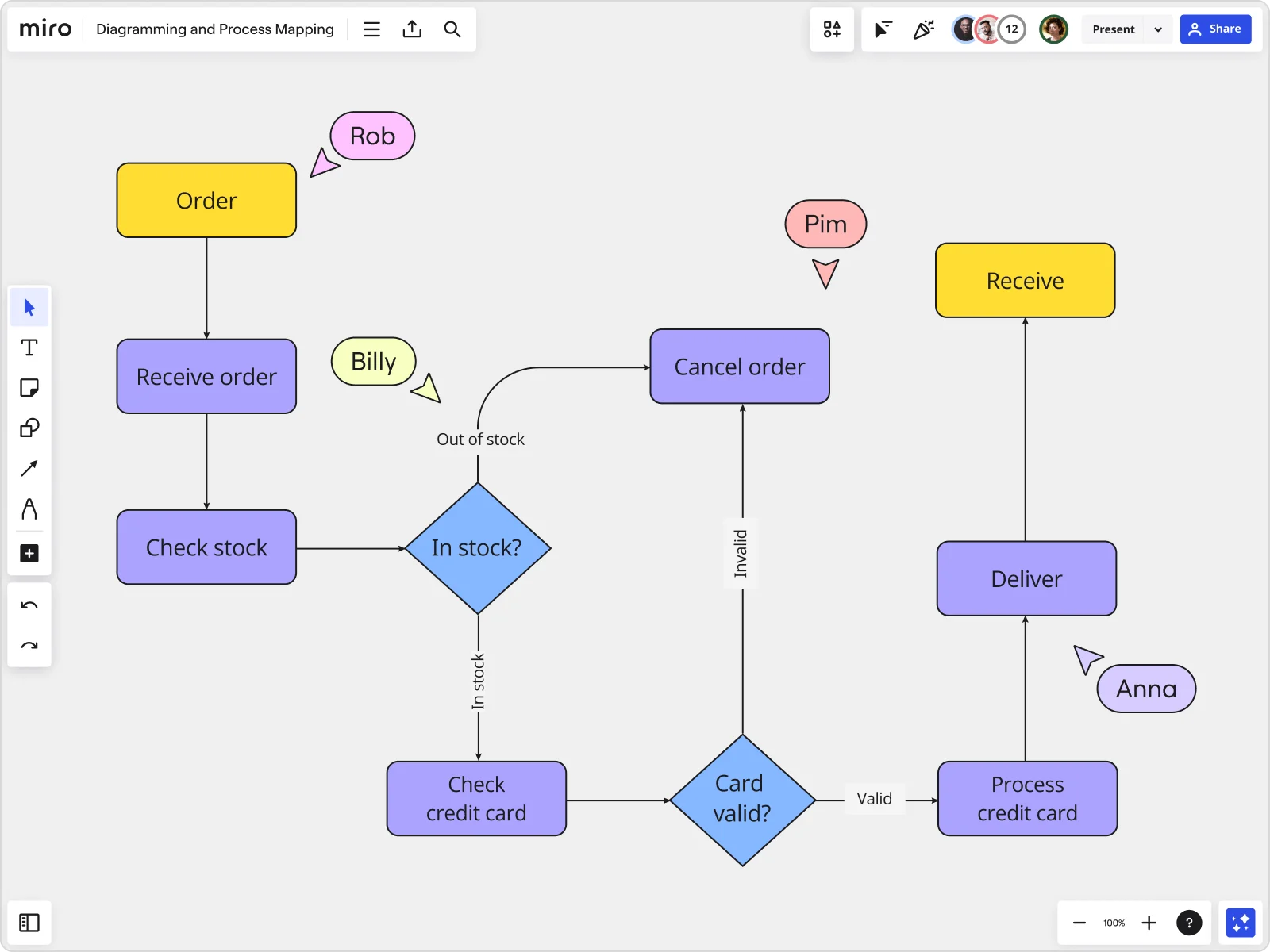
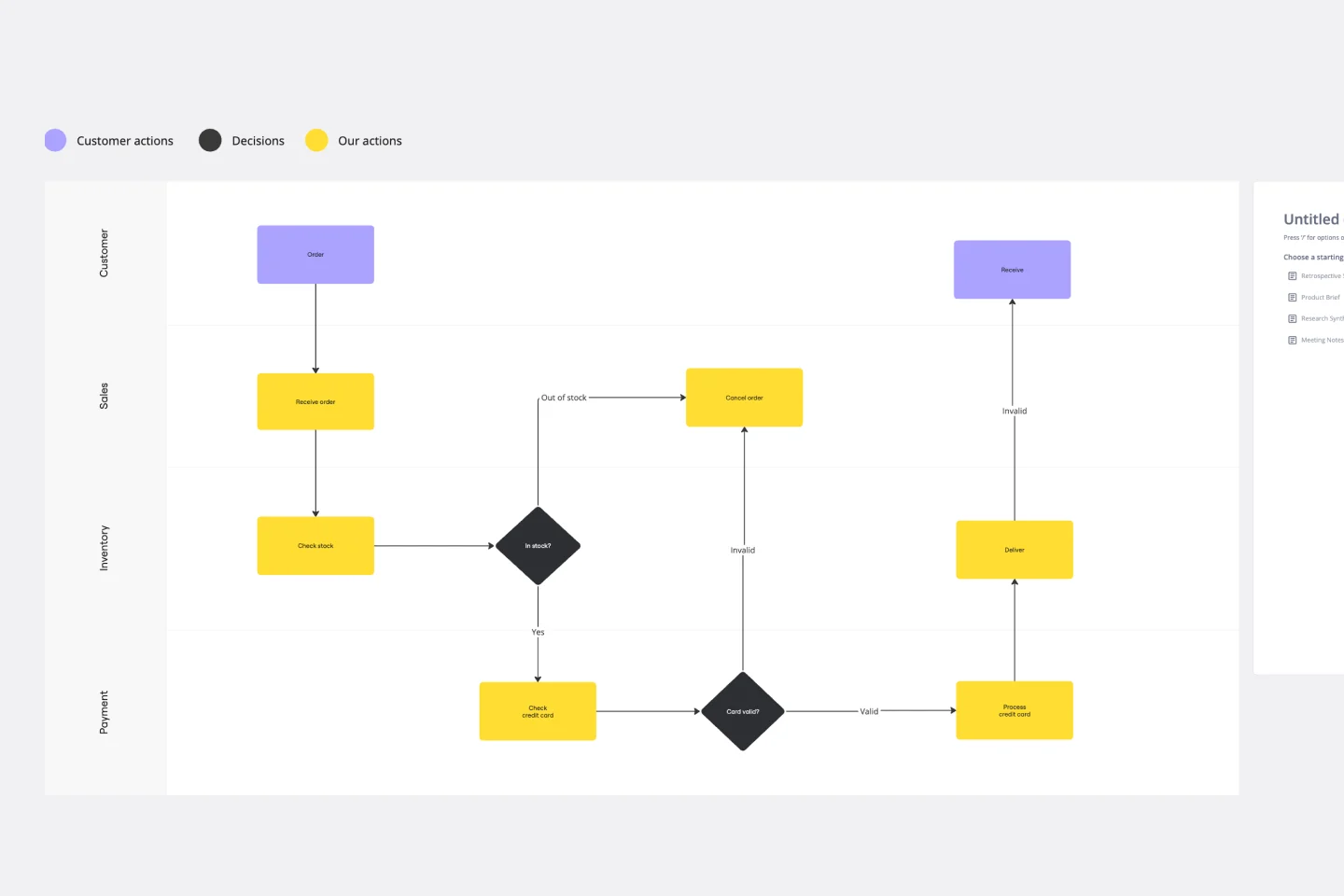
    Miro board displaying a detailed order processing flowchart with colored decision diamonds (blue) for 'In stock?' and 'Card valid?' checks, purple process blocks for steps like 'Receive order', 'Check stock', 'Check credit card', 'Process credit card', 'Deliver', and 'Cancel order', a yellow 'Order' start block and 'Receive' end block, plus named collaborator cursors (Rob, Billy, Pim, Anna) visible on the canvas.
  • Bring your existing diagrams with you

    Years of process documentation don't have to mean years of rebuilding. Import your existing diagram files directly into Miro with shapes, connectors, and layout intact. Compliance leads, FP&A analysts, and operations managers can then edit together in real time. No starting from scratch.

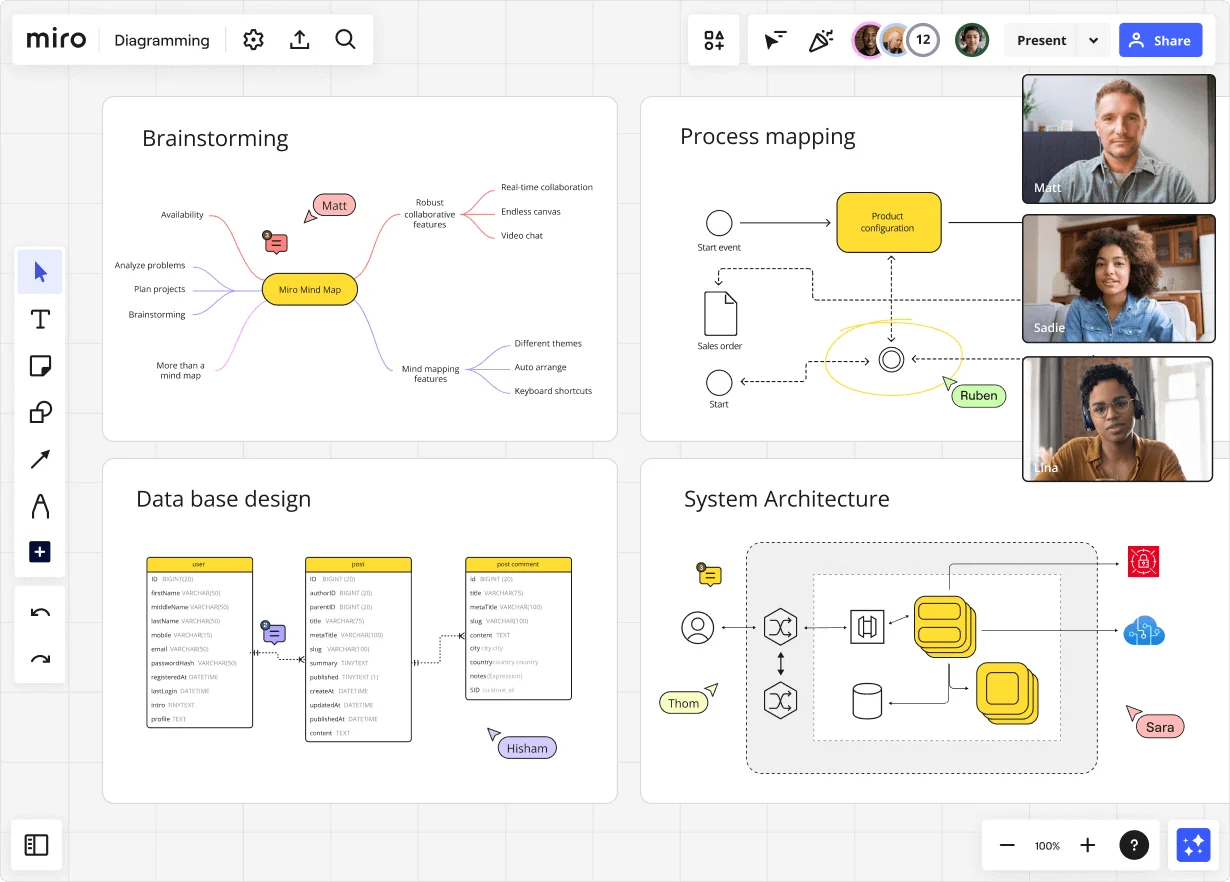
    Miro diagramming board showing four active workspaces: a mind map centered on 'Miro Mind Map' with feature branches, a BPMN-style process mapping flowchart with 'Product configuration' decision node, a database ER diagram with three related tables (user, post, post comment), and a system architecture diagram with interconnected components — all with visible collaborator cursors (Matt, Sadie, Ruben, Lina in video panel, plus Hisham, Thom, Sara as cursor labels).
  • Update your control framework fast when regulations change

    A new requirement drops and your current-state controls map is instantly wrong. Use swimlane layouts to separate treasury, compliance, and credit operations ownership, then update the master once. Miro's Synced Copies propagate the change to every sub-process board within seconds. Smaller teams fix the flow before the next standup. Larger orgs govern who can edit without forking the source of truth.

    Miro board displaying a BPMN process mapping diagram with two swimlanes (Customer and Online Shop), showing decision gateways, message events, and task boxes for an order/offer workflow including 'Send offer', 'Accept offer', 'Decline offer', 'Send Payment', 'Receive Confirmation', and 'Receive Decline' steps, with the BPMN shapes panel open on the left.
  • Prioritize the bottlenecks that matter most

    After your process review workshop, you've got scattered input and no clear consensus on priorities. Run Miro's structured ranking activity to score pain points across your budget approval, credit adjudication, and onboarding flows. Walk out with a prioritized list your CFO and compliance leads can act on.

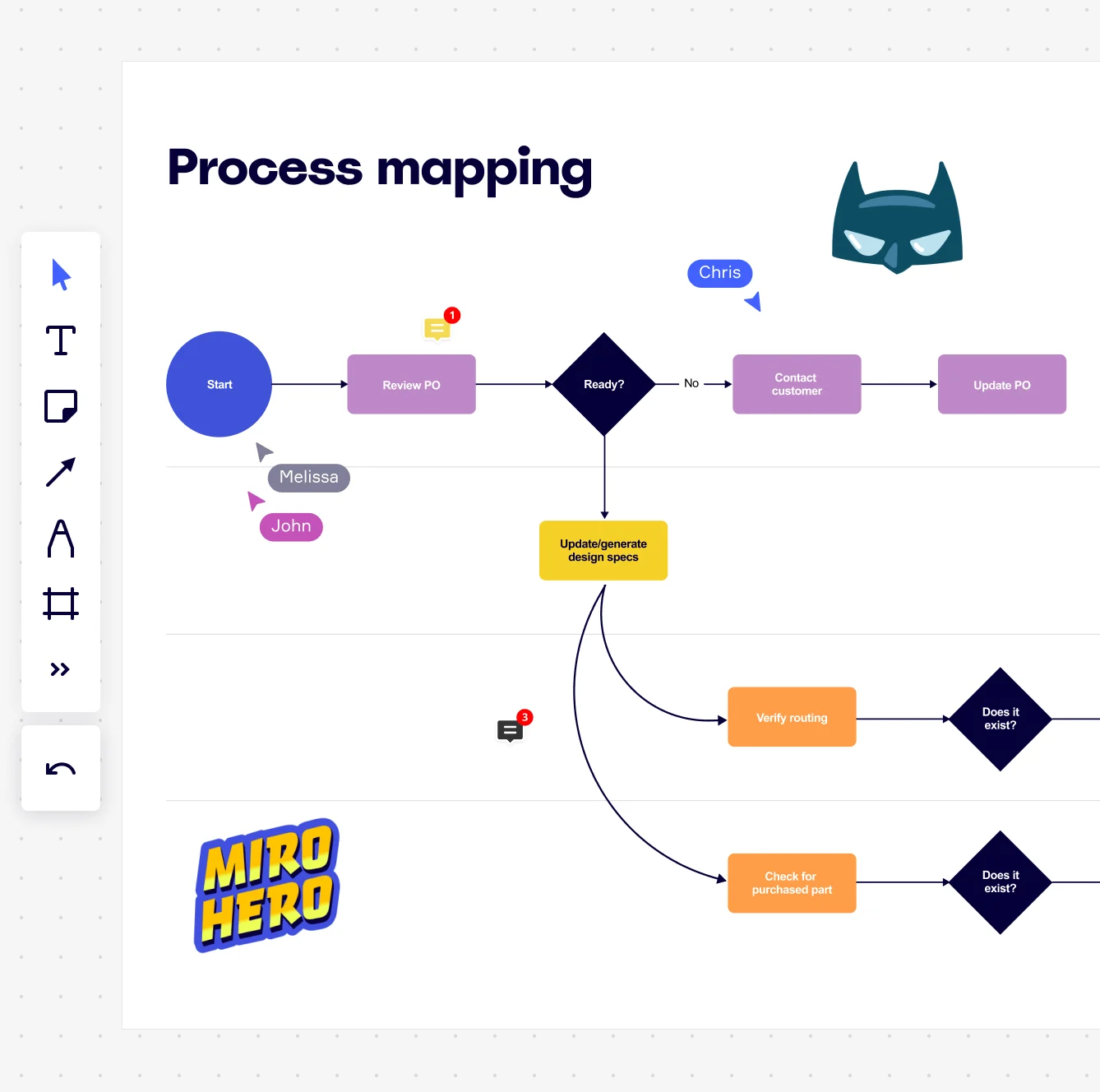
    Miro board displaying a process mapping flowchart with labeled nodes including Start, Review PO, a Ready decision diamond, Contact Customer, Update PO, Update/generate design specs, Verify routing, and Check for purchased part, with collaborative cursors (Chris, Melissa, John), comment badges, and decorative Batman and Miro Hero stickers.
  • Build the leadership readout without rebuilding the deck

    Generate your operations readout directly from your process-map frames using Miro's AI Slides, with brand colors pre-applied. Embed the live process map into Confluence or your team wiki via /miro so the CFO's read-out and the working canvas always reference the same source.

    Miro process mapping board displaying a cross-functional flowchart with circular process nodes (Process 1.0, 1.1, 2.0), decision paths (Yes/No branches leading to 'Accept offer' and 'Decline offer'), and rectangular action steps including 'Send payment', 'Receive Confirmation', 'Receive Decline', and 'Process', connected by solid and dashed arrows.

How financial teams get started with Process Mapping in Miro

  • Map a real compliance workflow first

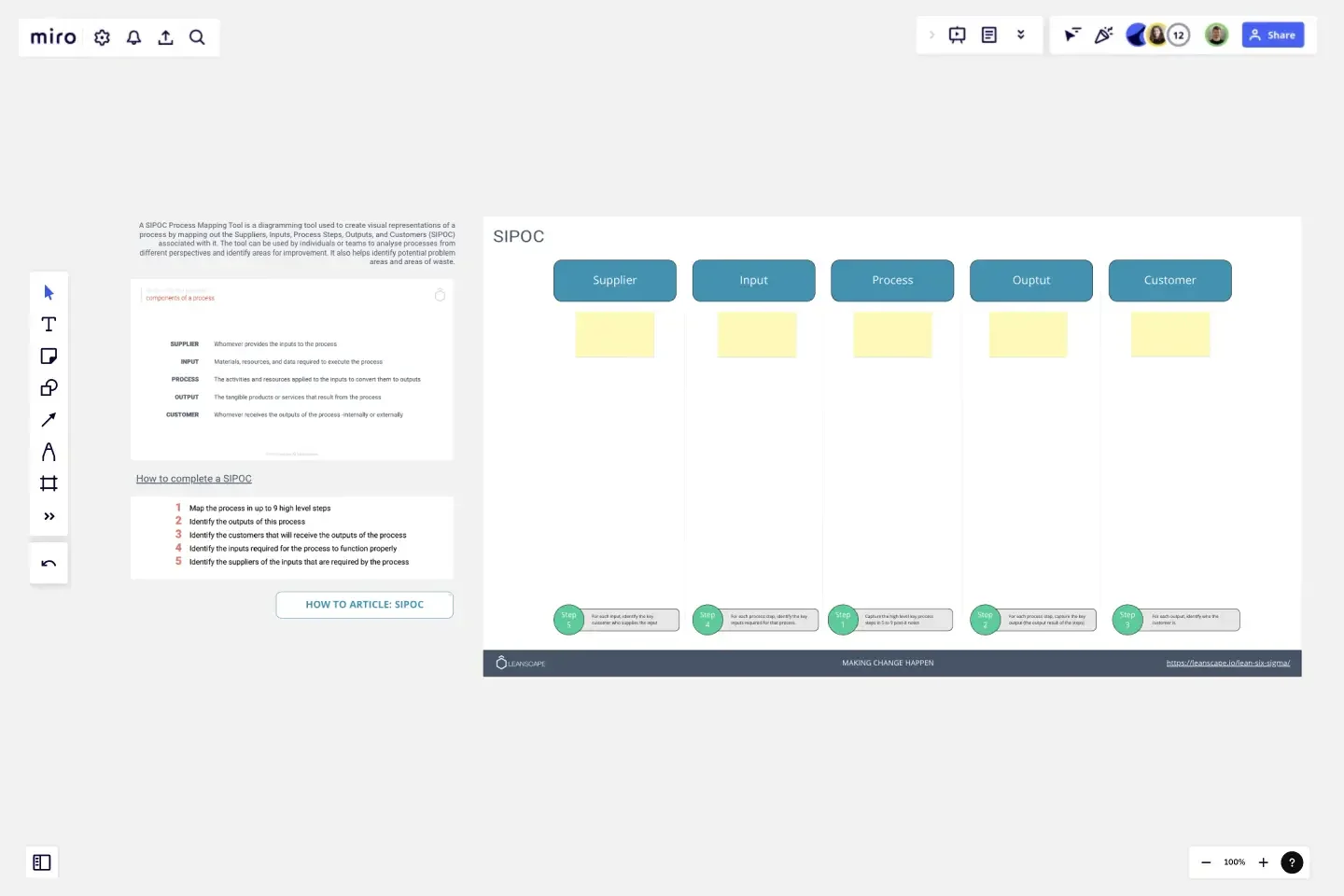
    Open a SIPOC Template from Miro's Template Library and sketch your highest-stakes regulatory process - think KYC onboarding, loan approval, or trade settlement - so your first map reflects what actually happens on the floor, not what the procedure manual says.

  • Build your swimlane in Diagramming Mode

    Switch to Diagramming Mode and add Swimlane lanes for each function involved - front office, compliance, risk, operations - then use Smart Connectors to wire up handoffs and decision points, making accountability gaps visible before they become audit findings.

  • Attach live data to every bottleneck

    Use External Embeds to pull in your Power BI or Excel process-metrics dashboards directly onto the board, so when the compliance team flags a step as a pain point via Comments, the cycle-time data is right there to back it up.

  • Lock the validated map as your audit-ready source of truth

    Once sign-off is in, set the Default View to the finalized process diagram and lock it, then embed the map into Confluence via the Confluence Integration so every auditor, regulator, or new analyst lands on the approved version - not a stale copy from last quarter's folder.

Process Mapping tips for financial services teams

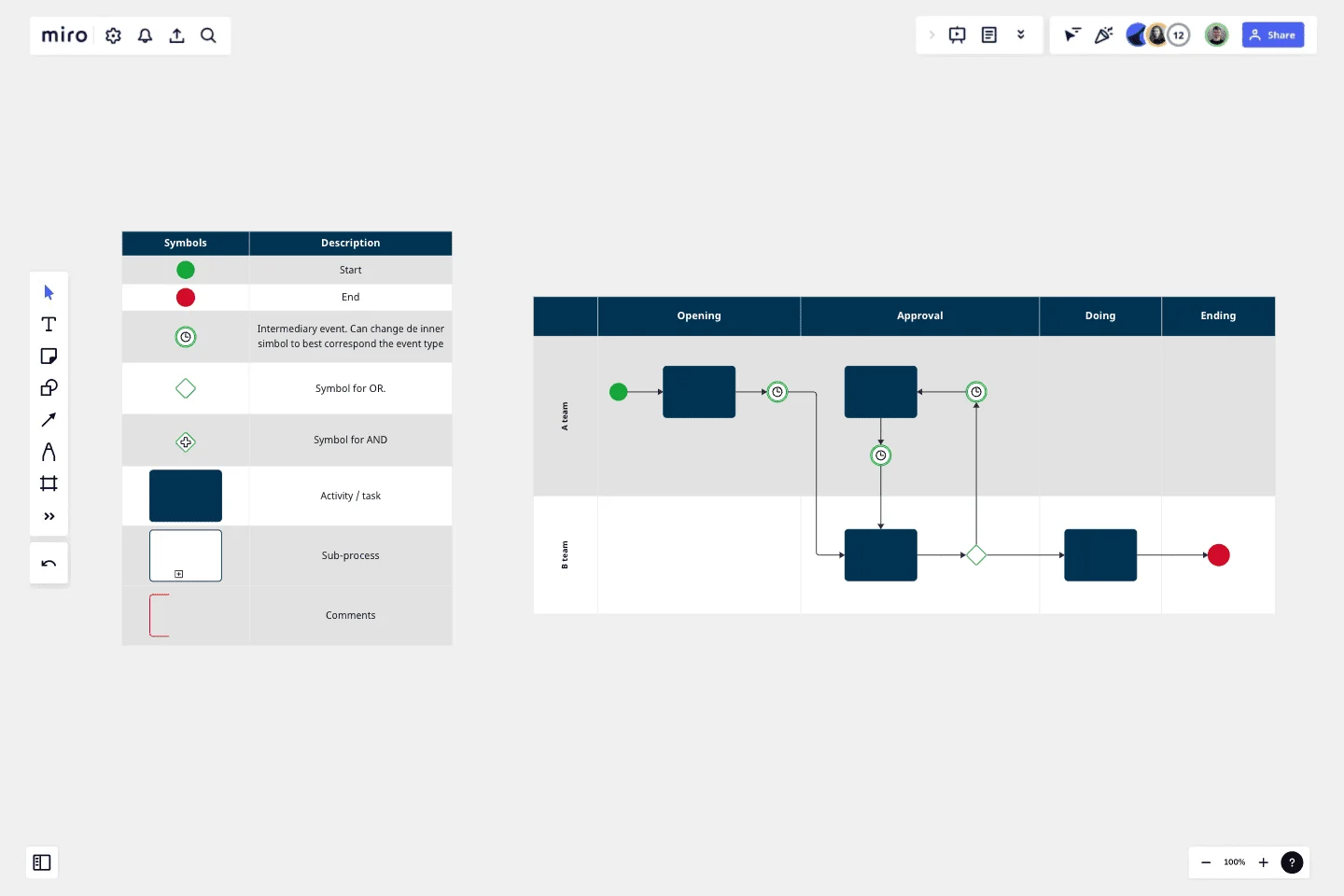
  • When mapping for regulatory review, use BPMN Shape Packs instead of generic flowcharts - notation-correct diagrams hold up under a compliance officer's scrutiny in a way that hand-drawn boxes simply don't.

  • For large financial institutions rolling this out across multiple business lines, use Synced Copies to push the master process map to each sub-process board, so a change to the settlement workflow propagates everywhere within seconds rather than spawning five divergent versions.

  • If your risk or operations team already has process diagrams in Visio, use Diagram Import to bring them into Miro rather than rebuilding - it keeps institutional knowledge intact and gets compliance analysts collaborating on the real map from day one.

Understand how financial services teams transform their work

  • Streamlining financial planning with Miro

    Verified User

    G2
  • Perfect tool to visualize and trace back complex input from multiple stakeholders aiming the objective of enhancing corporate processes.

    Verified User

    G2

Process Mapping essential guide for financial services teams

CategoryKey insights
  • Common mistakes to avoid

    The most common trap for analysts and compliance leads alike is mapping the process as it's written in policy, not as it actually runs on the floor. In financial services, that gap is where audit findings live. Whether you're a two-person fintech ops team or a large bank with dozens of process owners, agree on scope before you draw a single shape. Without a clear start and end point, your current-state map will keep growing until it's too big to present to anyone.

  • Key integrations for financial services teams

    Connect Miro to Jira to link each process improvement directly to a ticket, so nothing gets lost between the whiteboard and the backlog. Confluence keeps your documented workflows living alongside the policies and runbooks that compliance and ops teams already reference daily. If your organization runs formal process documentation in Visio or Lucidchart, Miro's import support means analysts don't have to rebuild diagrams from scratch.

  • When to use it

    Use this when a regulatory change, an audit finding, or a new product launch forces banking and capital markets ops teams to document exactly how a process runs today before anyone touches it. For example, a compliance team preparing for a SOX audit could map their month-end approval workflow in Miro using BPMN notation, validate it with department heads in a live session, and then design a future-state flow that removes redundant sign-off loops. It works equally well for a small credit union streamlining loan origination as it does for a large insurer mapping multi-department claims handling across regions.

  • Security & Compliance

    For financial services teams, SOC 2 Type II certification means Miro meets the baseline audit-readiness standard that most risk and compliance sign-offs require before a tool gets approved. Enterprise organizations with data residency requirements, SSO mandates, and granular admin controls will find those controls built in, not bolted on. Use Private Mode when mapping sensitive workflows around client data, transaction flows, or internal controls that shouldn't be visible to every board participant.

Frequently asked questions for financial services teams

Last updated: Thursday, June 25, 2026