
SAFe vs LeSS — what's the difference? And how to choose the right framework
Summary
In this guide, you will learn:
- The Scaled Agile Framework (SAFe) is a structured approach to implementing agile practices at enterprise scale.
- SAFe offers four configurations to accommodate different organizational scales.
- The framework emphasizes alignment, collaboration, and delivery across multiple agile teams.
- Large-Scale Scrum (LeSS) is an alternative scaling framework focused on simplifying organizational complexity.
- SAFe is popular for enterprises needing a prescriptive, top-down approach to scale agile.
- Implementation of SAFe involves a 12-step roadmap for continuous improvement.
Collaborative AI Workflows
Join thousands of teams using Miro to build the right thing, faster.
When it comes to scaling Agile practices across multiple teams, choosing the right framework is crucial. Two prominent frameworks designed for this purpose are SAFe (Scaled Agile Framework) and LeSS (Large-Scale Scrum).
In this article, we’ll compare SAFe vs LeSS and help you decide which one suits your team’s needs and goals. Let’s dive in.
What is SAFe?
SAFe stands for Scaled Agile Framework. It is a comprehensive Agile framework designed to scale Agile practices across large enterprises.
This framework provides detailed guidance across multiple levels, including team, program, and portfolio. It aims to align business goals with development work while managing complex interdependencies across multiple teams. SAFe introduces roles like Release Train Engineer and System Architect to help facilitate coordination and ensure alignment with business objectives.
What is LeSS?
LeSS stands for Large-Scale Scrum. It is a lightweight framework built on the principles of Scrum.
Designed to scale Scrum practices across multiple teams working on the same product, LeSS retains Scrum’s simplicity by minimizing additional roles, events, and artifacts. The framework promotes collaboration and shared responsibility among teams, making it a flexible approach that allows organizations to scale without adding unnecessary complexity.
Key differences between SAFe and LeSS
When choosing between SAFe and LeSS, it’s important to understand how they differ in structure, roles, and approach. Below, we explore the main differences to help you make an informed decision.
Structure and complexity
SAFe is more structured with detailed guidance at multiple levels, while LeSS is simpler and emphasizes autonomy.
Roles and responsibilities
SAFe introduces additional roles for coordination across teams, whereas LeSS keeps Scrum roles with minimal extra layers.
Decision-making approach
SAFe follows a top-down decision-making process, while LeSS emphasizes decentralized decision-making and team autonomy.
Benefits of SAFe
SAFe offers a structured approach that benefits organizations looking for comprehensive, scalable frameworks to support large-scale projects. Below are the main advantages of implementing SAFe in your organization.
Scalable and structured
SAFe offers detailed guidance across all levels of the organization, making it suitable for large-scale projects with complex interdependencies.
Aligns with business goals
It helps align development work with strategic business objectives, ensuring teams focus on the most valuable tasks.
Cross-team coordination
Roles like Release Train Engineer ensure that teams are well-coordinated, especially in complex, cross-functional projects.
Supports complex projects
SAFe is designed to manage large-scale projects and multiple teams, making it ideal for enterprises with complex needs.

Benefits of LeSS
LeSS offers a simpler, more flexible approach that allows teams to scale Scrum practices without adding unnecessary complexity. Here are the main benefits of using LeSS.
Retains Scrum simplicity
LeSS keeps Scrum’s core principles intact, making it easier for teams already familiar with Scrum to scale without significant changes.
Promotes team autonomy
The framework empowers teams to make decisions collaboratively, fostering a high level of autonomy and ownership.
Minimizes added complexity
LeSS avoids the additional roles and ceremonies seen in other frameworks, keeping the process simple and focused on delivering value.
Ideal for Scrum adopters
LeSS is particularly effective for organizations that have already embraced Scrum and are looking to scale their practices across multiple teams.
Best practices for implementing SAFe
When implementing SAFe, it’s important to follow certain best practices to maximize the framework’s effectiveness.
Align early with business goals
Ensure that strategic business objectives are clearly communicated and aligned with the teams from the start.
Foster collaboration
Encourage cross-functional teams to collaborate, communicate, and share information to minimize bottlenecks.
Scale incrementally
Start small with a few teams, gather feedback, and gradually scale the framework to fit your organization's needs.
Best practices for implementing LeSS
To effectively implement LeSS, it’s important to adopt best practices that focus on simplicity, collaboration, and team empowerment.
Maintain clear communication
Transparency is key in LeSS. Ensure teams have access to all necessary information and encourage open, honest communication.
Enable cross-team collaboration
Foster collaboration between teams to solve problems together, ensuring alignment on goals and progress.
Scale gradually
Start small and scale LeSS incrementally. Use feedback to refine processes as the framework expands across teams.
Scale your Agile events with Miro
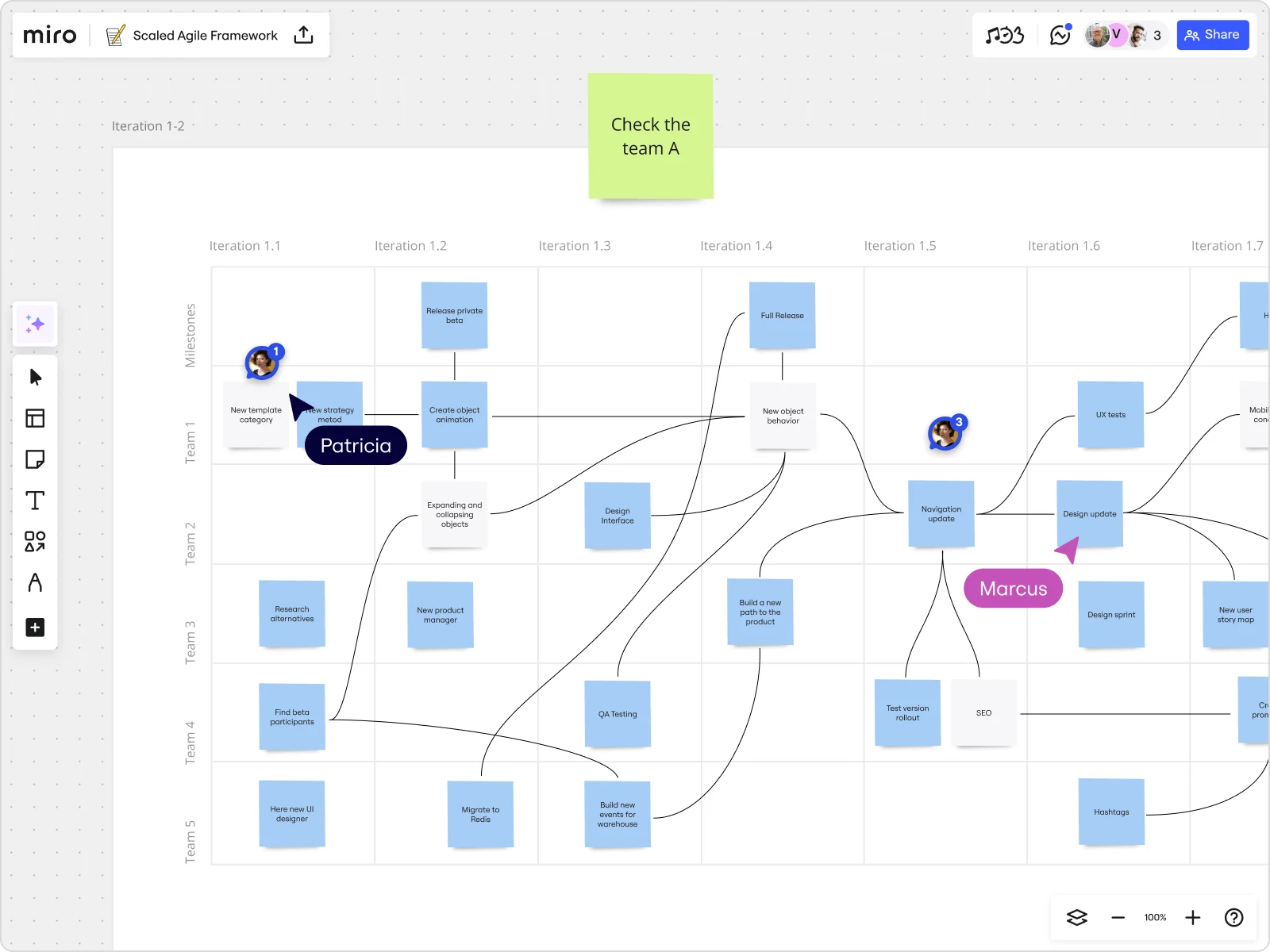
Miro’s innovation workspace comes with powerful and intuitive Agile tools to streamline your workflows — including real-time and async collaboration features to align teams, customizable Agile templaes to kickstart your work, and two-way syncs with Jira and Azure to unify your workflows.
Sign up today to get started.
Author: Miro Team
Last update: October 1, 2025
Read more
Join our 100M+ users today


