
Table of contents
Table of contents
How to value backlog: a guide for Agile teams
Summary
In this guide, you will learn:
- What a product backlog is and its role
- How to prioritize backlog items
- The process and importance of backlog refinement meetings
- How to organize and sort backlog tasks
- Ways to collaborate with teams using tools like Miro
- Best practices for maintaining and updating the backlog
Collaborative AI Workflows
Join thousands of teams using Miro to build the right thing, faster.
Understanding how to value your backlog is crucial for effective project management. In this guide, we'll explore the significance of backlog valuation, the factors that influence it, and the best practices to ensure your Agile team stays on track.
What is a backlog and why is it important
A backlog is a prioritized list of tasks and requirements that need to be completed within a project. It serves as a roadmap for your team, ensuring that everyone is aligned on what needs to be done and in what order. Proper backlog management helps in maintaining focus, improving productivity, and delivering value to stakeholders.
What does backlog valuation mean
Backlog valuation involves assessing the worth of the tasks in your backlog. This process helps in prioritizing tasks based on their potential impact and value to the project. By valuing your backlog, you can make informed decisions about where to allocate resources and effort.
Example: Imagine a software development team working on a new feature for their application. They have a backlog of tasks that includes bug fixes, new feature requests, and technical debt. To value their backlog, they assess each task based on criteria such as customer impact, revenue potential, and alignment with strategic goals. For instance, a task to fix a critical bug that affects many users might be valued higher than a task to add a minor feature requested by a few users. By assigning a value to each task, the team can prioritize the critical bug fix over the minor feature, ensuring that their efforts are focused on the most impactful work.
Factors influencing backlog value
Several elements can affect the value of your backlog, let's dive deep on a few of them.
Project complexity
Project complexity can significantly impact the value of tasks in your backlog. Complex tasks often require more resources, time, and expertise to complete. This can make them more valuable if they are critical to the project's success. However, they can also be riskier due to the potential for unforeseen challenges and delays. Understanding the complexity of each task helps in making informed decisions about prioritization and resource allocation.
Resource availability
The availability of resources, including team members and tools, plays a crucial role in backlog management. When resources are limited, it becomes essential to prioritize tasks that can be completed with the available resources. This ensures that the team remains productive and that high-priority tasks are not delayed due to resource constraints. Regularly assessing resource availability helps in adjusting the backlog to reflect current capabilities and constraints.
Market demand
Tasks that align with current market needs or customer demands often hold higher value. By focusing on these tasks, teams can ensure that their work is relevant and impactful. Market demand can fluctuate, so it is important to stay informed about industry trends and customer feedback. This allows for timely adjustments to the backlog, ensuring that the most valuable tasks are prioritized.
Methods for valuing backlog
There are different approaches to valuing your backlog, here are some of them:
- Cost-based methods: Estimating the cost of completing each task. Cost-based methods involve estimating the cost of completing each task in the backlog. This includes considering the time, resources, and potential risks associated with each task. By understanding the cost implications, teams can make more informed decisions about which tasks to prioritize. This method helps in balancing the budget and ensuring that resources are allocated efficiently.
- Market-based methods: Assessing the potential market impact of each task. Market-based methods assess the potential market impact of each task. This involves evaluating how completing a task will affect the product's market position, customer satisfaction, and overall business goals. Tasks that are expected to have a significant positive impact on the market are given higher priority. This approach ensures that the team's efforts are aligned with strategic business objectives.
- Value-based methods: Prioritizing tasks based on their expected value to the project or organization. Value-based methods prioritize tasks based on their expected value to the project or organization. This involves considering factors such as customer satisfaction, revenue potential, and strategic alignment. By focusing on high-value tasks, teams can maximize their impact and contribute to the overall success of the project. This method helps in ensuring that the most important tasks are completed first.
How to calculate the current estimated backlog

Valuing a backlog for Agile teams involves a systematic approach to ensure that the most critical and valuable tasks are prioritized. This process helps teams focus their efforts on work that delivers the highest impact. Here’s a step-by-step guide to calculating the current estimated backlog:
Data Collection
The first step in valuing your backlog is to gather all relevant data on tasks. This includes their status (e.g., to-do, in-progress, done), complexity (e.g., story points, t-shirt sizes), and dependencies (e.g., tasks that must be completed before others can start). Ensure you have a comprehensive list of all tasks, whether they are bug fixes, new feature requests, or technical debt. This data collection phase is crucial as it forms the foundation for your analysis and estimation.
Analysis
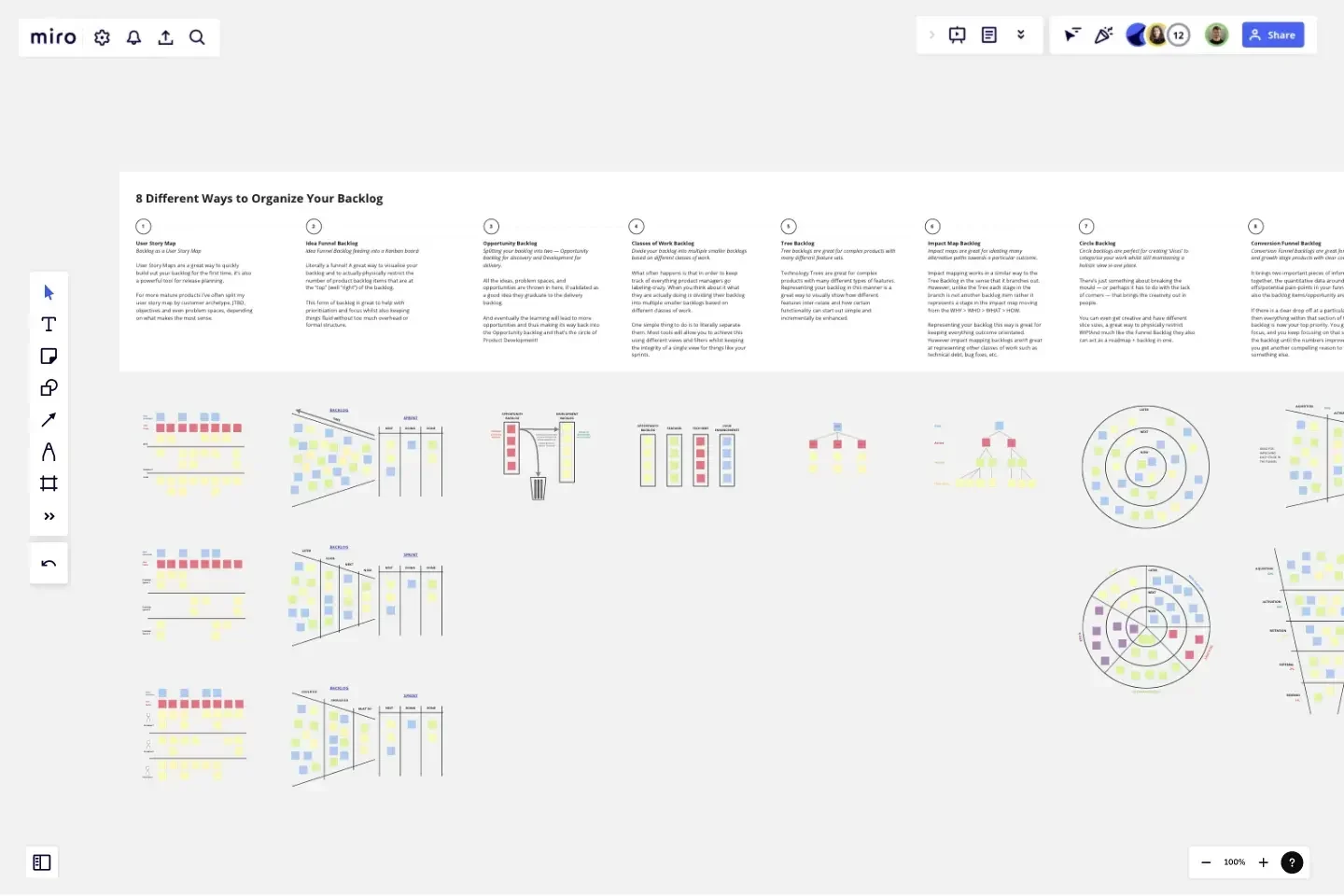
Once you have collected the data, the next step is to analyze it. Use tools like Miro's innovation workspace to visualize and analyze the data. Miro can help you create a clear picture of your backlog, making it easier to identify patterns and dependencies. This step is crucial for understanding the scope and nature of the tasks at hand. By visualizing the backlog, you can spot bottlenecks, redundant tasks, and opportunities for improvement. Use can use one of templates available on our collection to get started faster, like the 8 ways to organize your backlog created by Anty Murphy.
Estimation
With a clear understanding of your backlog, you can now apply your chosen valuation technique to estimate the value of each task. This could involve assessing tasks based on criteria such as customer impact, revenue potential, and alignment with strategic goals. For example, you might prioritize a task that fixes a critical bug affecting many users over a task that adds a minor feature requested by a few users. Estimation helps in assigning a quantifiable value to each task, making it easier to prioritize them effectively.
Example
Imagine a software development team working on a new feature for their application. They have a backlog of tasks that includes bug fixes, new feature requests, and technical debt. To value their backlog, they assess each task based on criteria such as customer impact, revenue potential, and alignment with strategic goals.
For instance, a task to fix a critical bug that affects many users might be valued higher than a task to add a minor feature requested by a few users. By assigning a value to each task, the team can prioritize the critical bug fix over the minor feature, ensuring that their efforts are focused on the most impactful work.
By following these steps, you can effectively estimate and manage your backlog, ensuring that resources and efforts are allocated to the most valuable tasks.
Tools for backlog management
Several tools can help you manage and value your backlog effectively. These tools offer various features that facilitate task organization, prioritization, and collaboration:
- Miro: Our AI-powered visual canvas supports real-time and asynchronous collaboration, making it easier to track and prioritize tasks. Miro’s visual approach helps teams see the big picture and make informed decisions.
- Jira: A popular tool for Agile teams, offering robust backlog management features. Jira allows for detailed tracking of tasks, user stories, and sprints, making it a comprehensive solution for Agile project management.
- Trello: A user-friendly tool for organizing and prioritizing tasks. Trello’s card-based system is intuitive and flexible, making it suitable for teams of all sizes.
Best practices for backlog valuation
Here are some tips to manage and value your backlog effectively:
- Regular refinement: Continuously update and refine your backlog to keep it relevant. Regular backlog grooming sessions help ensure that the backlog reflects the current priorities and project goals.
- Prioritization: Focus on high-value tasks that align with your project goals. Use criteria such as customer impact, revenue potential, and strategic alignment to prioritize tasks.
- Collaboration: Use tools like Miro to facilitate team collaboration and ensure everyone is on the same page. Effective communication and collaboration are key to maintaining a well-managed backlog.
Common challenges in backlog valuation
Valuing your backlog can be challenging due to several factors:
- Changing Priorities: Market demands and project goals can shift, affecting task value. Agile teams must be adaptable and ready to re-evaluate their backlog as priorities change.
- Resource Constraints: Limited resources can make it difficult to prioritize tasks effectively. Teams need to balance their workload with the available resources to avoid overcommitting.
- Complexity: High complexity tasks can be hard to estimate accurately. Estimating complex tasks requires careful consideration and often involves breaking down tasks into smaller, more manageable pieces.
By understanding and addressing these challenges, Agile teams can improve their backlog valuation process and ensure that they are working on the most valuable tasks.
Try Miro for effective backlog management
Ready to optimize your backlog? Try Miro's innovation workspace to streamline your backlog management and boost your team's productivity. Start valuing your backlog today.
Author: Miro Team
Last update: October 14, 2025
Read more
Join our 100M+ users today


