Table of contents
Table of contents
By signing up, you agree to Miro's Terms of Service and Privacy Policy.
Round robin brainstorming: Get every voice heard (without the meeting drag)
Summary
Round robin brainstorming is a structured technique where team members take turns contributing ideas independently, then building on each other's thinking before discussion. Unlike traditional brainstorming where the loudest voices dominate, round robin ensures every person—from junior designers to senior engineers—gets equal input. The result: better ideas, faster decisions, and teams that actually want to participate.
What you'll learn in this guide:
- How round robin brainstorming works and why it outperforms traditional brainstorming
- Step-by-step instructions for running sessions in Miro (20-30 minutes, 6-8 people optimal)
- Three variations: divergent (maximum creativity), risk identification (vetting ideas), and async (distributed teams)
- Common mistakes that kill the technique—and exactly how to avoid them
- How to make it work for remote and hybrid teams across time zones
- When to use round robin vs. other brainstorming methods
- Practical FAQs covering security, integrations, and getting started
Key benefits:
- Eliminates groupthink by giving everyone silent thinking time before discussion
- Levels personality differences—introverts and extroverts contribute equally
- Removes peer pressure through written rounds instead of verbal showdowns
- Produces documented ideas that flow directly into project execution
- Works for any problem: product decisions, technical architecture, go-to-market planning, process improvements
Time investment: 30 minutes to run your first session. Templates and step-by-step guides included.
Round robin brainstorming technique
Nothing shuts down good ideas faster than meetings where only a few people talk and everyone else just checks their phones.
In most brainstorming sessions, the loudest person shares an idea right away. Everyone focuses on it, and if the VP likes it, few people speak up with other options. The junior designer might have a great idea but waits for the right time to share. The backend engineer notices a technical problem but assumes someone else will bring it up.
You walk out with one half-baked idea instead of the 12 perspectives your team actually has.
Round robin brainstorming fixes this. It’s a structured technique that extracts ideas from every single person on your team—the loud ones, the quiet ones, the ones who need time to think. No endless meetings. No idea monopolies. Just your team’s actual best thinking, fast.
What is round robin brainstorming?
Round robin brainstorming is a method where everyone takes turns sharing ideas, building on each other’s thoughts before any group discussion starts.
Here’s how it works: Everyone writes down their first idea on their own. Then, the ideas are passed around the group. Each person reads someone else’s idea and either adds to it, points out risks, or connects it to something new. After a few rounds, the group discusses everything together. The discussion happens at the end, not the beginning.
Unlike regular brainstorming, no one talks over others or gets ignored. The first idea isn’t the only one that matters.
When teams use round robin:
Product teams use it to prioritize features without the roadmap turning into whoever lobbied hardest. Engineering teams use it to troubleshoot architecture problems and catch issues before they’re expensive. Design teams use it to explore multiple UX directions instead of falling in love with the first concept. Cross-functional teams use it to align on strategy when everyone’s coming from different contexts.
It works for teams in the same room passing index cards, for remote teams using a shared online workspace, and for hybrid teams with people in the office and others joining from home in different time zones.
Why round robin actually works
Let’s talk about what’s broken in traditional brainstorming.
Groupthink kills innovation before it starts
The first person to speak often sets the direction for the whole conversation. This is called anchoring bias. Stanford researchers found that people are most creative when they start by working alone, not in a group. Round robin gives everyone a chance to think on their own before coming together. Everyone comes up with their first idea at the same time, quietly, without being influenced by others.
Personality differences create invisible barriers
Some people like to think out loud, while others need more time to process. When you add in things like seniority (junior team members may not want to disagree with senior staff), language differences, and introversion, many ideas never get shared.
Round robin makes things fair. People who need time to think before speaking get that chance. The junior designer’s idea is considered just like the VP’s. Even the engineer who doesn’t like to interrupt gets a voice.
Peer pressure stifles honest feedback
If the VP likes an idea, it’s hard for others to raise concerns. Writing down feedback removes that pressure. You can point out a possible problem without feeling like you’re ruining the mood. This way, you get honest feedback, not just agreement.
The business impact (in terms you actually care about)
For product managers: Faster consensus on priorities, fewer revisits after stakeholder feedback.
For engineering leads: More technical perspectives surface early, fewer costly reworks mid-sprint.
For design teams: Broader range of concepts explored before committing to one direction.
For executives: Better team engagement scores, visible progress in weeks instead of months.
How to run a round robin brainstorming session in Miro
Here’s exactly how to do this, step by step.
Before the session (5 minutes of setup)
1. Define your problem statement clearly
This is where most brainstorms go wrong before they start. Vague problems generate vague ideas.
Bad: “How do we improve the product?” Good: “How might we reduce onboarding time from 3 days to 3 hours for new enterprise users?”
Use “How Might We” framing. It keeps questions open-ended while staying specific about the problem you’re solving.
2. Set up your Miro board
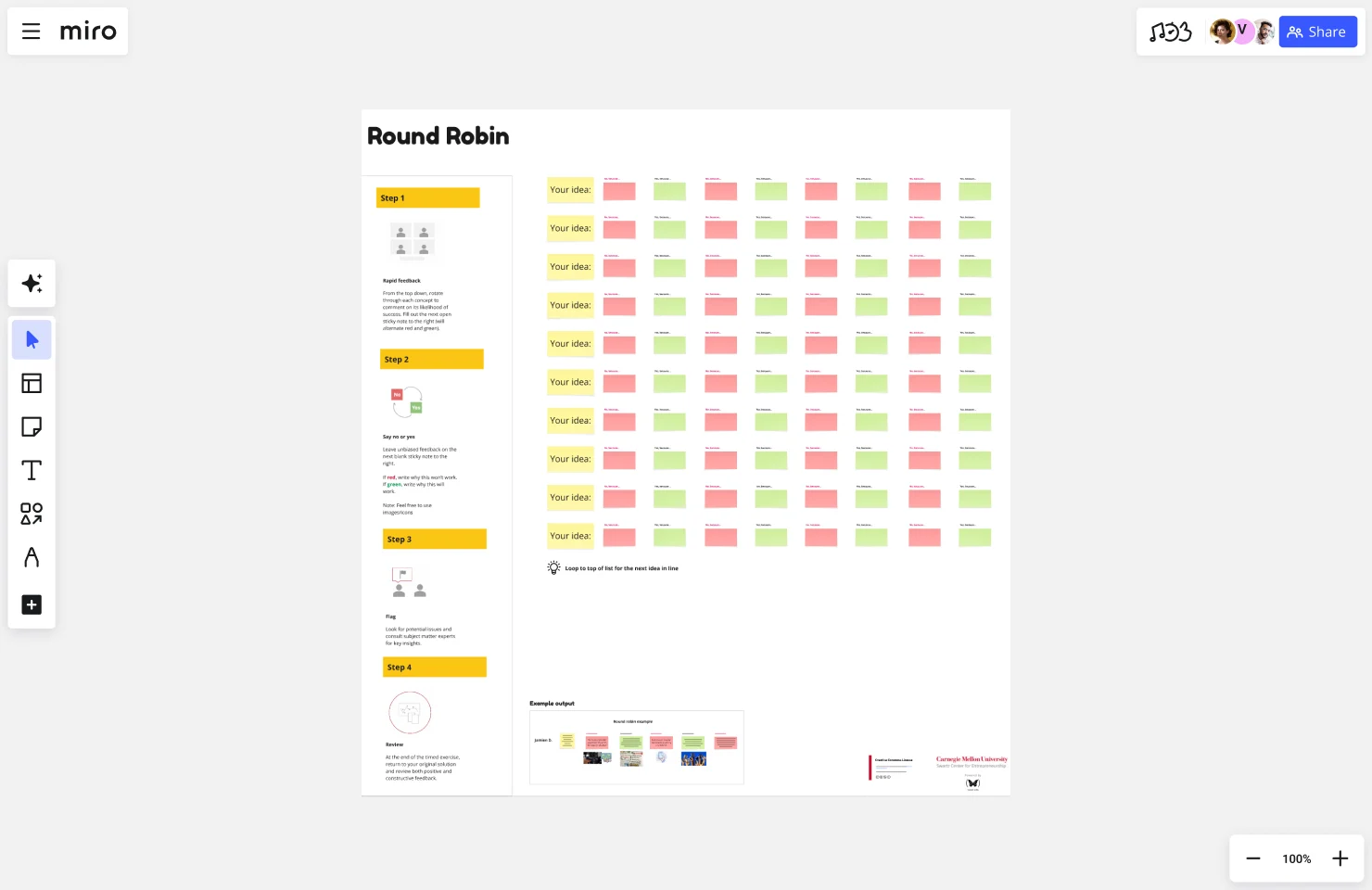
Grab the Round Robin template to start with a structure that works. You’ll get designated areas for each round, clear instructions for participants, and built-in features like timers and voting.
Create clear sections:
- Problem statement at the top (visible throughout)
- Individual ideation area for Round 1
- Building zones for Rounds 2-3
- Clustering area for discussion
- Action items section at the bottom
With an infinite canvas, you won’t run out of space, even when eight people are adding ideas at the same time.
3. Invite the right people (6-8 is optimal)
If the group is too small, you miss out on different viewpoints. If it’s too big, things slow down. Having a mix of roles always works better than a group where everyone has the same background.
Send the Miro board link ahead of time. Let people know what to expect: structured rounds, silent work, then discussion.
Round 1: Individual ideation (5 minutes)
Everyone writes their initial idea independently. No talking. No peeking at what others are writing.
In Miro, each person takes a sticky note and adds it to their own section. Focus on making your idea clear, not perfect—rough ideas are totally fine.
Set a timer (Miro has one built in) for 5 minutes. When time’s up, everyone stops writing.
Round 2: Pass and build (10-15 minutes)
Now it gets interesting. Each person’s idea is passed to someone else, either in order or at random.
Read the idea you received, then add to it. You can:
- Build on it with an addition or enhancement
- Identify a risk, challenge, or blocker
- Connect it to another concept or existing initiative
Add your input as a new sticky note in a different color. In Miro, you can quickly pick a new color for each round.
Pass again. Repeat 2-3 times depending on your group size and time available.
What’s happening: Ideas are getting stress-tested, expanded, and combined. The idea that started as “improve onboarding” might now have technical considerations, UX enhancements, and connection points nobody would have thought of in isolation.
Miro advantage: You can see what everyone’s working on in real-time. Cursors show you where people are active.
Round 3: Discussion and clustering (10 minutes)
Bring everyone back together. Time to talk.
Start by grouping similar ideas visually. Drag sticky notes near each other to create clusters. You’ll start seeing themes emerge.
Use Miro’s frames to define clear groupings. Label each cluster.
Then discuss:
- Which ideas got the most development?
- Where do you see unexpected connections?
- What risks surfaced that you didn’t anticipate?
Use Miro’s voting feature to quickly prioritize without lengthy debate. Everyone gets 3-5 votes. In 30 seconds you’ll see what resonates with the group.
Try using Miro AI to find themes across all your sticky notes. It can spot patterns you might miss and highlight common threads. The AI works right on your board, so you don’t need to export anything.
Action planning (5 minutes)
Pick your top three to five ideas and assign them to specific people. Don’t just say, “the team will look into this”—make sure each idea has a name and a deadline.
In Miro, convert your sticky notes to action items. Tag people, set due dates, and link directly to project management tools. If you’re using Jira, Asana, or Monday, the integration means your brainstorm flows straight into delivery.
The board becomes your single source of truth. Share the link with stakeholders. Anyone who wasn’t in the session can see the full evolution.
Three round robin variations for different goals
Match the variation to what you’re trying to accomplish.
Variation 1: Divergent round robin (for maximum creativity)
When to use it: Early ideation. Product discovery. Campaign concepting. Anywhere you need volume and variety.
How it works: Each round focuses purely on generating NEW ideas. No building, no criticism, just quantity. Keep going until you’ve done 3-4 rapid rounds.
Time: 2-minute rounds. Speed forces your brain into unfamiliar territory.
In Miro: Use the timer to keep rounds moving fast. Bulk sticky note mode lets you create multiple ideas quickly.
Variation 2: Risk identification round robin (for vetting ideas)
When to use it: After you have initial concepts but before you commit resources. Technical architecture decisions. Launch planning.
How it works: Start with 3-4 solid ideas. Pass them around, but this time each person ONLY adds potential risks, blockers, or challenges.
Why it works: You identify problems before you’re too invested to change course.
In Miro: Use red sticky notes for risks, yellow for cautions, green for opportunities. The color coding makes it instantly visible where challenges concentrate.
Variation 3: Asynchronous round robin (for distributed teams)
When to use it: Your team spans multiple time zones. You need thoughtful input over speed.
How it works: Set a 24-48 hour window. Structure it in clear phases:
- Day 1 (by 5pm): Everyone adds their initial idea
- Day 2 (by 5pm): Everyone builds on 2-3 others’ ideas
- Day 3 (by noon): Vote on top directions
- Day 3 (3pm): Live discussion session to finalize
In Miro: The platform handles real-time and async collaboration on the same board seamlessly. Notifications keep people looped in without requiring them to constantly check the board.
Use Miro AI to create summaries of what happened between rounds, so people can quickly catch up when they return.
Common round robin mistakes (and how to fix them)
Mistake 1: Skipping the silent phase
The problem: You just defeated the entire purpose. The silent phase is where introverts get equal footing, where independent thinking happens.
The fix: Enforce it. “For the next 5 minutes, no talking. Just write.”
Mistake 2: Vague problem statements
The problem: Scattered ideas that don’t build on each other.
The fix: Make it specific and measurable. Include context about who you’re solving for and what success looks like.
In Miro: Pin your problem statement at the top of the board in a frame that stays visible as people scroll.
Mistake 3: No clear facilitator
The problem: Structure collapses, and you’re back to whoever’s most assertive running the show.
The fix: Assign someone to facilitate. Their job is to keep time, enforce structure, and redirect when things drift.
Mistake 4: Stopping at ideas
The problem: Teams get cynical fast. Why contribute your best thinking if it’s going nowhere?
The fix: Always end with owners and next steps. Ideas without execution timelines are just wishes.
The follow-up that matters:
- Within 24 hours: Recap sent with all ideas documented
- Within 48 hours: Owners confirm their assignments
- Within 1 week: First action completed (even if small)
- Within 2 weeks: Team check-in on progress
Making round robin technique work for remote & hybrid teams
Traditional round robin with physical index cards doesn’t work when your team is distributed across continents.
Tool choice actually matters
You need real-time collaboration without lag. Everyone needs equal ability to contribute—someone on mobile shouldn’t be fighting the interface.
What works in Miro:
- No software installation—just send a link
- Works across devices (laptop, tablet, mobile)
- Real-time cursors show you where everyone’s working
- Frame-based navigation guides people through the board
Async capability becomes critical
When your team spans London, New York, and Singapore, there’s no great meeting time. Async round robin solves this with clear phases and deadlines.
Structure and deadlines: “Do this when you can” becomes “nobody does it.” “Do this by Tuesday 5pm local time” gets done.
Visual organization prevents chaos
When 8 people are adding sticky notes simultaneously, things get messy fast. Use clear sections, color coding, and frames from the start. The Round Robin template already has this built in.
Miro’s infinite canvas helps because you never run out of space. If one area gets crowded, just expand or move clusters apart.
Engagement tactics shift
In a physical room, you can read body language. Remotely, you lose those signals.
Tactics that work:
- Use reactions—emojis, comments, highlighting—to keep energy up
- Have people add a 👍 to ideas they’re excited about
- Use comments for quick questions instead of interrupting the flow
- Between rounds, do quick verbal check-ins
Miro AI advantage: Analyze patterns across all contributions and surface themes you might not spot manually. Particularly useful in remote settings where you don’t have everyone physically standing around pointing at clusters.
"Miro is a must-have product for each product team today. I see how it evolved just from a "sticky notes whiteboard" to a one-stop shop for designing, brainstorming, planning and presentation tool both for solo users and collaboration with the team."
Product Manager Source: Gartner Peer Insights.
Round robin vs. other brainstorming techniques
When round robin beats traditional brainstorming:
You have personality imbalances—mix of loud and quiet people. You need documented output. You’re remote or hybrid. The problem needs diverse perspectives, not just volume.
When traditional brainstorming wins:
You need lightning-fast decisions. Your team already has high psychological safety. Building energy and momentum matters more than documented ideas.
Better together: Combining techniques
Start with divergent round robin to generate possibilities → narrow with dot voting → deep dive with traditional discussion on the top 3.
Use async round robin for research phase → synchronous workshop for synthesis.
The technique serves the work, not the other way around.
Getting started: Your first round robin session
Don’t overthink this. Pick a real problem you’re facing this week and try the technique.
Start small:
- Real problem: Something your team actually needs to solve
- Small group: 5-6 people
- Short time: 30 minutes
- Proven template: Use the Round Robin template
Set yourself up for success:
Send the problem statement 24 hours ahead. Let people think about it before the session starts.
Let people know what to expect. Say, “We’re using round robin: structured rounds, quiet work, then discussion. It takes 30 minutes total.”
Stick to the structure the first time. Don’t skip any steps. Try it as designed so you can see how it works.
Debrief afterward: What worked? What felt clunky? What would you change next time?
The template gives you: Problem statement area, individual ideation zones, building areas for iterative rounds, discussion and clustering space, action items section, built-in timer, and instructions for participants.
If you want even more help: Miro AI can generate additional ideas based on your team’s input, suggest themes and patterns, and help synthesize discussion into clear next steps.
What happens after the brainstorm
Generating ideas is the easy part. Turning those ideas into shipped work is where most teams fail.
The pattern that works:
Within 24 hours: Send the session recap. Share the Miro board link.
Within 48 hours: Owners confirm their assignments.
Within 1 week: First action completed. Show progress fast.
Within 2 weeks: Team check-in on progress.
Why this timeline matters: Teams get cynical fast when brainstorms lead nowhere. But show progress quickly and people stay engaged.
The through-line from idea to execution:
Your brainstorming workspace shouldn’t be separate from your project workspace. In Miro, you’re converting sticky notes to action items, linking to Jira or Asana, tagging people, setting dates. The board that held your brainstorm becomes the board that tracks execution.
Your team’s next brainstorm
Your team already has the ideas you need. They’re sitting in people’s heads right now—the technical concern your backend engineer hasn’t voiced, the UX improvement your designer’s been thinking about, the customer insight your support lead picked up.
Round robin brainstorming is how you extract that thinking without spending hours in meetings or letting the loudest voices make all the decisions.
Try it this week:
- Pick one real problem your team’s facing
- Grab the Round Robin template
- Block 30 minutes
- Invite 5-6 people
- Follow the structure
- See what ideas your team’s been sitting on
The ideas are already there. You’re just creating space to hear them.
Start your round robin session in Miro →
Round robin brainstorming FAQs
How long should a round robin session take?
20-30 minutes for most problems. Complex strategic decisions might need 45-60 minutes. Anything longer and you're probably tackling too big a problem—break it down into smaller questions.
What if someone passes or has no ideas during a round?
That's completely fine. The goal is inclusion, not pressure. If someone's stuck, they can pass that round and jump back in the next one. Often seeing others' ideas sparks their thinking. Don't force contribution—let it happen naturally.
Can round robin work for technical problems or is it just for creative ideation?
Works great for technical decisions—architecture choices, debugging approaches, optimization strategies, security considerations. Engineers often prefer the structured thinking time over being put on the spot. The written format lets people articulate complex technical concepts without interruption.
How do you handle very large teams (20+ people)?
Break into smaller groups of 6-8, run parallel sessions, then bring back top ideas from each group for cross-pollination. Don't try to run a single round robin with 20 people—it bogs down and loses the intimacy that makes the technique effective.
Is my brainstorming data secure in Miro?
Yes. Miro uses enterprise-grade security with TLS 1.2+ encryption in transit and AES-256 encryption at rest. All plans include SOC 2 Type II, ISO/IEC 27001, and GDPR compliance. For teams handling sensitive data, Enterprise plans offer additional features like data residency options (EU, US, Australia), domain verification, and granular access controls. Enterprise Guard adds automated content classification, intelligent guardrails that prevent risky sharing based on sensitivity levels, and Enterprise Key Management where you control your own encryption keys.
Can I connect Miro to our existing project management tools?
Absolutely. Miro integrates with 150+ apps including the tools most teams already use. Two-way sync means changes update automatically in both places—no manual copying. Key integrations include:
- Jira & Azure DevOps: Sync tasks, turn sticky notes into issues, visualize sprint planning
- Asana & Monday: Embed tasks as cards, update status in real-time
- Slack & Microsoft Teams: Get notifications, share boards, collaborate without leaving your chat tool
- Confluence: Embed live Miro boards in documentation
- Google Workspace & Microsoft 365: Import files, single sign-on, seamless workflow
The integrations mean your round robin brainstorm flows directly into execution without the "translation" step where good ideas usually get lost.
Can I access templates and examples from other teams?
Yes, through Miroverse—Miro's community template gallery with thousands of battle-tested frameworks shared by real teams. You'll find round robin templates, retrospective formats, workshop structures, and brainstorming frameworks that other teams have already proven work. Every template is:
- Free to use and customize
- Created by practitioners, not theorists
- Searchable by use case, industry, or team type
- Updated daily with new contributions
You can also publish your own templates to share your approaches with the global Miro community of 100M+ users.
What's the ideal frequency for using round robin?
Don't overuse it. Save it for decisions that matter and need diverse input. If you're doing it weekly, you're probably using it for problems that don't need this much process. Use it monthly or quarterly for strategic questions, ad-hoc for pressing challenges where you genuinely need everyone's perspective. The technique works because it's special—make it routine and it loses impact.
Author: The Miro Team Last update: January 13, 2025
Read more
Join our 100M+ users today


