Table of contents
Table of contents
What is brainwriting?
Summary
In this guide, you will learn:
- What brainwriting is and how it differs from traditional brainstorming
- The step-by-step brainwriting process
- Popular brainwriting variations and how to adapt them
- How to run a brainwriting session using Miro's digital templates
- Ways Miro supports brainwriting with features like real-time collaboration
- Tips for facilitating effective brainwriting sessions
Collaborative AI Workflows
Join thousands of teams using Miro to build the right thing, faster.
What is brainwriting: A quick guide to boost creative collaboration
When you want to generate ideas, there are many engaging tools and techniques, and brainwriting is one of the most effective. As a working professional in any field, it's worth exploring creative methodologies, especially if you want to innovate. This article is for everyone curious about this innovative technique, whether you're a seasoned manager or an enthusiastic beginner.
Understanding the concept of brainwriting
So, what is brainwriting? At its core, brainwriting is a group creativity technique. It's similar to brainstorming but with a twist: instead of verbally sharing ideas, participants write them down. This subtle shift causes a significant impact—it promotes democratic participation, reduces cognitive biases, and often results in a more substantial number and diversity of ideas.
Compared to traditional brainstorming, where the loudest voices often dominate, brainwriting ensures that everyone's input gets equal consideration. It alleviates pressure, encourages quieter members to contribute, and allows ideas to build upon each other organically.
Origins of brainwriting
Brainwriting started in the late 1960s as a new alternative to traditional brainstorming, which Alex Osborn, an advertising executive, made popular in the 1950s. Osborn’s methods focused on open, verbal idea sharing, but researchers soon saw problems, especially with how group dynamics and personality differences affected who participated.
In 1968, German marketing professor Bernd Rohrbach created a structured brainwriting method called the 6-3-5 technique. This approach solved the “production blocking” problem by having everyone write ideas at the same time instead of taking turns. Since then, brainwriting has developed into many forms and is now used in many fields, from tech companies to schools, because it helps generate a wide range of ideas and includes everyone.
More organizations are choosing brainwriting as their teams become more spread out, diverse, and focused on fairness. This method helps make sure that the loudest voices don’t always have the advantage.
The brainwriting process
The magic of brainwriting lies in its simplicity. Here's the step-by-step process:
Define the problem: Start with a clear and concise problem statement. This serves as the focus for idea generation.
Generate ideas: Each participant writes down ideas individually, allowing for an independent thought process.
Share ideas: Participants pass their ideas to the next person or post them on a shared board, depending on the chosen method.
Build upon ideas: Each person reads and expands on the ideas they've received, triggering a chain of collective creativity.
Discuss and refine: The group comes together to discuss, evaluate, and refine the ideas.
Remember, there are no bad ideas in the initial stages, and the key to effective brainwriting is creating an open and non-judgmental environment.
Variations of brainwriting
Brainwriting is flexible and adapts to different contexts and team needs. Here are three variations that address common situations:
The 6-3-5 method (structured and time-bound)
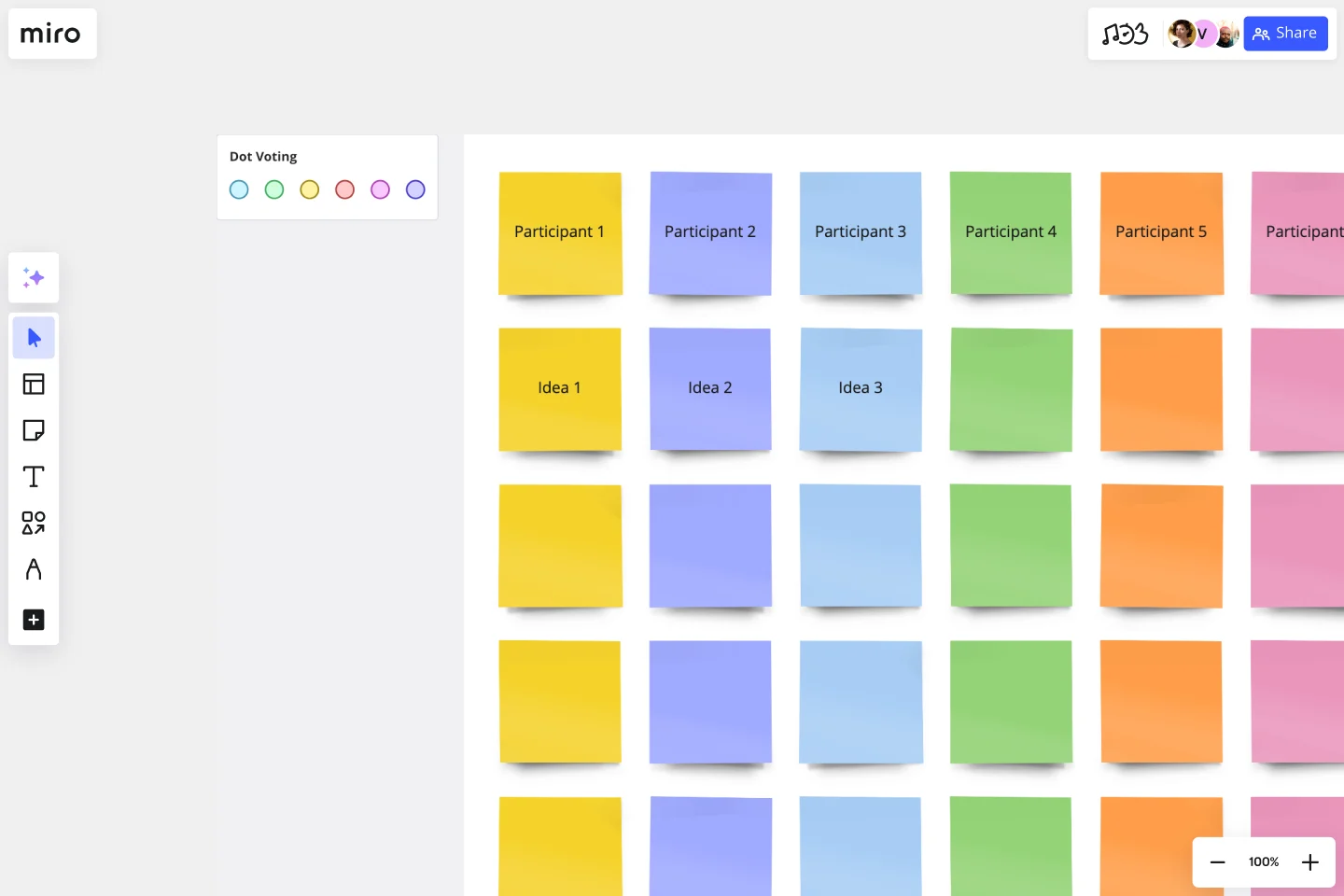
Six participants, three ideas each, five minutes per round. Papers (or digital sections) rotate after each round, and participants build on existing ideas. After five rounds, you’ve generated 108 idea variations in 30 minutes.
This method is great for teams new to brainwriting because the structure is clear. Everyone knows what to do: three ideas, five minutes, then move to the next set. These limits actually help creativity by stopping overthinking and keeping the energy up.
Try Miro’s Brainwriting Template which structures the 6-3-5 method automatically with designated sections, timers, and clear instructions embedded in the board.
Rapid ideation (high volume, fast pace)
Set shorter time limits, like 2 minutes per round instead of 5. Focus on coming up with as many ideas as possible, rather than making them perfect. The aim is to generate lots of directions without getting stuck on details.
Use this when you need to break through creative blocks or when the team keeps gravitating toward the same safe ideas. The time pressure forces people to write their first instinct rather than self-editing, which often surfaces more unexpected concepts.
Gallery method (visual and collaborative)
Post all ideas on a shared board from the start. Participants add sticky notes in one phase, then “walk around” the gallery adding “+1” votes, questions, or expansion ideas directly onto others’ contributions. Think of it as brainwriting meets asynchronous feedback.
This method is especially good for remote teams using Miro. Everyone can add their ideas at their own pace, even across different time zones, and the visual setup makes it easier to see patterns. It also feels less rigid than having set rounds, so the process is more natural while still making sure everyone gets to participate equally.
Each type of brainwriting has its own strengths, including Miro's Brainwriting Template. Try different versions to see which one fits your team’s needs and way of working best.
The benefits of brainwriting
Brainwriting, with its democratic and collaborative nature, delivers measurable improvements to ideation and team dynamics. Organizations adopting brainwriting consistently report significant changes across several key areas:
Higher participation rates
In traditional brainstorming, 2-3 people typically generate 70% of ideas. Brainwriting inverts this—participation becomes evenly distributed across all team members. When everyone contributes the same number of ideas within the same timeframe, no personality type gets priority. This structural equality means your UX Researcher’s insights carry the same weight as your VP’s directions, and your newest Engineer’s technical observations get the same consideration as your most senior Architect’s suggestions.
More diverse ideas
When you remove the pressure to verbally defend ideas immediately, people explore directions they’d otherwise self-censor. The written format encourages risk-taking and unconventional thinking. Ideas that might sound “too risky” or “too simple” when spoken out loud get written down and built upon. Teams often discover their best breakthrough concepts came from ideas that would never have survived the first five minutes of verbal brainstorming.
Better ideas survive
Verbal brainstorming often elevates ideas based on presentation skills rather than merit. The person who pitches with confidence and charisma gets buy-in regardless of substance. Brainwriting lets concepts stand on their own, and the building process naturally surfaces the directions with the most potential through iteration. When five different people independently expand on the same concept in different ways, you know you’ve found something worth pursuing.
Inclusive by design
Personality type, language fluency, processing speed, and seniority level matter less when everyone contributes through writing. Introverts contribute as much as extroverts. Non-native speakers have time to formulate thoughts. Junior team members can challenge senior assumptions without direct confrontation. The playing field levels automatically—not because anyone enforces participation quotas, but because the structure removes the advantages that certain personality types and communication styles typically hold in verbal settings.
Cultivates psychological safety
When ideas are written and built upon collectively, it becomes less about individual ownership and more about collaborative development. This reduces defensiveness and increases openness to feedback. No one’s protecting “their idea” because ideas evolve through multiple hands. The Designer who wrote the initial concept won’t feel attacked when the Engineer modifies it for technical feasibility—instead, they’re collaborating on something better than either could have created alone.
Common misconceptions and challenges of brainwriting
Even though brainwriting has many benefits, it’s not a perfect solution. Knowing about common misunderstandings and challenges can help teams use the method well, instead of giving up when problems come up.
Misconception: Brainwriting guarantees instant innovation
Reality: Brainwriting is a structured method that takes practice and commitment from everyone. The first session can feel awkward, and the ideas might seem basic or obvious. This is normal. Teams improve with practice as they learn to trust the process and build on each other’s ideas.
Misconception: Written ideas are always better than verbal ones
Reality: Brainwriting is great for solving certain problems, especially those related to inclusion and production blocking. However, some challenges need quick, back-and-forth discussion that writing can’t provide. The best teams use brainwriting to generate ideas, then talk them through to refine and prioritize.
Misconception: More ideas automatically means better outcomes
Reality: Having lots of ideas is helpful only if you have a good way to organize and review them. Without proper grouping and evaluation, hundreds of ideas can just feel overwhelming. That’s why the “discuss and refine” phase is just as important as generating ideas, and why AI tools that help with organizing are useful.
Challenge: Participants write surface-level ideas
Solution: Frame the challenge more specifically. Instead of “improve the product,” ask “what would need to change for enterprise customers to complete setup without contacting support?” The more concrete the problem, the more concrete the solutions.
Challenge: People don’t build on ideas—they just add unrelated concepts
Solution: Make the “build on this” instruction explicit. Try: “Read the idea above. Add one specific way to make it work or one variation that addresses a different use case.” Sometimes participants need permission to modify or challenge existing ideas rather than just adding their own.
Challenge: The quiet people stay quiet even with written prompts
Solution: This usually means they’re still processing or unsure if their ideas are “good enough.” Address it directly: “There are no bad ideas in the first round—we’re looking for volume and variety, not polish.” Set a minimum requirement: “Everyone writes at least three ideas, even if they feel incomplete or obvious.”
Challenge: Too many ideas, no clear path forward
Solution: Use AI-powered clustering in Miro to automatically group similar concepts, then prioritize clusters rather than individual ideas. Or deploy an AI Sidekick like “The Synthesizer” to identify common themes and connections. The technology handles the organizational work so your team can focus on the strategic assessment of which directions align with your goals.
Challenge: Remote teams struggle with pacing and energy
Solution: Use asynchronous brainwriting for generation phases (everyone contributes on their own schedule over 24-48 hours), then bring the team together synchronously for synthesis and discussion. This hybrid approach works better for distributed teams than trying to maintain energy across time zones during the full session.
To overcome these challenges and make brainwriting work for your team, it’s important to clearly explain the process, create a supportive environment, and be willing to adjust your approach as needed.
Frequently asked questions about brainwriting
How long should a brainwriting session take?
Most sessions run 30-60 minutes total: 5-10 minutes per round across 3-5 rounds, plus 15-20 minutes for discussion and synthesis. Shorter sessions work for focused problems; longer sessions suit complex challenges requiring deeper exploration.
Can brainwriting work asynchronously?
Yes—this is one of brainwriting’s biggest advantages for distributed teams. Set up a Miro board with clear instructions, give participants 24-48 hours to contribute their rounds, then bring the team together synchronously for synthesis and discussion. Async generation, sync discussion.
How do I prevent groupthink during brainwriting?
Use AI Sidekicks like “The Challenger” to surface potential risks and question assumptions. Explicitly ask participants to add contradictory ideas or explore “what if the opposite were true?” And make sure the initial problem framing doesn’t presuppose a specific solution direction. Starting with “How might we…” rather than “Should we…” keeps options open.
What’s the ideal team size for brainwriting?
5-8 participants creates enough diversity without becoming overwhelming. Smaller teams (3-4) can work but limit perspective variety. Larger teams (10+) should split into smaller groups, each running their own brainwriting session on related aspects of the challenge.
How is brainwriting different from regular brainstorming?
Brainstorming is verbal and synchronous—ideas get shared out loud in real-time. Brainwriting is written and structured—everyone generates ideas independently in parallel, then builds on each other’s work in rounds. Brainwriting typically produces more ideas with more balanced participation and less production blocking.
Can I combine brainwriting with other ideation methods?
Absolutely. Many teams use brainwriting to generate initial concepts, then switch to verbal discussion for refinement and prioritization. Or use rapid brainstorming to identify problem areas, then brainwriting to develop solutions. Mixing methods based on what each phase requires works better than rigidly sticking to one approach throughout your entire innovation process.
How do I handle participants who dominate even in written format?
Set clear constraints: “Each person contributes exactly 3 ideas per round—no more, no less.” Use timers to enforce boundaries. In digital brainwriting, assign specific board sections to each person so contribution levels are visible. If someone consistently writes paragraphs while others write sentences, address it directly: “Let’s keep initial ideas to 1-2 sentences so everyone moves at the same pace.”
Do I need special tools to run brainwriting?
No—brainwriting works with paper and sticky notes in a conference room. But digital tools like Miro solve real friction points: everyone can work in parallel without passing papers, ideas persist and connect visually, AI can help with synthesis and clustering, and async participation becomes viable for distributed teams. The core method remains the same whether you’re analog or digital.
Conclusion
So, what is brainwriting? It's a powerful, collaborative technique that fosters innovation and ensures every voice is heard. By embracing brainwriting, your team can unlock untapped creative potential and devise unique solutions. Whether you're part of a small startup or a global corporation, I encourage you to give brainwriting a shot. Remember, the next big idea might just be a brainwriting session away!
References
For more details and case studies on brainwriting, you can refer to these resources:
"Brainwriting for New Product Ideas: An Alternative to Brainstorming" by Paul Paulus.
"Innovation Step-by-Step: How to Create & Develop Ideas for your Challenge" by Darin Eich.
"Tools for Innovation" by Arthur B. Markman and Kristin L. Wood.
Author: Miro Team
Last update: December 23, 2025