Do the math on AI’s impact at your company. Add up every hour it saved last quarter — research synthesized in minutes, prototypes generated before lunch, code drafted overnight. Then, look at how much impact those shipped ideas are driving in terms of traffic, revenue, whatever metric means most to your business. The two numbers rarely add up.
That mismatch is the story of AI at work in 2026. People have gotten dramatically faster, but that speed hasn’t translated into outcomes for organizations. Individuals can craft confident, polished products with their agents in private chat windows and AI sessions, shipping an idea in a single sprint without ever validating as a team that it’s the right one. This is why leaders point to applying AI to solo productivity, rather than to collaboration within and across teams, as the biggest barrier to return on their AI investments.¹
Now, what if product teams measured success not just by delivery speed but by decision quality, using AI to align on what’s worth building before they commit? At Canvas 26, product leaders from around the world and from organizations of all sizes spoke to what that shift looks like in practice — and the shifts in mindset, technology, and ways of working required to succeed.
Getting AI out of the chat window
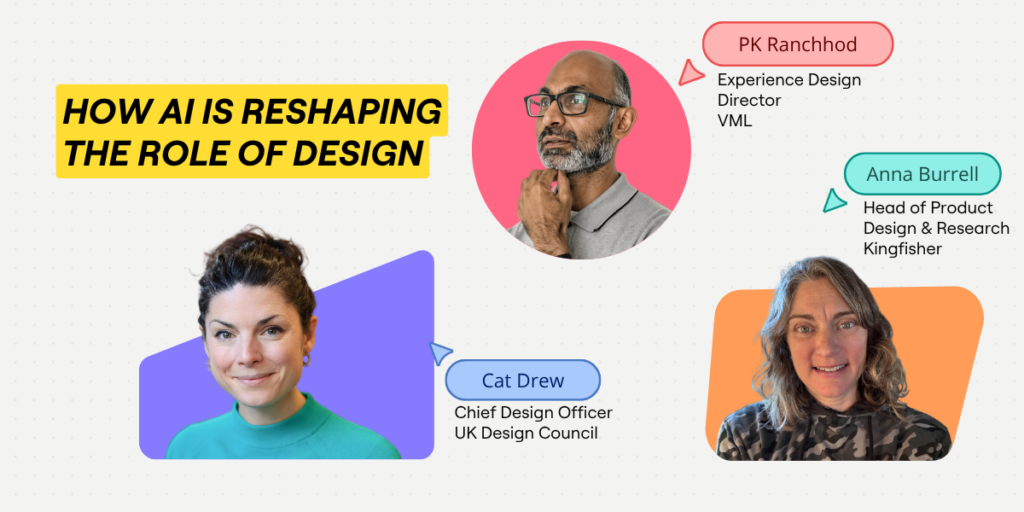
A panel of design leaders in London — Cat Drew of the Design Council, Anna Burrell of Kingfisher, and Pundarik (PK) Ranchhod of VML — put words to what’s slowing teams down and hampering their impact. PK called it “the tyranny of text”: walls of prompts and outputs passing between individuals, far from the shared visual surfaces where a team thinks together.
His point was that teams don’t need another tool so much as a shared place to work. Individual AI wins become team-wide impact only once someone’s insight leaves their chat window and lands where the rest of the team can react to it, challenge it, and build on it.
Anna named the part of the job that AI can’t shortcut: judgment. When everyone can generate more, faster, the value shifts to a team’s ability to tell good from good enough. Cat added that, for product teams (and designers, in particular), the timeless work is “setting the collective vision, the problem you’re all trying to share at the beginning, and holding that intent.”
That’s not work you hand to an agent. It’s work a team does together, in a shared space — which is exactly what the teams below built.
J.Crew Group: Building AI into the canvas
When J.Crew Group — the company behind J.Crew, J.Crew Factory, and Madewell — looked at why design work kept stalling, they found the holdup lived between when work got started and when everyone understood it well enough to move it forward. They named the problem “alignment latency” and treated it as an environment problem rather than a process one.
Their answer is the Digital Atelier: a shared workspace built on Miro as the primary canvas, where design, merchandising, operations, and technology work together on boards organized around products instead of the org chart. What makes it click is where the AI sits. Cost data, material feasibility, and AI-generated insights surface in the collaboration layer, so the context is already on the board when the team needs to come to a decision together; these decisions then flow back out to the systems of record.
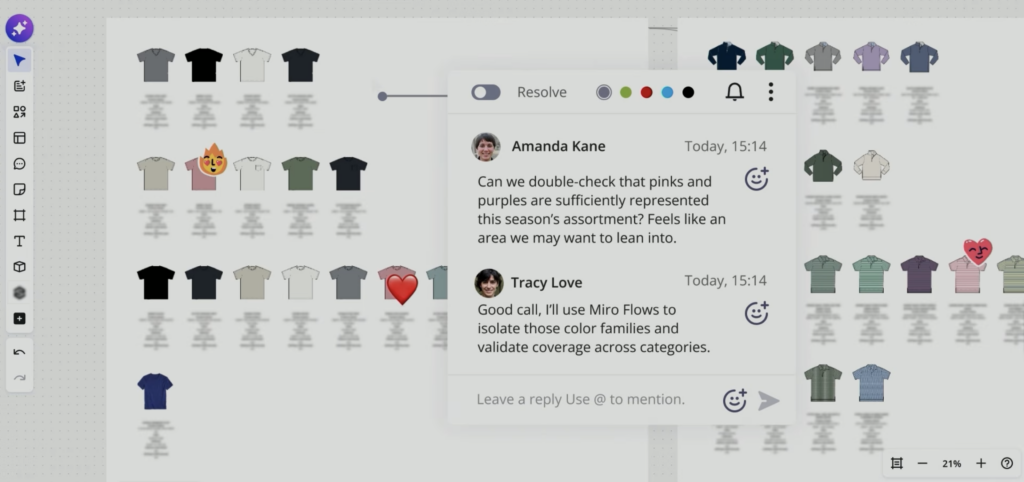
Their guiding principle: AI works best when it’s built in, not bolted on. When AI lives in a separate tab, someone has to leave the work, fetch the answer, and reconcile it with whatever’s already in flight. Building it into the canvas removes that round trip — and, J.Crew Group reports, leads to less rework, earlier decisions, and more confident calls.
“Speed isn’t just about how fast each step runs. It’s about how quickly teams align.”
Proximie: Deciding what to build on shared evidence
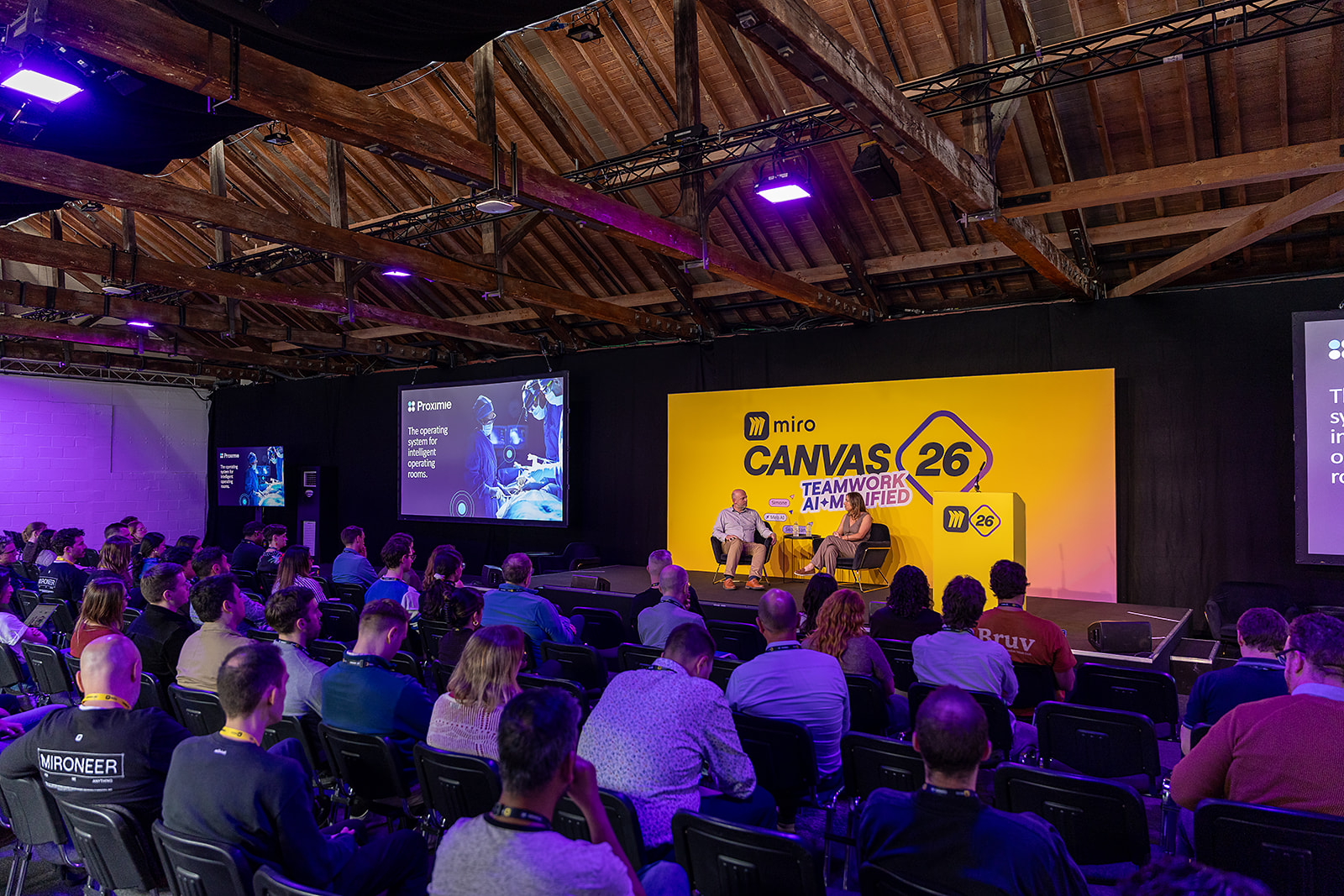
Proximie, a healthtech startup broadening access to surgery, builds with a fully distributed engineering team of 45. Its hardest problem has never been engineering the product — it’s deciding what to build next in a fast-moving market, without defaulting to whoever argues hardest.
The whole company now works that decision out on a shared Miro canvas. Engineering started there, mapping data flows; over time everyone from the CEO to sales joined them, so anyone could weigh in on what to build and why, with the reasoning visible to all. A feature earns its place on the roadmap based on the evidence behind it — revenue, a signed contract, a competitor, technical debt — not because the loudest voice in the room pushed hardest.
“We have the CEO making comments. We have engineering making comments. We have product, commercial, marketing. Everybody is making comments and the visibility … creates a space where … everybody knows exactly why these features are being prioritized.”

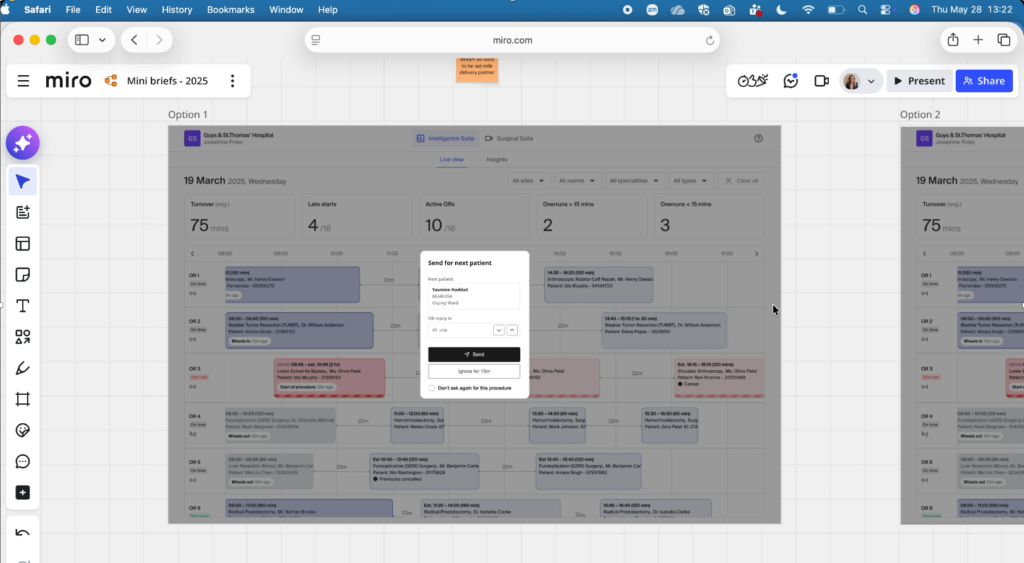
That shared clarity is what empowered the team to ship its Intelligence Suite — a product handling sensitive healthcare data across global infrastructure — in nine months, and the canvas remains where the team decides what to build next. For CTO Richard Carter, this all points to a bigger shift: AI becoming less about an individual’s “look what I did” moment and more about a team that decides, validates, and builds together.
Belfius: Validating the idea before building it
Belfius, one of Belgium’s largest banks, set out to upgrade a banking app so feature-rich that its 2.2 million users often couldn’t find what they needed. The goal was to show customers the right feature at the right moment — which meant working out what “right” was before building it. A team of 70 stayed coordinated by making the Miro canvas its shared memory.
Every idea landed there first, alongside the trend reports and product notes the team tracked. The same canvas held the backlog and priorities, then became the hub for decisions and record-keeping. Teams could stay in sync and find the right work without hunting for it.
Miro Prototypes turned concepts into drafts the team validated in usability labs, and the resulting research came together in Miro Slides so everyone could see both the findings and the evidence behind each call.
“Miro became more and more our centralized hub. Every deep dive on a topic that we need to take, that started in Miro.”
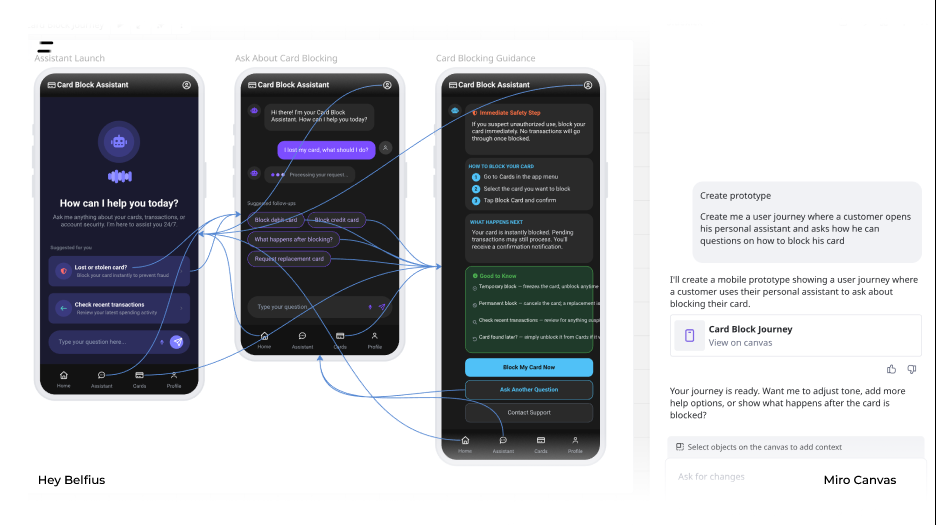
The result is “Hey Belfius,” a smart assistant customers talk to in their own words, which handled more than 255,000 conversations in the first weeks following its soft launch.
The hard part is deciding what’s worth building
Miro CEO Andrey Khusid talked about the Great Inversion at Canvas 26: the shift from work being 80% doing to 80% thinking. And these stories show what that means for teams every day. Different starting points, different products, all succeeding with the same solution: bringing their work onto a shared surface, where teams and their agents can align on the right problems to solve and products to build — faster and together.