Proximie is a Series C healthtech company on a mission to improve access to surgery worldwide. It began as a telepresence platform that let surgeons call each other for live, high-quality guidance even in bandwidth-constrained settings, starting with heart valve operations. Today, its focus is everything that happens around the operating room, using computer vision and AI to move people, instruments, and information through a healthcare setting in real time.
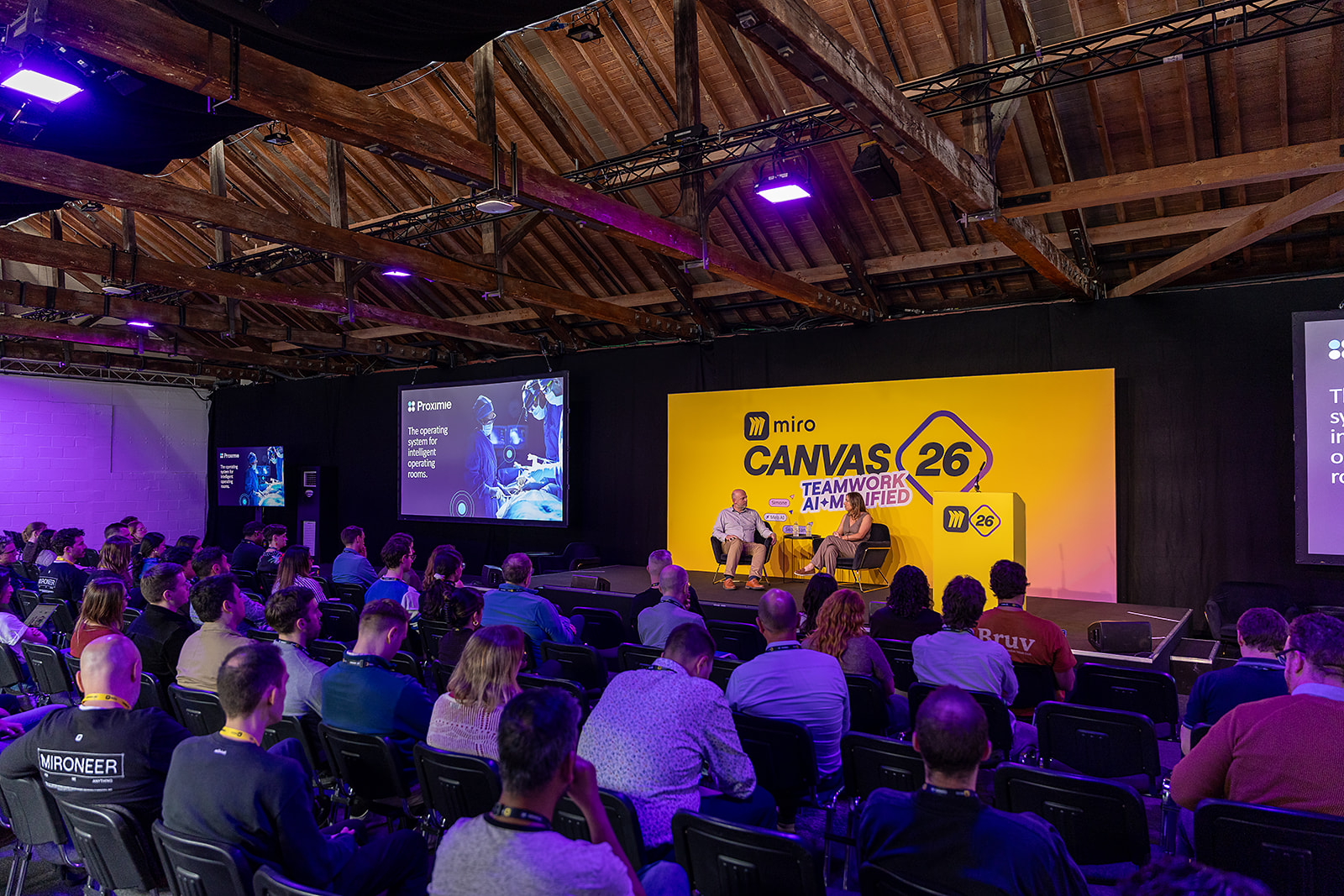
At Canvas London, Proximie’s CTO, Richard Carter, and Director of Product Delivery, Ciara McCarthy, sat down for a conversation about how Proximie built their Intelligence Suite product in just nine months, with a fully distributed engineering team, in one of the most demanding environments there is. Their message: once the treatment is clear, the rest of healthcare is a logistics and communications problem, and solving it well comes down to how a team makes decisions together.
Challenge
When Richard joined Proximie from a career in financial markets, his first task was to watch a surgery. He was struck by how manual and analog the operating room still is: lots of physical work, machines that monitor patients, and almost no digitization of the workflow around them. That gap is the opportunity that Proximie sees to improve patient outcomes, but closing it leaves no room for error.
When Dr. Nadine Hachach-Haram, Founder and CEO at Proximie, first tasked the Proximie team with building a solution to support better outcomes in the operating room, Richard determined that any product the team produced had to be three things at once: real time, contextual, and accurate. When an engineer offered to deliver data “in two or three minutes,” the answer was that it had to be live, captured every few seconds, and layered with the hospital’s electronic health records so the right person sees the right information at the right moment.
Building what is now known as Proximie’s Intelligence Suite meant coordinating roughly 45 developers who have never all been in the same room, working over teleconference software, alongside a CEO who is a practicing surgeon. The hardest part for the distributed team has not been engineering the solution; it has been deciding what to build next in a fast-moving, well-funded market, where competitor pressure creates constant scrutiny on what features to develop. Before the team had a shared way to prioritize their roadmap, the process was, in Ciara’s words, messier.
“I think it was just the loudest voice. And if you didn’t like the answer you got, you came and asked Richard or me afterwards, and they might give you the answer you wanted.”
Ciara McCarthy, Director of Product Delivery at Proximie
Solution
To tackle the Intelligence Suite, the team started with a literal, physical whiteboard, but that process lasted less than a day. After a quick attempt to photograph it, they realized how impractical this way of working would be, and moved into managing their product roadmapping process in Miro and have never looked back.
Context-driven clarity
In the early days of developing their solution, roughly 18 months ago, the Proximie team used Miro to map data flows: where operating room data is captured, how it moves to the AI vision model and through AWS, and how it finally reaches a healthcare worker’s screen in real time. From there it grew into customer journeys, user flows, and backend architecture diagrams, and then spread well beyond engineering into the whole company utilizing Miro to stay connected and to move as one.
Expanding usage of Miro throughout the entire company helped Proximie solve their prioritization problem. Now the product and engineering team could collect full context in Miro – everyone from the CEO to sales to marketing could comment on what to build and why, and the reasoning stayed visible to all. Whether a feature was driven by revenue, a signed contract, a competitor, or engineering’s need to pay down technical debt, the rationale was on the board. As Ciara put it, there was no room for argument because the decision rested on fact.
With that context-driven clarity, Proximie made a deliberate choice to prioritize user experience feedback over competitor intelligence. The team ran extensive interviews with frontline clinicians rather than designing from the viewpoint of healthcare workers that sat in an office, and heard the same thing repeatedly: staff moving through a busy hospital need to know which OR (operating room) is free, which doctor is becoming available, which patient is next, and, above all, they want to know they will finish their shift on time.
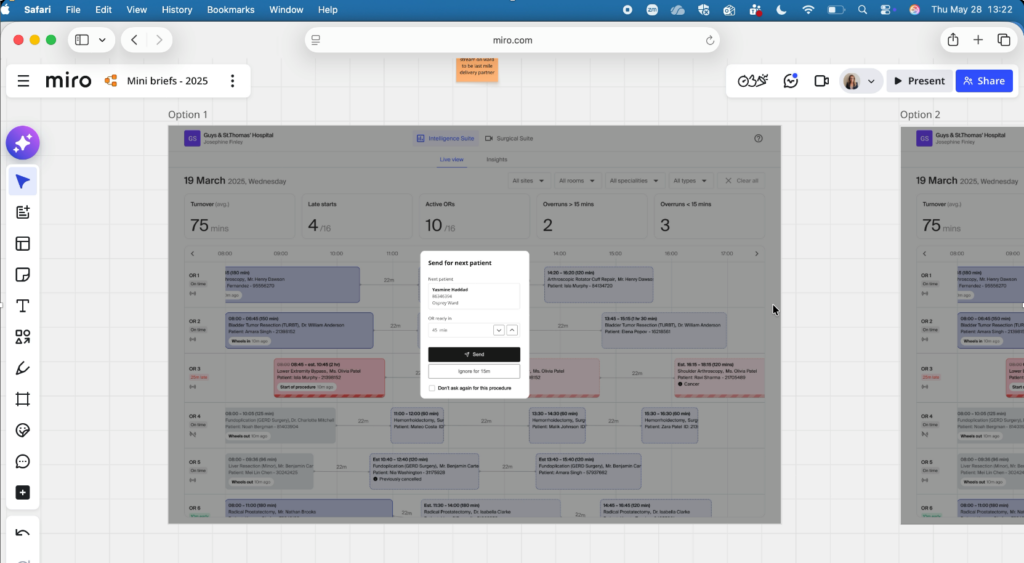
Today that information is often still passed by phone, but Proximie’s live view puts it on screen, with different lenses for different audiences: an anonymized public view with no patient data (but enough context to support families in waiting rooms to understand the status of their loved ones), and fuller clinical views in private areas and the OR itself.
Compliance considerations
Miro also became central to the work that lets Proximie operate in a highly-regulated environment. Because the company puts sensors into sensitive environments and sends data to the cloud, it faces serious compliance and cybersecurity scrutiny. The team produces its required instructions for use and runs its threat modeling in Miro using the STRIDE methodology, keeping different views of the same material on one canvas so a single source can serve engineering, regulatory, and commercial audiences.
AI-accelerated roadmap
Over the past two years, the newest Miro AI tools opened up work the team had never attempted. Proximie now builds competitor battle cards by feeding in connectors and contextual information about each competitor, and gets back a clear read on what they do, which part of the market they target, their feature sets, and how they price, in less than a few minutes. That work led to a strategic realization: Proximie does not really compete on features. Many competitors use similar computer vision technology but are focused on hospital wards and problems like patient falls, while Proximie goes deep into the OR.
“Since those competitor battle cards, we are more confident in the role of our product, which is very much OR-centered.”
Richard Carter, CTO at Proximie
The team also uses Miro AI to generate persona-specific dashboards. By combining sensor timestamps with electronic health record data, they can ask for a view tailored to an operations manager or a ward manager and get back layouts they had not thought of themselves. Making that possible required real investment. As Richard explained, you cannot hand real patient records to an AI tool, so the team built realistic synthetic data for the Miro tools to work with, which was a non-trivial effort in its own right.
Impact
The clearest gains the team described are in speed and confidence. Battle cards that inform high-stakes prioritization now take minutes to produce and live as one shared canvas across product, commercial, and marketing. New dashboard views that used to be a weeks-long design exercise now appear in seconds. And by failing fast and early, including swapping out their first operating room hardware within days when it did not work, the team has kept its product moving at the pace the market demands.
Just as important, the way Proximie decides what to build is now transparent and grounded in evidence rather than volume. For a startup in a crowded, fast-moving category, that shift from following the “loudest voice” in the room to using shared context informed by facts is its own result.
With Miro keeping distributed teams in sync and collaboration moving fast, Proximie shipped its Intelligence Suite from concept to production in nine months, an unusually quick timeline for a product handling sensitive healthcare data across global infrastructure.
The bigger picture
For Proximie, their work in Miro ladders up to the company’s founding mission: safe access to surgery for as many patients as possible, including through global health equity work that shares the expertise of NHS surgeons more widely. Reducing the documentation burden on clinicians, who can spend 30 to 40 percent of their time on administration, is just part of how technology serves that goal.
Richard closed on where he sees this going, and it maps closely to why a shared canvas matters. He is excited about tighter integration with agentic workflows, and hopeful that AI in engineering becomes less about an individual’s “look what I did” moment and more about teams collaborating naturally on the work. That is the shift Proximie has been living: not faster individuals, but a team that decides, validates, and builds together.