Belfius is one of Belgium’s largest banks, supporting millions of customers daily with banking, brokerage, and insurance services. Its mobile banking app has become a fixture of everyday life for its customers, with more than 2.2 million active users who open it an average of 38 times a month, more than once a day.
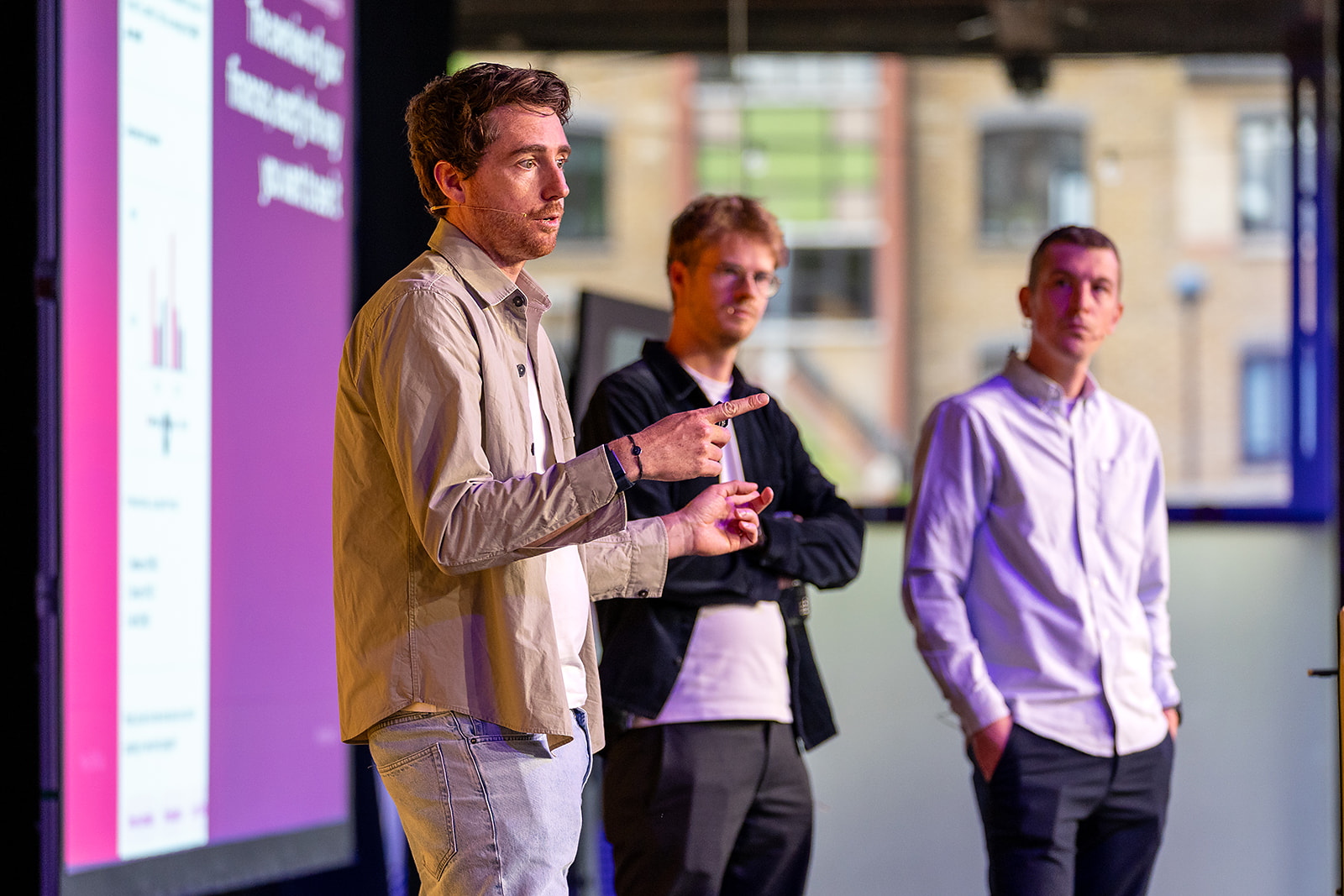
At Canvas London, three members of Belfius’ product team shared how they’re transforming their customers’ mobile app experience. Jonathan Neubourg, Head of AI & Tech Lab, was joined by Stef Ceuppens, product owner for the mobile banking app, and Laurent Verbanck, who owns and designs customer journeys. Their story tracked the journey from a feature-rich app that had grown hard to navigate to “Hey Belfius,” a smart banking assistant that lets customers ask for what they need in their own words. Let’s take a closer look at their journey.
Challenge
The Belfius banking app started as a simple daily banking tool, which they launched scrappily in 2011 without board approval and funded quietly out of other budgets until it crossed 100,000 users. It grew into something customers reached for constantly, creating a problem that most banks would envy — the pressure to add more, like investment and brokerage support, beyond-banking services like paying for parking, and managing home and car insurance.
These additions resulted in an experience weighed down by its own complexity. The yearly satisfaction survey made the issue plain; when customers were asked what they wished the app could do, roughly 70% of their answers described features that already existed. Users of the Belfius banking app could not find what was already there.
“Instead of always reinventing new features, new flows, and new stuff, one of the main things we started to see as a real need is we need to show customers the right feature, precisely when they need it.”
Jonathan Neubourg, Head of AI & Tech Lab at Belfius
At the same time, the rise of generative AI and conversational interfaces was changing what was possible. The team saw how quickly people had taken to typing and speaking their requests rather than navigating and searching, and the team treated it as a shift they needed to build into the product. That insight produced three foundational pillars for what came next:
- Proactivity: showing the right feature at the right time
- Personalization: serving 2.2 million customers across very different ages, needs, and levels of wealth
- Multimodality: meeting customers through chat, a thoughtful application interface, and voice
Solution
To illustrate their point to the audience at Canvas London, the Belfius team grounded the concept in journeys every customer recognizes: booking a trip, buying a house, and reporting on investments. Take the first type of journey — booking a trip to Japan — as an example. The team showed that before leaving, the Belfius banking app could prompt a customer to order cash, estimate the trip’s cost, raise a card limit, confirm the card works abroad, activate an eSIM, and pause subscriptions they will not use. During the trip, Hey Belfius can answer whether their insurance covers a rental car or point them to the nearest ATM. Upon their return, it can break down spending on the trip by category. The Hey Belfius assistant turns scattered tasks into a single conversation.
To get from those ideas from concept to a shipped product, the Belfius team ran their planning and prototyping in Miro. The team started without a fixed plan, and that was the point: They did not need a predefined structure or process before they could begin. Early on, Miro was the place where every idea landed, alongside trend reports and product launch notes.
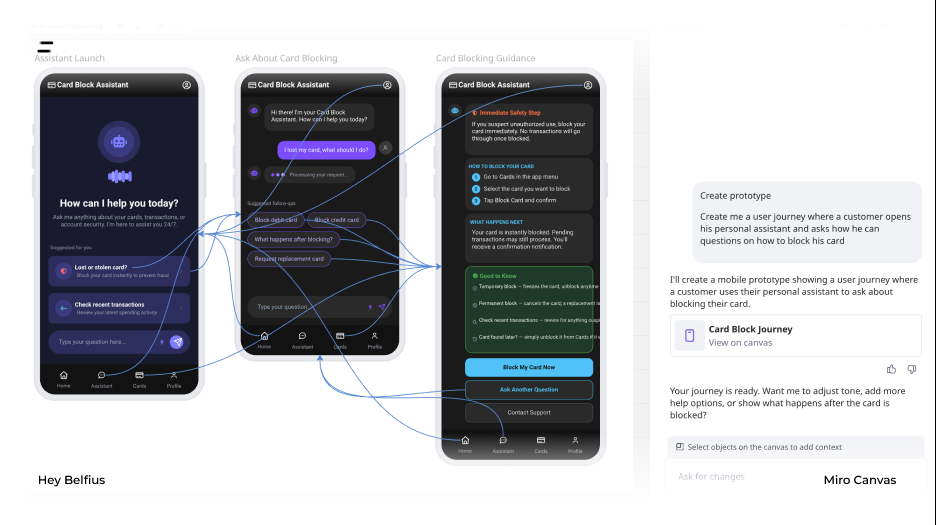
“When we had the bright ideas, Miro was for us more like a battlefield where all the ideas come in: the good ideas, some darlings that we need to kill, and we complemented it with all the trend reports, product launches, and TLDRs that we see.”
Stef Ceuppens, Product Owner, Mobile Banking App at Belfius
Miro then became the project management space for the team’s backlog and priorities, and, as the project matured, Miro became their central hub for decision-making and record-keeping. Every deep dive began with a rough sketch in Miro before creating the polished version.
Just as important, the team treated the canvas as their memory. Because the full history of how each decision was made lived on the Miro board, a team of 70 could stay in sync and find the right deliverable without hunting for it.
Miro’s AI features did the heavy lifting that freed the team to focus. With Miro Prototypes, the team turned concepts into testable drafts they could validate in usability labs; then pulled research transcripts, researcher findings, and AI summaries together into Miro Slides so everyone could see the key findings and the structure behind them. The team’s conversational designers built a tone-of-voice Sidekick loaded with their full style guides, so they could check a piece of copy against their standards, get suggestions, and in the strongest cases apply the right tone directly to a new flow.
The assistant itself reflects the same care for the customer and dedication to shared context. “Hey Belfius” draws on a centralized knowledge hub fed by product, marketing, and business teams, which keeps answers current and lets the bank respond quickly to new questions. Each answer comes back in three parts: an acknowledgement that the question was understood, the response itself, and tappable follow-up suggestions so customers can go deeper without retyping. Critically, information leads straight to action.
Impact
The early signals from the app’s soft launch in April are encouraging. In a matter of weeks, “Hey Belfius” has already handled more than 255,000 conversations. Customers were not only finding the assistant, they were staying in it and resolving their questions without needing to be handed off to a person. Belfius also saw an early drop in the number of calls reaching branches, where those questions were previously answered manually.
For a product still in soft launch, those numbers point to genuine adoption rather than novelty. Customers are choosing the conversation, and the workload on Belfius’ support teams is starting to ease.
The bigger picture
For Belfius, “Hey Belfius” is a reframing of what a banking app should be. Success is no longer measured by how many features the app contains, but by how well it surfaces the right information at the right moment, in the customer’s own language.
The team is already extending the model. A claims bot can handle the full registration process when something goes wrong with a customer’s car or home, with the ambition of instant reimbursement for smaller claims so a customer can get straight to the repair shop.The team is also working toward making investing simpler, which Jonathan framed as a mission for the bank: too many people in Belgium hold back from investing because of its complexity, and lose spending power to inflation as a result.
“We believe that the technology we have in hand, and the technology we demoed, can make investing easier and more explainable.”
Jonathan Neubourg, Head of AI & Tech Lab at Belfius
The longer-term vision is multimodal: an assistant that meets customers where they are, picking up a conversation later when someone has time to talk it through. Belfius is targeting production by the end of this year. What began as a way to cut through a crowded app is becoming a new way for customers to bank, conversationally.