Good strategy doesn’t guarantee good results, especially when you can’t see how the work connects.
Product leaders set the product vision, but then struggle to turn that vision into reality, and many tell us what keeps them up at night is not knowing if their teams are focused on the right business priorities.
Teams, meanwhile, inherit fragments. Once work begins, context dilutes quickly. It’s not surprising that 66% of director-level EPD leaders say product development goals aren’t clearly tied to revenue impact — compared to just 38% of VPs and C-levels.¹ The further you get from strategic conversations, the harder it becomes to translate intent into day-to-day decisions.
And when strategy is disconnected from execution, the outcomes are predictable: slower time to market, wasted resources, and products that miss the mark.
So the question is: How can product leaders keep strategy and goals connected to day-to-day work?
AI is worsening the strategy-to-execution disconnect
Strategy, prioritization, roadmapping, and execution all operate in different spaces. Teams are working hard, but not always moving in the same direction.
And AI is intensifying the problem because execution velocity is exploding while strategic planning processes remain stuck in an earlier, slower era.
That creates a clash: teams that can pivot in days, but are trapped in strategic frameworks that take months to adjust. As a leader, do you let teams run at AI speed and watch strategic alignment evaporate — taking business objectives with it? Or do you maintain traditional governance and watch your AI-empowered competitors devour your market share while you’re still in planning meetings?
This isn’t sustainable. The organizations that will win in the AI era will transform their strategy-to-execution process into a continuous, intelligent flow — where strategic intent guides every sprint, and execution insights inform strategy in real time.
The competitive advantage of fixing the disconnect
Across roles — product, engineering, design, and product ops — a consensus is emerging:
- Strategy needs to stay connected to daily work instead of living in slides and spreadsheets.
- Goals and OKRs have to be visible where teams work instead of sitting in leadership dashboards.
- Roadmaps need to evolve with changing priorities instead of going stale.
- And dependencies must be managed proactively instead of becoming blockers.
Here’s how product leaders are making that shift happen.
Go from vague, disjointed goals to org-wide goal clarity
Where things stand now
For many teams, goals are clear at kickoff but quickly fade into the background once work begins. They live in separate tools, are hard to measure consistently, and rarely show up in the rituals where real decisions get made. As a result, progress becomes subjective, and teams can’t confidently connect their work to business outcomes.
Where teams are heading
When goals live where work happens, teams can actually use them — not just reference them. They show up naturally in planning and daily decisions instead of slipping out of view after the kickoff.
Teams keep strategic intent in view so they’re always working on the projects that matter to the business. Leaders can see whether work ladders to outcomes. And progress updates flow naturally from the work itself, not from ad hoc check-ins.
How Miro helps
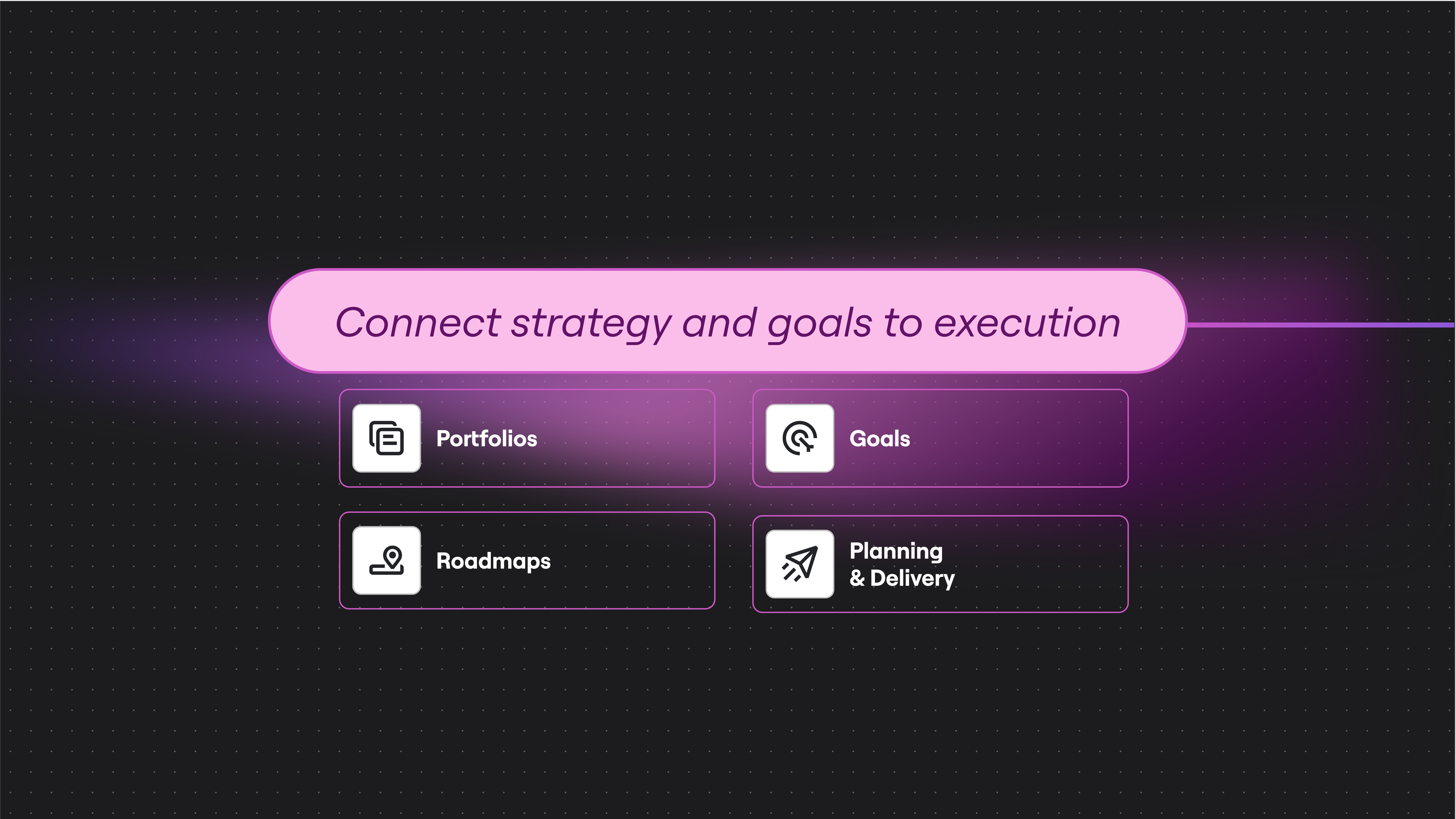
Miro Goals brings OKRs and strategic objectives into the same environment where initiatives are defined, roadmaps are built, and delivery plans take shape. Teams articulate objectives clearly, define measurable key results, and maintain continuity as priorities evolve with guidance from AI that’s trained on your full company context — all without relying on a disconnected OKR tool.
Teams stop losing sight of the “why,” and leaders gain confidence that the organization is working on the things that move the needle.
Get a clear, connected view of the entire portfolio
Where things stand now
When work is spread across tools and teams, it’s nearly impossible to have full visibility across the entire product portfolio. Leaders lack a single, trusted view of which initiatives are on track, where risks are forming, or where resources are misaligned. Dependencies and duplication are often discovered only after they’ve slowed teams down.
Where teams are heading
Organizations move faster when leaders have a clear view of what’s happening across the portfolio — who’s working on what, how initiatives align to goals, where potential issues emerge, and where resources need to shift.
Unified visibility helps teams spot drift early, prevent duplicative efforts, and ensure that high-value initiatives get appropriate investment. And leaders know it: 88% say visibility across the product development process is important or critical to achieving company goals.¹
How Miro helps
Miro Portfolios gives leaders a single view of initiatives and their connection to goals and key results. Teams can evaluate alignment, understand dependencies across workstreams, and track progress in a way that’s both lightweight and grounded in real execution data.
It becomes far easier to keep the portfolio anchored to strategy — not just historical plans or stakeholder preferences.
Forrester’s Strategic Portfolio Management Tools Landscape, Q4 2025 report is an overview of platforms that help enterprises take planning and portfolio prioritization to the next level, provide more substantial support for analysis and decision-making, and leverage AI to supply increasingly sophisticated analytics that support scenario analysis and expanded criteria analysis. The report recognizes Miro, which we believe underscores how important it has become for organizations to see goals, initiatives, and delivery plans in one workspace.²
Replace static roadmaps with living plans that keep teams aligned
Where things stand now
Roadmaps are often created in slide decks or standalone roadmapping tools that sit apart from the rest of the work of discovery, definition, and development — making it hard for teams to stay aligned on the plan. Roadmaps become outdated quickly, and teams don’t have a shared space to come back together and work through new information. Over time, the roadmap drifts from strategy and becomes a feature delivery timeline as teams lose sight of the “why” behind the “what.”
Where teams are heading
Living roadmaps give teams a shared, always-current view of priorities, changes, and dependencies in the same space where the day-to-day work of building happens — so alignment doesn’t depend on a monthly meeting or a static slide. When roadmaps evolve in real time, teams can adjust with confidence, understand the implications of changes before they disrupt other work, and keep momentum through shifting conditions.
How Miro helps
Miro Roadmaps gives teams a living, collaborative space to map priorities, identify dependencies, and understand the impact of changes before they ripple through the organization. Because roadmaps connect directly to goals and initiatives, they stay tied to strategy even as teams adjust the plan.
Teams spend less time reconciling conflicting spreadsheets or point-solution roadmaps, and more time moving the work forward.
Streamline execution while keeping strategy front and center
Where things stand now
As work moves from planning into execution, teams often lose momentum because context and expectations don’t carry through. Delivery plans get rebuilt in separate tools, cross-functional dependencies become bottlenecks, and leaders have to chase status to understand where things stand. This makes it harder to course-correct early and slows down time to market.
Where teams are heading
Execution becomes dramatically smoother when planning happens in the same place as strategy. Teams maintain clarity from discovery and definition to delivery. Dependencies are always visible. Expectations stay realistic. And cross-functional collaboration becomes much easier.
How Miro helps
Miro Planning & Delivery gives teams one shared space to define epics, conduct “big room” planning sessions, align cross-functionally, and track progress through execution.
It pulls in context via integrations with Jira, Azure DevOps, and more, so instead of jumping between systems to piece things together, teams plan and deliver in a collaborative AI workspace where goals, initiatives, and roadmaps already live.
The result is more reliable delivery, fewer surprises, and a system that keeps strategy intact all the way to release.
The opportunity ahead
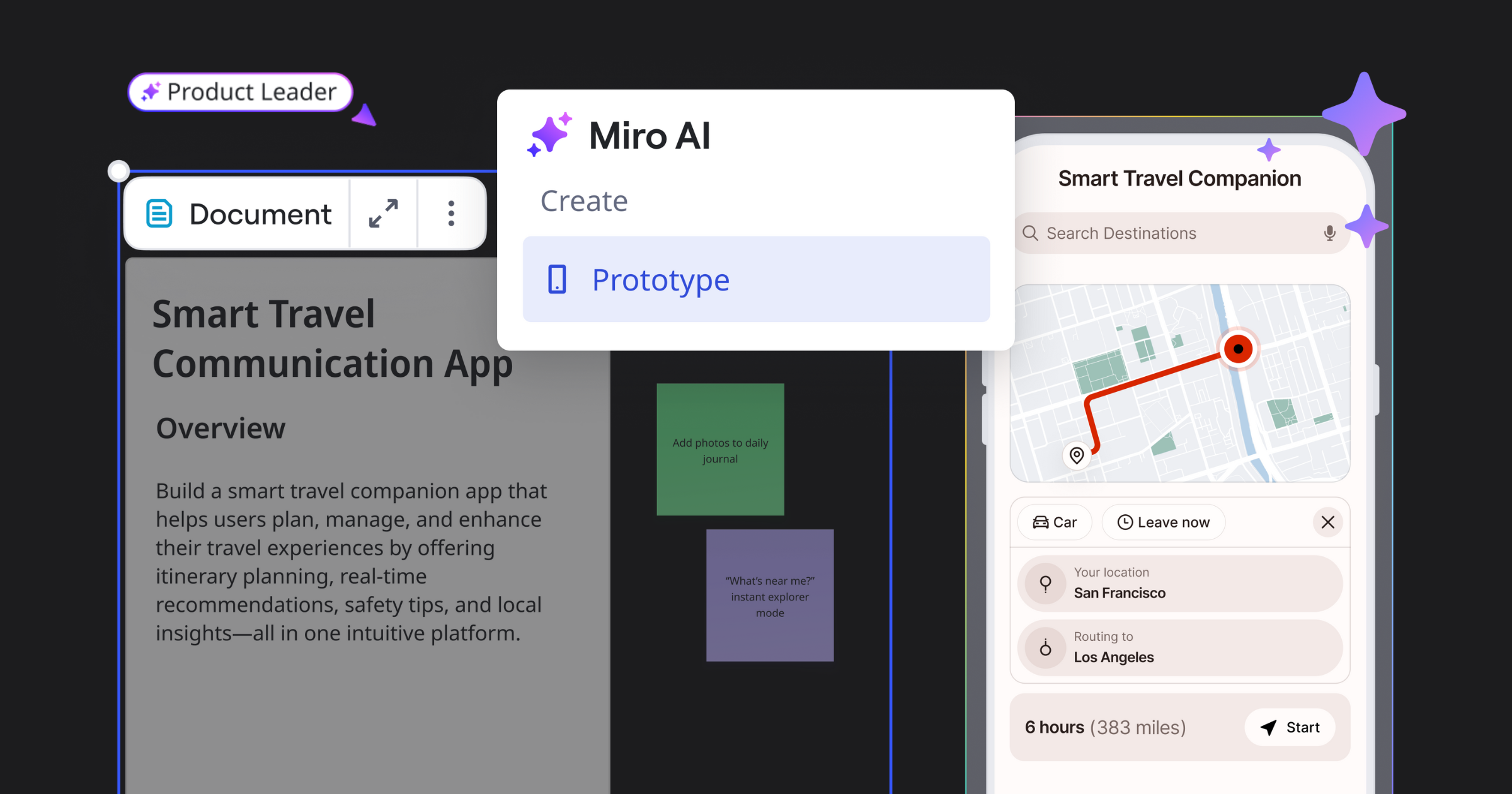
We believe the future of product development is teams and AI working together in a shared space where strategic thinking becomes visible and actionable, context flows naturally across the product lifecycle, and plans evolve continuously.
When strategy travels with the work, teams move with intention at every step. The result is a product organization that advances quickly and stays aligned, even as priorities shift and new information surfaces.
Miro for Product Acceleration brings all of this together in an end-to-end solution that helps engineering, product, and design teams connect strategy to execution, build the right things, and get the most from their AI investments, all while flowing from early concepts to final delivery at speed.
¹ Forrester’s AI Workflows For Team Innovation Survey, Q3 2025.
Base: 170 EPD leaders in organizations across USA, EMEA, and APAC currently integrating or planning to integrate AI into workflows.
² Forrester does not endorse any company, product, brand, or service included in its research publications and does not advise any person to select the products or services of any company or brand based on the ratings included in such publications. Information is based on the best available resources. Opinions reflect judgment at the time and are subject to change. For more information, read about Forrester’s objectivity here.