“AI is everywhere. Alignment’s not.”
Mural CRO Bill Duyinen made that observation at the Gartner® Digital Workplace Summit in London. The organizations struggling with AI, he argued, aren’t facing a technology problem but rather “an operating model opportunity.”
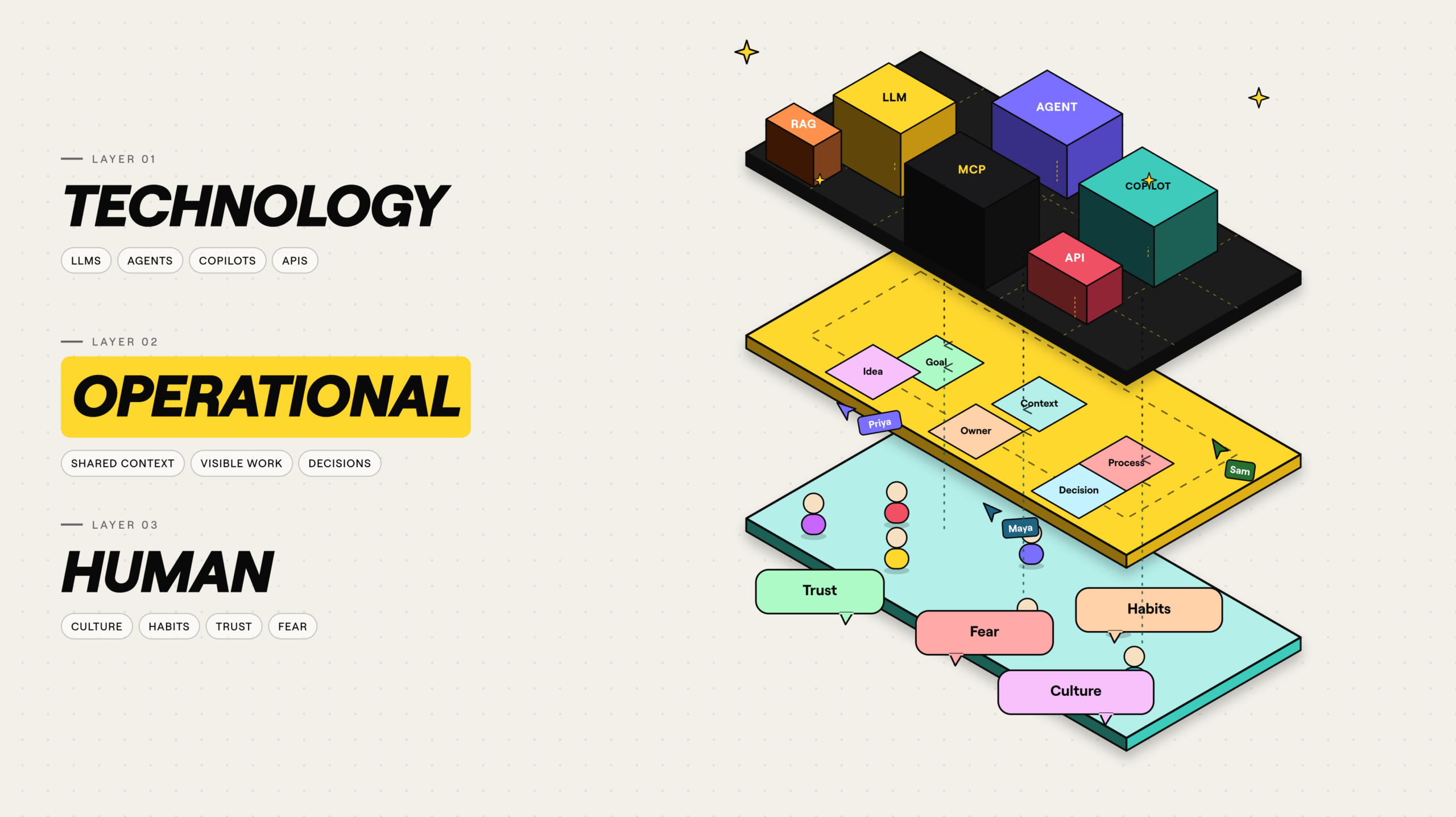
In most organizations, the operating model for AI consists of two layers. At the top, a technology layer — models, agents, architectures, integrations. And underneath, a human layer — training, communications, change management.
What’s missing is a middle layer that connects the two. That “missing middle” is where the value gets lost. And without it, no amount of investment in either layer above or below it closes the gap.
Tools don’t change organizations
Chelsea Bullock, Senior Principal Product Leader at Atlassian, picked up the same point: “The ceiling in most AI programs isn’t the model,” she said, “it’s the human and organizational layers beneath it.”
And yet, right now, a disproportionate amount of attention is being spent on those models at the expense of everything else. As David Fletcher, VP of Workplace Experience at AppSpace, put it: “Most organizations bought the tool and just simply expected the value to follow. They layered in things like AI summaries or AI-generated content without a strategy. That just amplified the fragmentation and confusion instead of solving it.”
It’s not that the tools don’t work. It’s that those tools land on top of existing organizational structures while leaving those structures unchanged. In other words, the technology layer is in place. The question now is how we change the organization to get the most out of it.
Why context is the missing piece
Of course, the human layer matters too. Organizations are right to invest in culture, habits, psychological safety, and decision making (according to one statistic shared at the Summit only 32% of employees feel safe taking risks with their work).
But the reason AI change management frameworks so often fail to move AI adoption is that there’s a missing layer in between: The operational infrastructure that makes work observable and AI useful.
According to Atlassian’s Chelsea Bullock, there are three foundational elements to this layer: Connecting knowledge, explicit collaboration norms, and visible work. “When all three of those things are in place, something fundamental shifts. AI stops being a tool that you have to manage and begins being a participant — an active collaborator in the work alongside your teams.”
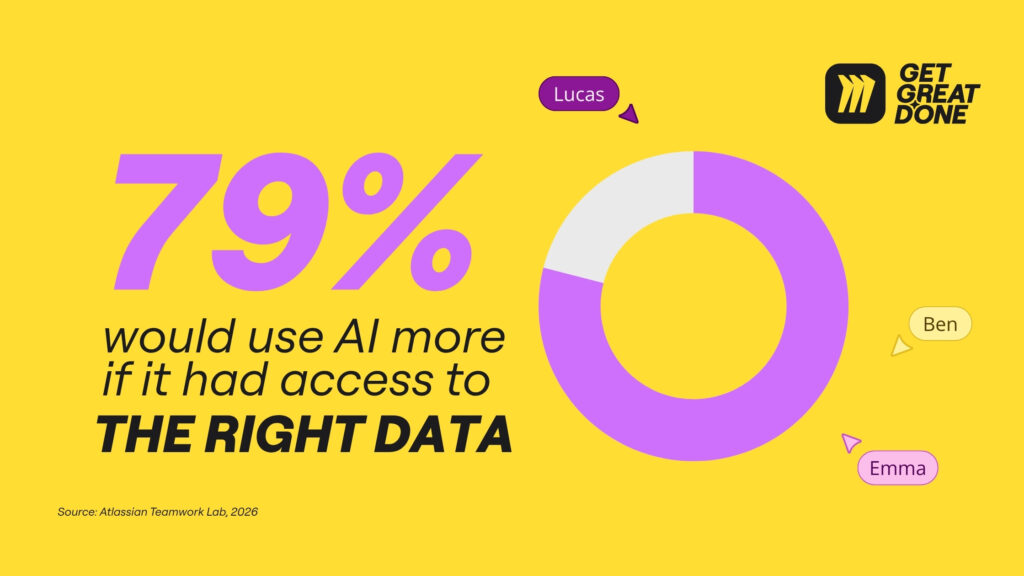
In their absence, AI becomes less useful and less sticky. According to research from Atlassian’s Teamwork Lab, 79% of knowledge workers say they would use AI more if it had access to the right data. “That 79% isn’t an AI readiness gap,” said Chelsea, “it’s a context access gap.”
The job of an operational layer is to provide that context — in systems rather than in someone’s head, in shared norms rather than individual habits, and in work that’s visible enough for AI to reason about it.
This is the shift Nicolas Bonvin, CTO at Pictet Alternative Advisors, described inside his own organization. “AI shifted from being a tech project to being a business project,” he explained. When Pictet stopped asking which tool to use and started asking how work needs to change, the operational layer began to exist.
How to build the operational layer
The organizations generating returns from AI have built the operational layer deliberately, not hoped it would emerge from tool deployment. That means three things in practice.
- First, making work visible — not just logged, but shared and connected, available for teams to build on rather than recreate from scratch
- Second, establishing collaboration norms that define when AI is in the workflow, where human judgment is required, and how teams hand off to each other
- Third, creating shared context that travels with the work itself rather than staying with the person who did it, so AI has authoritative sources to reason over and teams have a common picture of what’s happening
“What’s missing isn’t another tool,” Mural CRO Bill Duyinen said. “It’s a shared way of how we work.” The operational layer is that shared way. It’s what makes the tools at the top observable and safe. It’s what gives the culture change at the bottom something real to change toward. And it’s what scaling AI in the enterprise actually requires — not more investment in the tech layer, but the infrastructure that connects it to the people doing the work.
This is exactly how Miro is evolving. A recent Gartner report revealed that platforms like Miro will create a $58bn market shake up “by delivering industry-specific context and role-based support, tailored to employees’ job functions and collaboration needs within their organizations.”
As we move towards a future where all work will involve human-to-AI and, eventually, AI-to-AI collaboration, every organization will have a critical decision to make about where and how that work happens.