
Ask anyone on your team how AI is going and you will hear some version of the same sentence: “What used to take me a week now takes an hour.” It is the kind of thing that makes a leader feel the bet is paying off. The work really is faster, and the proof shows up every month on the token bill. People are not imagining the speed. A recent METR study of experienced developers found they believed AI had made them about twenty percent faster. Anecdotally, I see people moving much faster.
So here is the question that should be keeping executives up at night. If everyone in the building is moving several times faster, why is the company moving at roughly the speed it was a year ago?
The individual gain is obvious. The company gain has gone missing, and it has gone missing at scale. A survey of around 6,000 executives found that more than eighty percent of firms report no measurable productivity gains from AI, with the winners concentrated in a small handful of technology-intensive companies.
Individual velocity, it turns out, isn’t much more than a vanity metric.
Is it too early to look for ROI?
There is a reassuring story going around to explain all this, and it is the one executives are repeating to their boards. It is the productivity J-curve. Every general-purpose technology, from electricity to the personal computer, takes years to show up in the numbers, because the organization has to rebuild itself around the new tool before the payoff arrives.
Economists even named the earlier version of this the Solow paradox, after Robert Solow’s 1987 quip that you could see the computer age everywhere except in the productivity statistics. So relax! The gains are coming.
Half of that is correct, and it is worth saying so plainly. The reorganization point is right. The payoff really does depend on changing how work is done, not just on handing people better tools, and the researchers agree. MIT concluded the thing holding companies back was not the technology but the failure to rebuild workflows and culture around it.
The trouble is the conclusion. “Be patient” assumes the value is sitting in a queue, waiting its turn to show up. It assumes a lag. And a lag is a forgiving thing, because a lag closes on its own if you simply wait long enough.
You have a leak, not a lag
What is actually happening is not a lag. It is a leak.
The value AI creates is real, and it is created at the level of the individual. Then it drains away at the seams, in the handoffs between one person and the next.
Picture a marketing team launching a campaign:
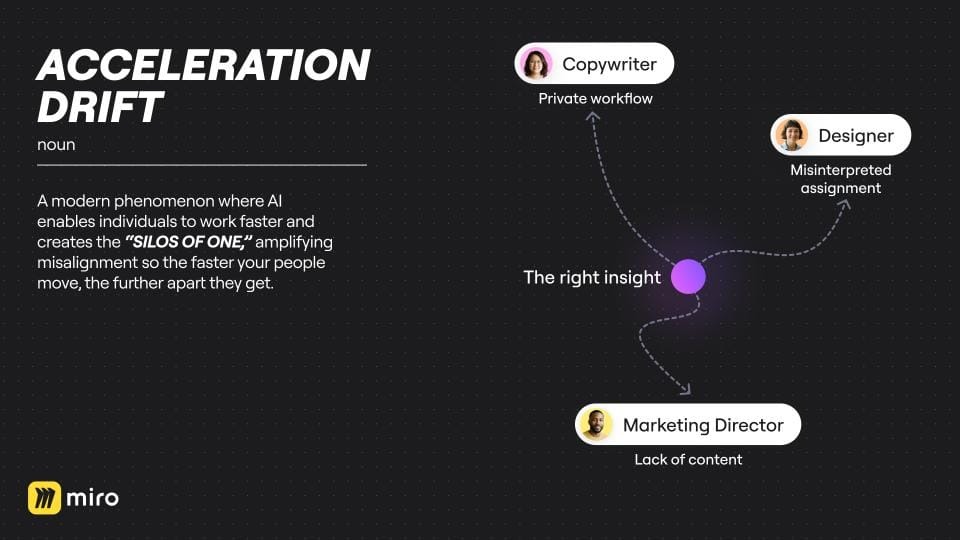
- The marketing director uses AI to chew through customer data in an afternoon and lands on a genuine insight, which is that this audience responds to trust, not to claims about speed. She and the model test angles, discard some, keep others, until she has a sharp brief. The brief looks polished. But the reasoning that produced it, the discarded angles and the why behind the keeper, stays locked in her chat history.
- The copywriter receives a clean brief, sets his own AI to work, and the model does the obvious thing: it leans into speed and efficiency, the exact angle the brief was meant to avoid. The copy looks great.
- The designer builds something sleek to match. Everyone moves fast. Nobody is wrong. And when the three of them finally meet, the work is wrong, because the insight that should have shaped all of it never left the first laptop.
This is what I call Acceleration Drift. The faster individuals move with AI, the further apart they drift before anyone notices.
It is worth separating from the other “drifts” in circulation. This is not an AI agent quietly diverging from its goal, and it is not the slow strategic drift that creeps into any growing company over years. It is specifically human, and it is fast. It is what happens when each person is sprinting and no one is checking the heading.
AI accelerates misalignment
Pilots have a rule of thumb called the 1-in-60 rule. Flying one degree off course over sixty miles puts you about a mile off target. The error is tiny and the consequence scales with distance. One degree is nothing on a short hop. Fly far enough at that same one degree and you arrive at the wrong city.
AI did not change the degree of error. Teams have always slightly misunderstood each other, which is why we invented the weekly stand-up. What AI changed is the distance traveled before anyone corrects the course. A week of divergence now happens between Tuesday and Wednesday, and the check-in that used to catch it arrives far too late.
The leak is structural, not a matter of carelessness, and the data shows it. When engineering teams adopt AI heavily, they complete more tasks and open far more pull requests, but the time spent reviewing those requests climbs a lot. Faros found that, “Median time to first PR review is up 156.6%. Average time spent in code review is up 199.6%. Median time in review is up 441.5%.”
Speeding up one stage does not speed up the system. It moves the bottleneck to the next human seam and makes it bulge. Worse, the leaking work looks finished.
Time will not fix AI transformation. And real change must come from the top.
Here is why the distinction between a leak and a lag is not academic. If you believe in the lag, waiting is prudent. But if it’s a leak, waiting is the most expensive thing you can do.
Here’s what we know from working with some of Miro’s largest customers on AI transformation: upskilling individuals is a bottoms-up approach that hits a local maximum quickly. Giving people all the best tools and latest models with training and hackathons is a great way for people to become comfortable with this new way of working, but it will never deliver company-wide gains. Workflows, not individuals, are the correct unit of transformation.
And here’s where it all comes together. No individual can transform a workflow they don’t fully own. That change has to come from the top down. You have to look at workflows across product, marketing, engineering and sales and rebuild them to be properly AI native. This is much more difficult than adopting technology because it can completely change the way individuals and teams work together.
It may not be popular. In fact, if it is, you probably aren’t going far enough. But once you do, here are some things you’ll start to notice.
- The org chart becomes a workflow chart. Reporting lines dissolve. People attach to outcomes, not managers. You don’t report up, you coordinate with adjacent AI agents running parallel workstreams. The hierarchy is replaced by a dependency graph.
- Middle management becomes a monitoring layer, then disappears. The primary job of middle management—relaying context up and down—is done better by AI. What remains is coaching, teaching judgment, and critical thinking. Most current mid-manager roles as they are defined today are obsolete within 5 years.
- Handoffs are a design failure, not a feature. In a legacy organisation work crosses 6–12 people before completion. In an AI-native org, one human or a very small group of people define the outcome; AI executes across functions. If the number of handoffs in your process did not reduce by a factor of x3 you haven’t rethought it enough — you’ve just sped up the old one.
- Customer feedback loops close in hours, not quarters. AI agents monitor sentiment, synthesise signals, and surface patterns in real time. The gap between customer said X and product changed because of X shrinks from months to days.
- Every decision has a real-time intelligence layer underneath it. No more “let me pull the data together for next week.” AI agents surface relevant signals, precedents, and contradictions in real time — so every decision is made with full context, not recollection.
- Institutional knowledge is no longer locked in people’s heads. The legacy org’s killer risk: key-person dependency. AI-native orgs encode knowledge into living systems — decision rationale, customer insight, competitive context. It becomes organisationally owned, not personally hoarded.
- The bravest leadership decision is deciding what NOT to automate. Every organisation will face the question: what human contact, creative ambiguity, or ethical judgment do we deliberately protect from AI? The answer defines culture. Companies that automate everything lose the human signal that makes them trustworthy.
Every day you spend waiting for the J-curve to bend, the people you so carefully accelerated are drifting a degree further apart, and the cost does not show up on the token invoice. It shows up in the room where three capable people, all moving at remarkable speed, discover they have built three different things.