Give 293 writers the same AI tool and ask them to brainstorm a short story, and something strange happens. Individually, each writer’s ideas came out as more novel and more useful than anything they would have produced alone. Collectively, though, the pool of finished stories gets worse. Researchers who ran the experiment found the stories were roughly 11 percent more similar to each other than stories written with no AI help at all.
The tool that sharpens the individual, dulls the room.
That pattern is now playing out at company scale. Open a handful of banking apps and you’ll find the same AI assistant wearing a different logo: same tone, same flows, same reassuring copy. Everyone is racing to adopt the same models, trained on the same data, and arriving at the same answers.
What gets traded away in that race is the thing that used to justify a premium: the sense that this company, this product, this piece of work is special – and genuinely distinct.
It’s becoming clear that one of the real costs of AI adoption has turned out to be sameness.
Everyone has the same intelligence now
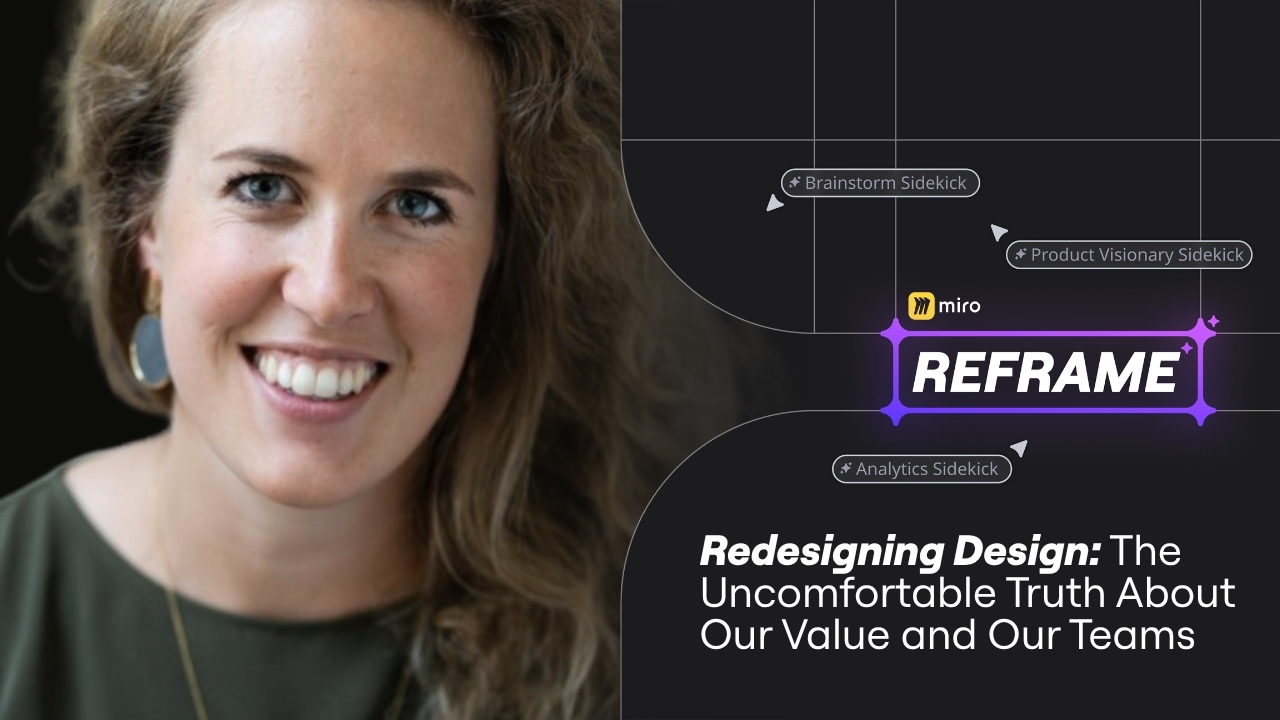
Stephanie Lacher has spent the past year and a half watching that trade-off up close. She leads Tangity UK and Ireland, the design consultancy inside NTT DATA’s global design network, having come up through management consulting at both Bain and Capgemini before switching sides to build design teams.
Her conclusion: we’ve moved from a knowledge economy into what she calls the intelligence economy, where intelligence itself behaves less like an advantage and more like electricity. Just having electricity doesn’t secure success she argues. “What you need to do is use it, and then build upon it.”
For consultancies and agencies, that argument cuts twice. It’s the sameness your clients are shipping into their own markets, one AI-generated feature at a time. And it’s the risk inside your own delivery model, every time a proposal or workshop output leans on the same prompts everyone else is running.
The seat at the table battle, again
This isn’t the first time design teams have had to enter battle. For years, the fight was focused on moving beyond the standard “can you make this look nice?” or “can you make this a bit more polished?”. Successfully proving the value of design in shaping product strategy, rather than just decorating its outputs.
About 18 months ago, at an AI event her own company was hosting, Lacher watched that seat at the table get questioned again. A fellow event attendee cornered her after dinner and told her she must be worried about her team not having a job soon…
Her first reaction was that she wasn’t worried at all. “It’s not about making designs and producing designs,” she says. “It’s about understanding the user need, the human need, and that is a skill that will always be relevant.”
But the comment stuck, because it meant the case for design’s seat needed remaking. Clients have started asking similar questions that hit the same nerve: why spend three months on discovery when AI can apparently get there in three weeks?
Lacher’s answer is to move design up another level. That’s a bigger ask than defending the seat it already has: it means deciding what AI should prioritise, where human judgment enters a process, and what gets automated along the way. Those, she argues, are design questions before they’re anything else.
A lesson from IKEA on upstream thinking
Ingka Group, which runs most of IKEA’s stores, hit exactly that fork, well outside of any design function.
Its chatbot was resolving under half of customer queries, and laying off the 8,500 agents handling the rest would have been the easy efficiency case to make.
Instead, Ingka looked at what those agents actually knew: which products people struggled with, what customers were really trying to solve, how to translate a catalogue into an actual room. The company retrained them as remote interior design consultants, selling paid video consultations instead of closing support tickets.
That new service now runs into the billions in annual revenue, and Ingka has said it wants to keep growing that share, which suggests this wasn’t a one-off efficiency hack. The least automatable thing on IKEA’s payroll turned out to be its most valuable asset once someone moved it upstream. That’s the same shift Lacher argues design itself has to make: from producing outputs to deciding what stays human at all.
Three things to try this week
For design teams still wrestling with how to define their role and where it intersects with AI in this new world – Stephanie shares 3 things you should try this week to help take a step forward on that journey.
Protect one hour, and say so out loud. Block it next week, for yourself or your team, purely for experimentation, and name it as that rather than letting normal work swallow it. Lacher tried mandating AI adoption through everyone’s objectives last year. It fell flat. Giving people permission and space worked better than giving them a target.
Pick one thing to go deep on, and drop something else. Choose a single capability worth building this month, and consciously drop something else to make room for it. Adding AI fluency on top of an already full workload is how the learning never happens.
Run an experiment on one real workflow. Do it once by prompting AI straight from a blank brief. Do it again, but this time decide on paper, before AI touches anything, what should feel distinct about the result. Compare the two honestly and see whether you can actually feel the difference.