The pain of losing something we value registers twice as powerfully as the pleasure of gaining something equivalent. It’s one of the most replicated findings in behavioural science – and it is why so many experienced creative professionals are genuinely stuck right now.
When AI produces in seconds something that took years of practice to develop, it goes beyond feeling threatened, it registers neurologically as genuine loss. A 2026 study in Frontiers in Psychology on algorithmic anxiety found that this is distinct from ordinary job insecurity. Knowledge workers and creative professionals reported questioning whether it even made sense to continue honing skills that AI could now approximate. That is a different kind of threat than “I might lose my job.” It is “what I built myself around may no longer define my value.”
And when that kind of loss registers, we tend to fall into a predictable pattern: we protect what we have built, cling to what we know, and dress avoidance up as discernment.
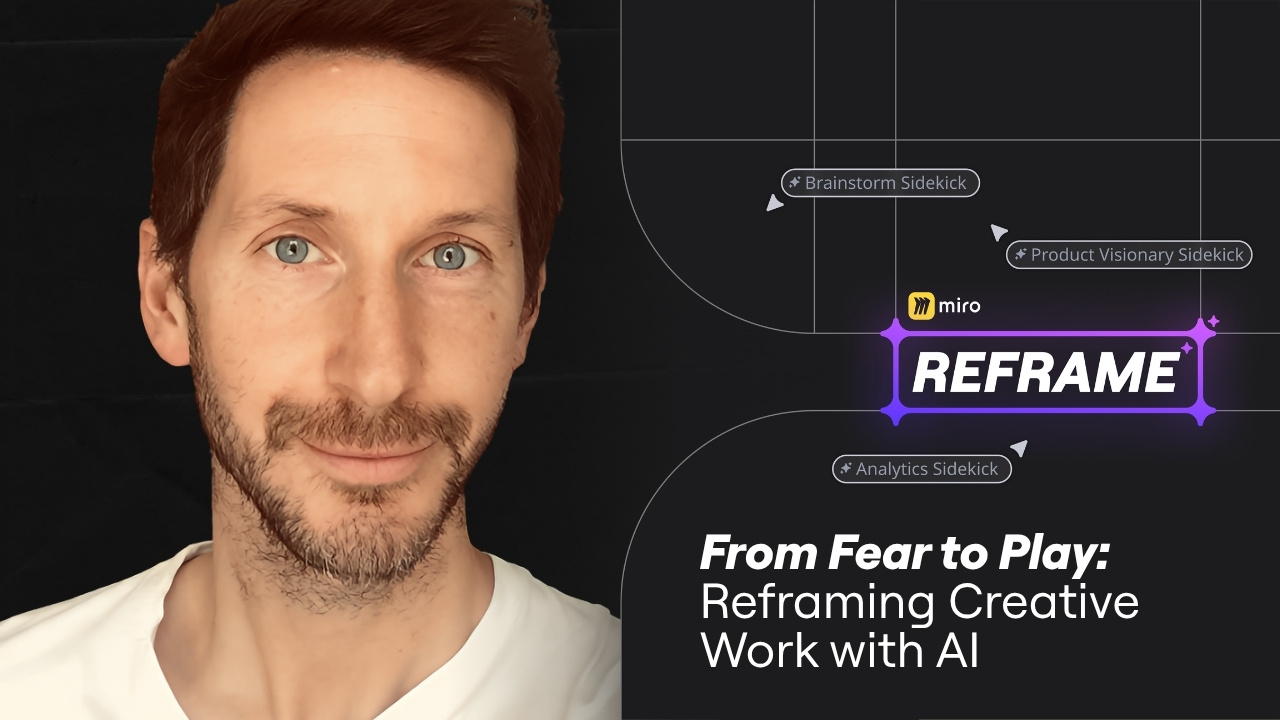
Jerome Ribot has spent twelve years at Coglode translating behavioural science research into practical tools for designers and strategy teams. He lived this transition himself, as a designer and writer who watched AI become capable of parts of his own craft. His key learning from the journey so far – your anxiety is a good thing. The discomfort we feel is in fact data, the first input in a process that when followed through, leads somewhere genuinely new.
“What felt like a loss,” he said, “was really a gain in disguise.”
The thing you’re actually losing
When prospect theory is compounded by sunk cost bias: we feel losses more acutely than gains, and we hold on too long to identities we have invested in. When the skills you’ve honed over years – concept generation, first drafts, synthesising insight – are now cheaply approximated by AI, the emotional response is understandably heavy and often turns defensive.
For agencies and consultancies, the weight of this operates on two levels at once. Your team is navigating it. So are your clients’ teams. The same question is present in both places: how do we define our value and what are we actually charging for now?
“AI may generate,” Ribot said, “but you orchestrate.” What looks like displacement is actually a division of labour that didn’t exist in the pre-AI world. The generation has moved, but the direction, judgment, and taste have not.
From loss to experiment
Ribot’s experiments at Coglode show how that shift works in practice. He ran small experiments, deliberately starting where curiosity outpaced discomfort.
He had already built something strong for a change management training with sixty senior leaders: Barrier Island, a six-zone behavioural science theme park in Miro where participants explored the psychological barriers to organisational change.
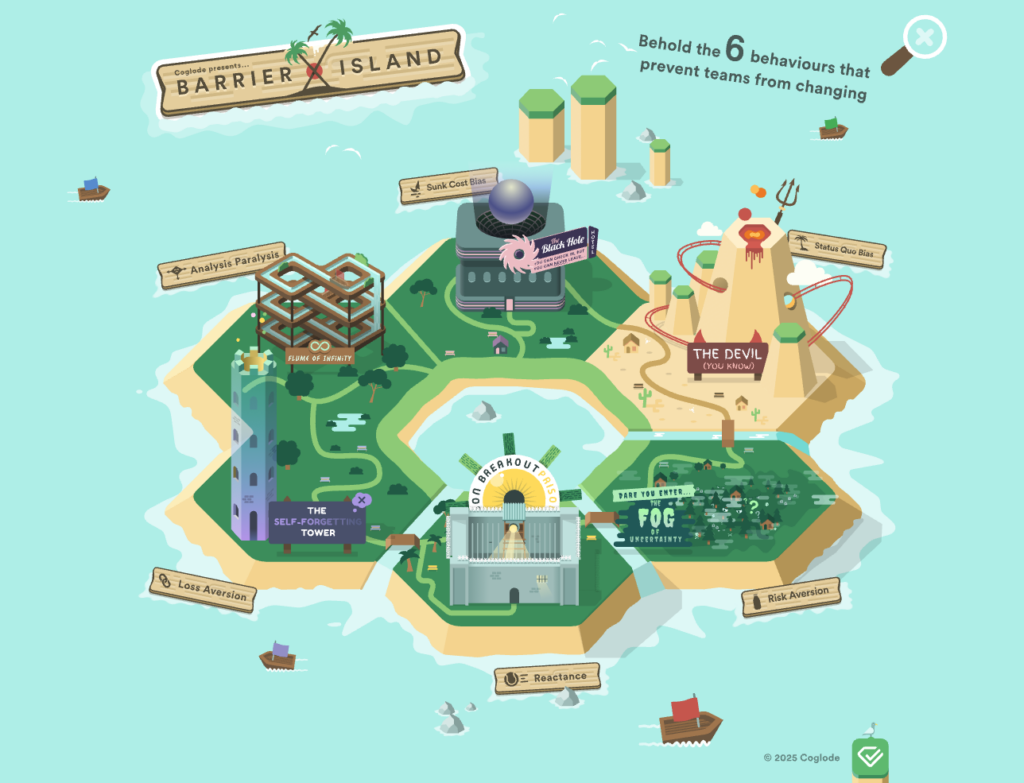
The board worked well. Then curiosity pushed him one step further. He used Suno, an AI music tool, to write and produce a song about the six barriers – not the main event, but a finishing touch on top of work he had already validated.
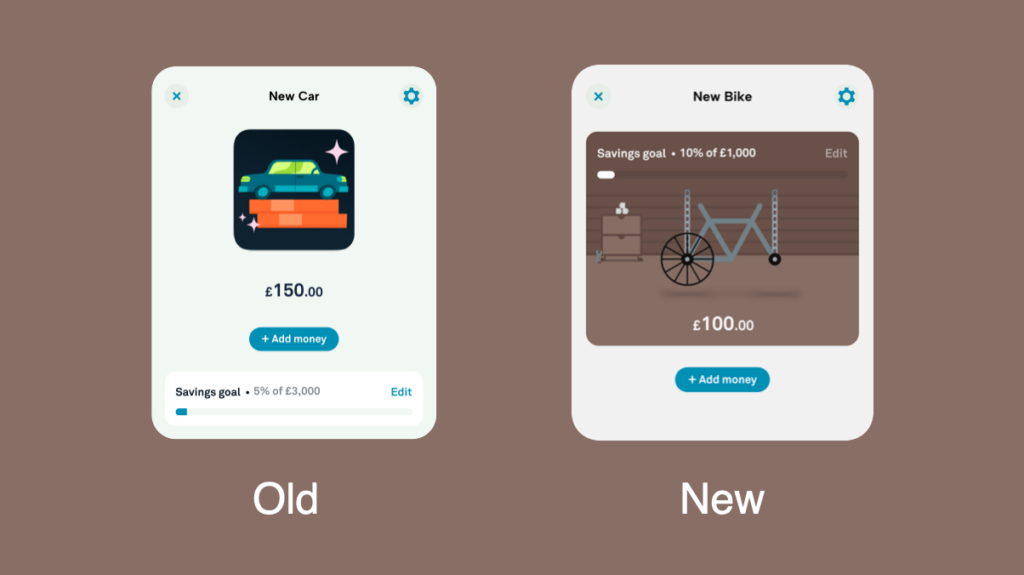
The second experiment went further. A concept for Monzo’s savings feature imagined a visual story unfolding as customers saved toward a goal: a bike assembling piece by piece as the bank balance grew.
Again Ribot turned to music, writing the lyrics himself while an AI tool generated the full track. The result was something he couldn’t have made alone, and that’s what brought out an emotional response. “I cried,” he said. “I’ve never cried at my own work before and I did. I cried twice.”
Each experiment began where Ribot felt competent and curious, not threatened. That curiosity – what he calls a form of play – carried him through the discomfort rather than around it.
What to take forward
Start small, not with a rebuild. Large-scale restructuring creates paralysis. Small experiments that extend what you already do well build confidence. Ribot’s first experiment was a song as garnish on top of validated work – the AI contribution was peripheral, the human design was the structure. That’s a pattern worth replicating.
Separate generation from orchestration, explicitly. For each stage of your delivery process, ask yourself: generation task or orchestration task? First drafts, research summaries, options – good candidates for AI. Diagnosis, synthesis, the call on which direction is right – those stay with you. Making this distinction visible with your team, and eventually with clients, turns it from a concession into a value statement.
Protect your taste. As AI output becomes abundant, work shaped by genuine judgment will stand out more, not less. The contrast effect means that the more average-quality content proliferates, the more clearly strong editorial or creative choices register against it. The value of knowing what good looks like will be the strongest selling point you bring to the table.
The underlying principle is straightforward: AI may generate, but you orchestrate. The output grows while the creative authority stays with the person who knows what good looks like and keeps asking what else is possible.
Watch Jerome Ribot’s live session
This article was based on a Miro Reframe webinar. Reframe is our series for agencies and consultants rethinking what great client work looks like in the age of AI.