Reframe Expert Round-ups bring together some of the leading voices reshaping agency and consulting in the age of AI. Each month we tackle one of the industry’s most charged questions and ask our guest experts to give their honest, unfiltered takes. We aren’t here to give you identical, PR-polished, best practice answers. We’re here to help you navigate the messy middle – including the good, the bad and the ugly.
In the first instalment of the series we’re exploring the AI trust paradox and the dilemma currently facing agencies and consultants:
When clients expect the same output for less money and faster delivery – do you use AI to protect your margins while keeping your methods to yourself? Or do you renegotiate the entire client relationship and show exactly how and where AI is changing how you work?
Why this matters now
This is a question the industry is actively wrestling with, and there’s no consensus answer. That’s exactly why this is such an important and interesting topic to discuss.
At Miro, we’ve seen a dramatic shift in how professional services firms work with clients. Across hundreds of conversations with agency founders and senior consultants over the last 12 months – the same pressure keeps surfacing: clients are arriving with higher expectations, tighter budgets, and a growing awareness of what AI can now do themselves.
The days of opaque delivery, time-based billing and deliverable dumps that never see the light of day after a final presentation are long gone. PwC’s own Chief Digital Officer has acknowledged that clients are now actively replacing the work of “consultants of yesterday” with AI tools.
To win work in this new world, consultants and agencies need to embrace an entirely different operating model. One where AI-enabled co-creation delivers not just artefacts, but operating systems that live on long after the engagement ends. In practice, that means clients joining the work rather than simply receiving it, with visibility into the process as it unfolds, and a stake in shaping the decisions that matter. And it means AI compressing the timeline without compressing the quality of the relationship.
In reality, most firms are still somewhere in the messy middle of this transformation – deploying strategic honesty to meet client demands for transparency, while mitigating the risk of client in-sourcing. As one anonymous expert contributor explained:
“Let’s be honest. AI augments and assists the kind of knowledge intensive work that the consulting and agency world lives for. But it also allows clients to compete with us in new ways and to push us on the value we’re adding. I am keenly aware of the risk of being commoditized, and also (and here comes the real honesty), I want my piece of the value AI brings to this too! So dear client, if you are up for splitting the difference, so am I. But if not. You’ll get better deliverables than ever before, but how exactly they’re made and what it took, I might keep that to myself.”
Read on to find out where the rest of our experts stand on this hot topic and how they’re seeing the consequences play out across the consulting landscape.
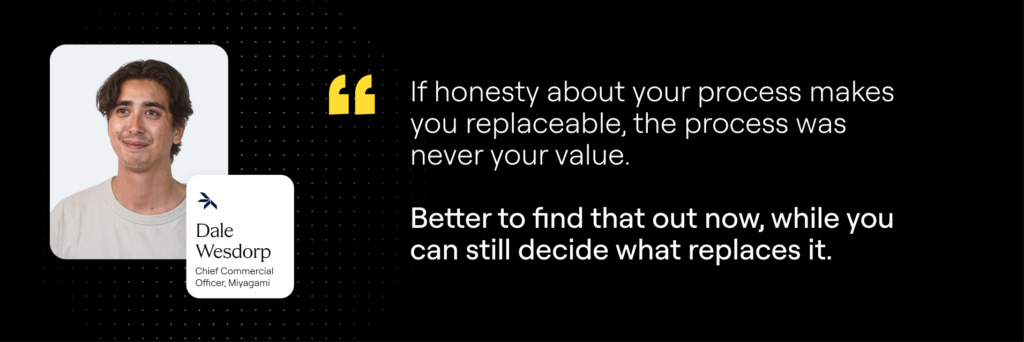
Dale Wesdorp, Chief Commercial Officer at Miyagami
“The honest answer is that we chose transparency, and it cost us before it paid off.
A while back we audited our own workflow, discovery through delivery, and asked which parts actually produced value for the client. The uncomfortable answer: not as much as we were billing for. A lot of it was coordination overhead dressed up as process. AI didn’t just speed that work up. It exposed it.
Exploiting the knowledge gap was never really an option, because the gap is closing on its own. Our clients use the same tools we do. They arrive with prototypes they vibe coded over a weekend. An agency charging human rates for concealed machine output is one screen share away from being found out, and once a client suspects concealment, every pricing conversation becomes a trust conversation.
But transparency isn’t free. Showing clients exactly where AI sits in our process accelerated the question every firm dreads: if effort is no longer a proxy for value, what are we paying you for? The lazy answer is to cut your rates because you’re faster now. That’s a race to the bottom, and it adds no value in the long term; you’ve commoditised yourself, which isn’t a strategy.
We took the harder route. We stripped our process back to the parts that genuinely produce value, and we now share what we learn along the way, what works with AI across the product development lifecycle and what doesn’t, at events and through consulting. Instead of using AI to quietly widen our margins, we turned that knowledge into a new service offering. Better to sell the learning than to fight the shift.
The trade I’d defend: transparency converts margin pressure into a repositioning conversation. Concealment defers the same pressure to a worse moment, on the client’s terms instead of yours.
If honesty about your process makes you replaceable, the process was never your value. Better to find that out now, while you can still decide what replaces it.”
Robert Goesch, CEO at DUMBO
“There is no paradox. There is only a question the industry is asking wrong.
In ten years of running a digital strategy and design agency working with large enterprises, I have never once told a client which tools we use to get the job done. Not Figma, not Miro, not our Slack channel. Nobody asked, and if they did, it was over lunch, out of curiosity, not control. They hired us because they wanted to get somewhere. How we got there was on us.
AI is no different. Using it to accelerate a workflow is as unremarkable as switching to video calls. Something we all just did, and nobody sent a disclosure notice. Using it as an agent, letting it research, analyse, build, and maintain, that is newer and more powerful. And it is still my call. We are not in the body leasing business. We are in the problem solving business. If you bring us in to solve a real challenge, you are trusting us to know how. Who and what we deploy to get there is part of what you are paying for.
Where it genuinely gets complicated is not ethics, it is law. The moment an agent touches client data, you enter a different conversation: processing agreements, ownership of outputs, cross-border risk. None of this is neatly defined yet, and in a world where a single government decision can take an AI model offline overnight, that risk is real. Agencies that have built the infrastructure to work this way are already ahead. Everyone else is waiting.
Recently we built a fully AI-ready multi-brand design system in nine days. The same project used to take ninety. Another agency owner asked me what we should have charged — for the nine days or the ninety. That question is exactly what this debate is really about. And it is the wrong one. The right one is much harder: how do we get to value faster?”
Stephanie Lacher, Head of Tangity
“A year ago, many teams quietly used AI behind the scenes to accelerate research, synthesis, ideation, and production. There was a genuine debate about whether to disclose it. In my opinion, today that conversation feels completely outdated.
Clients expect us to use AI.
The reality is that few organisations are willing to fund months of research and weeks of synthesis before seeing outcomes. AI has fundamentally compressed delivery timelines, and the traditional design process has been disrupted. Hiding AI use no longer protects margins. It misses the point.
The more important question is what value consulting and design teams provide when everyone has access to the same tools.
For many organisations, the challenge is not access to AI but knowing how to use it effectively. We increasingly see client teams generating what many call “AI slop”: large volumes of outputs that look polished but create little value. We also see non design practitioners producing impressive looking prototypes that spark excitement but lack validation, coherent information architecture, or a clear path to implementation.
This is where design leadership matters. Our role is shifting from creators of artefacts to advisors of responsible adoption. We help organisations understand where AI adds value, where human expertise remains critical, and how to position AI generated outputs appropriately. At Tangity, we have started using the term provocatype for concepts designed to provoke discussion and explore possibilities rather than represent production ready solutions. We urge our clients to label those artefacts transparently.
For more AI mature clients who might actually be ahead of us (which can be scary), our role evolves again. The value is not education but partnership. The technology is moving too quickly for any organisation to solve alone. The most successful relationships are becoming collaborative experiments where clients and consultancies learn, test, and shape the future together. More hands, more brains, more perspectives will lead to better results.
Whether your client needs you to be the advisor of responsible adoption, or the partner in collaborative innovation – the pressure to deliver faster with AI has created these two new opportunities for consultancies.”
Tom Castle, VP Strategy & Transformation at Futurice
“Last year, we ran a discovery project with a new client. Before we started, we had an honest conversation: we plan to use AI across this engagement. Some of it is established (transcription, synthesis, pattern finding etc.), some of it is experimental, and we haven’t fully worked out where it adds value yet. We want you involved in figuring that out.
The client’s response was better than I expected. They brought in their own people. They experimented alongside ours. By the end, we weren’t just delivering findings, we were handing over a team that knew how to do this kind of work. That’s not incidental. That’s the whole point.
Futurice has been building digital products and services for 25 years. The consistent pattern across the engagements that really created long term value, not just delivered to spec, are the ones where the client didn’t just want the end result, they came inside the process to learn from how we work. They understood how we thought, why we made the calls we made, what we learned along the way.
The same logic applies to AI. Firms that are hiding their AI use from clients are making a choice that feels commercially safe, but is actually commercially fragile. They’re optimising for short-term margin at the cost of the thing that’s hardest to replicate: trusted, embedded partnership.
Our clients aren’t paying us for our prompts. They’re paying for cross-industry experience, for practitioners who’ve navigated this kind of uncertainty before, and for the judgment to know which experiments are worth running. None of that is diminished by being transparent. It’s demonstrated by it.
The knowledge gap will close. Build on something that lasts.”
Sunny Bonnell, Co-founder & CEO at Motto
“The question assumes the real tension is transparency versus secrecy. I think the deeper issue is whether clients are paying for effort or outcomes.
For decades, professional services have been built on an invisible equation: more hours equals more value. AI breaks that equation. Now, a task that once took ten hours may take one. The temptation for agencies is to preserve the old economics by hiding the new reality. The temptation for clients is to assume the work should now cost ten times less.
Both sides are asking the wrong question.
Clients have never hired Motto® for the number of hours we spend. They hire us for perspective, experience, and outcomes. They buy the ability to make sense of ambiguity and move toward a future that isn’t obvious yet. AI can accelerate parts of the process. It cannot replace the responsibility of aligning the right decisions to an organization. That’s still a leadership decision.
We have more creative power than ever. But less creative meaning than before. AI can generate information. But can it manage meaning?
AI is remarkably good at identifying patterns, synthesizing knowledge, and expanding the range of possibilities. The harder challenge is deciding what matters, what an organization should stand for, and which future is worth pursuing. Those choices sit squarely in the realm of human judgement.
That’s why I believe radical transparency is the right path. Not because clients need a play-by-play of every tool we use, but because trust has become the most valuable asset in professional services. When clients understand what is changing and what remains uniquely human, the conversation shifts away from hours and toward impact.
AI changes how work gets done. It does not change why great work matters. AI should serve the idea, not the other way around.”
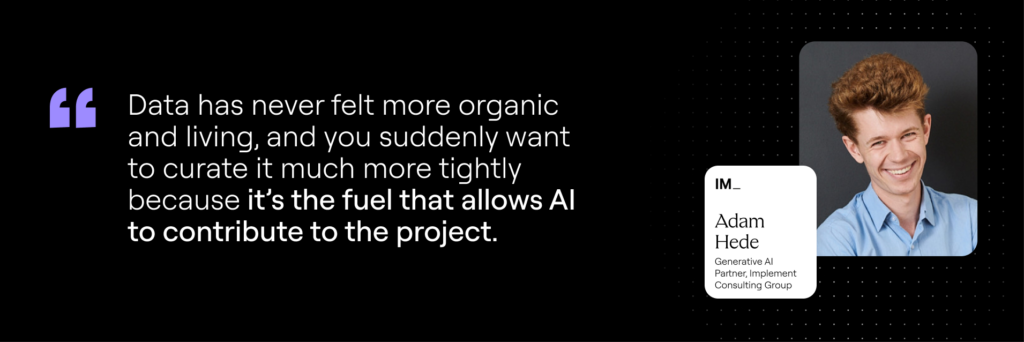
Adam Hede, Generative AI Partner at Implement Consulting Group
“AI is a fantastic collaborator. I’m really excited about new three-way co-creation between consultants, clients and the AI models. Our work is changing almost week by week and we’re seeing more clients enable high-powered modern AI platforms. Sharing new formats, splitting form and content much more explicitly. Redefining what a draft is compared to a final product.
For example, on a recent engagement, we started out in traditional PowerPoint for everything, mainly due to habit from the consultants. After just two weeks, everything was running in HTML, and the client deliverable became almost a little stand alone application of knowledge. We developed new ways of storytelling that were much more product-tour-like, instead of a linear PowerPoint. But also honestly, at week 8 – PowerPoint was also back. The familiar format and conventions still had legitimate strength, and today the project runs in multiple formats depending on the type and maturity of the deliverable.
The knowledge generated as part of the project is particularly on my mind these days. Data rooms, project memories and miro boards are assets that’ll live on long after the project is finished. We’ve had the first client ask for deliverables to be handed in as raw markdown files. Data has never felt more organic and living, and you suddenly want to curate it much more tightly, because it is the fuel that allows the third party (the AI) to contribute to the project. And man, does the AI contribute!”
Where this leaves us…
Strip away the surface disagreements and something clarifying emerges: this debate isn’t really about disclosure. It’s about what the value proposition of professional services looks like when effort can no longer stand in for value.
While our experts each had a unique POV, what they all point toward is a shift in where the client relationship is constructed. The landscape is moving towards transparency, towards co-creation, and toward a model where value is built inside the relationship rather than handed across a table at the end of it.
AI has acted as both a forcing factor for a shake-up in the traditional business model – and an enabler to create the vision of what comes next.