Last November, a Fortune 100 company sent an RFI to every consulting supplier on its roster. The ask: justify your rates, list your AI tools, and quantify the efficiency savings you’ll pass on.
Most consultancies responded with efficiency projections. They didn’t make the cut.
Mosaic Innovation reframed the question entirely. Not just efficiency savings – three to five times the value through reimagined workflows. They made the cut. Colin Duff, Mosaic Innovation‘s CEO, is direct about what that moment signals: the firms still selling on doing are losing ground to the firms selling on judgment.
Duff has spent twenty years doing innovation work for clients including HP, BT, Marriott, and Unilever. He joined our third Miro Reframe session to lay out where AI has moved value in the innovation process – and what wins the RFI in today’s market.
What has been commodified
By Duff’s account, AI now beats most people at standard idea generation, both in novelty and in volume. The skills that used to command fees – writing a compelling concept, synthesizing qualitative research, running a structured brainstorm – are becoming the floor.
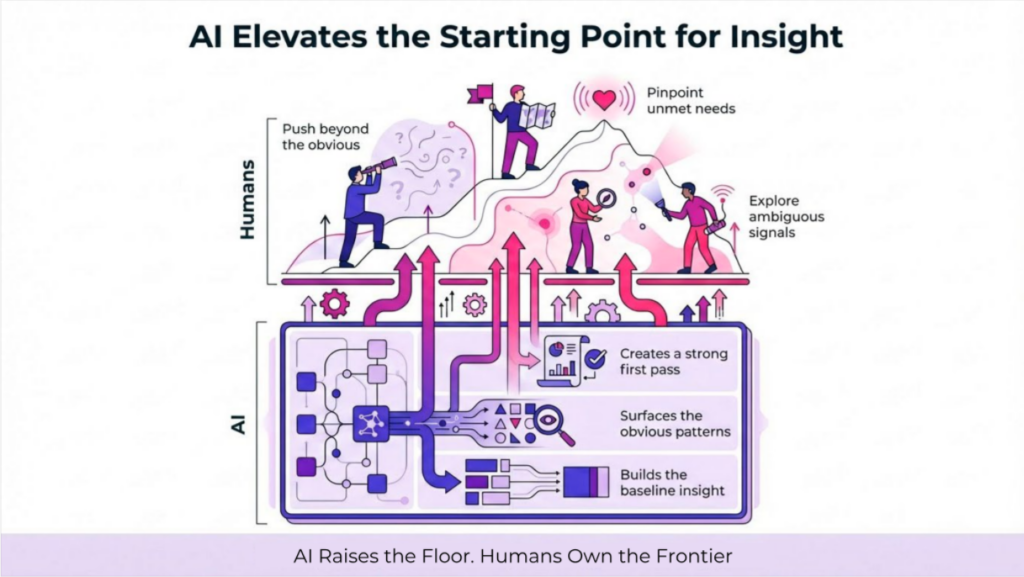
“The biggest value,” Duff said, “is in how you frame the problem.” Give AI the wrong frame and you’ll get excellent answers to the wrong question.
His favourite illustration of this concept in action: NASA reportedly spent millions developing a pen that could write in zero gravity. The Soviet space program used a pencil. Both executed competently on the problem they were given. But the framing of the problem itself was wrong.
“The RFI is coming for everyone. The question is whether your answer is about efficiency – or about something that cannot be replicated.”
The three skills that moved upstream
While AI is commoditising key parts of the agency and consulting value chain, Duff identifies three things AI cannot reliably replace:
Problem framing. Diagnosing which question is actually worth answering, before any generation begins, is a fundamental and valuable skill that still sits firmly in the remit of human judgement. In the AI era, clients can write concepts and generate options themselves. What they struggle to do is step back from their own brief and ask whether the problem they are tackling is actually the problem worth solving. That diagnosis is the upstream leverage.
Insight interpretation. “If you put the same qualitative research transcripts into two different models,” Duff said, “the variance in their analysis is significant.” Where models agree, you have a baseline. Where they diverge, that’s the interesting territory where you’re expertise and judgement become most valuable. That’s the job clients pay you for.
Prioritization. Digital prototyping costs are approaching zero, and AI can generate dozens of concept variants in seconds. Innovation failure rates haven’t dropped, because more ideas was never the bottleneck. Deciding which ideas deserve resources is. That’s where the leverage sits now.
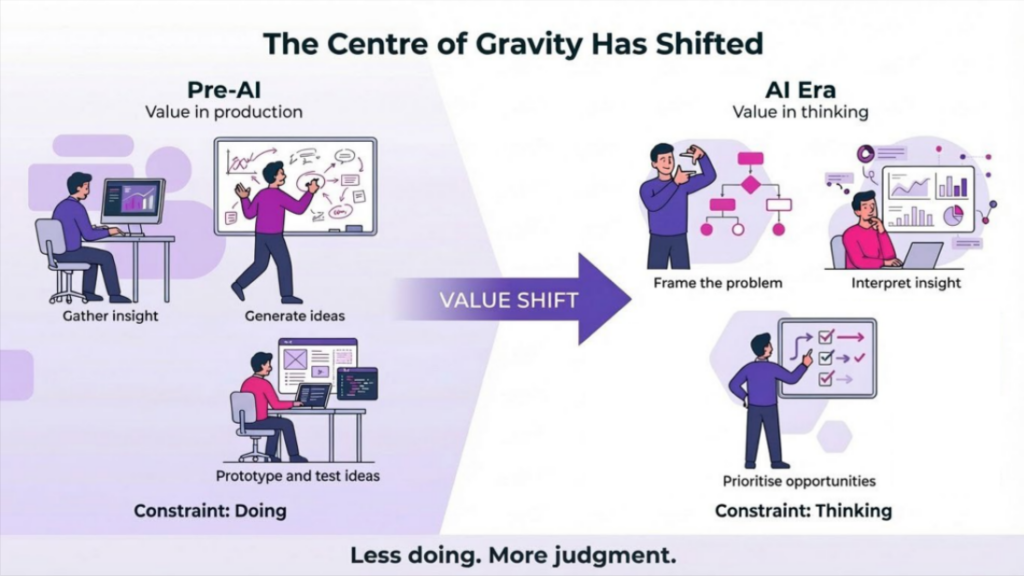
Your clients are generating more ideas than ever. They’re not getting better at deciding which ones are worth pursuing. That’s the role worth positioning for.
What Mosaic actually does differently
Two changes, both simple, but surprisingly impactful.
Load context before the brainstorm. Upload every prior consumer study, persona document, and available research before the session starts. Context, Duff notes, matters two to three times more to output quality than the prompt itself. A well-briefed model raises the floor human judgment operates from; an empty model produces generic output your client could get without you.
Run the same brief through two models and compare. Not as a sanity check – as a deliberate step in your method. Where the outputs converge, you have a working baseline. Where they diverge, sometimes dramatically, that divergence is where you focus your attention. In Miro, Duff demonstrated this live using a custom SCAMPER sidekick, which took one idea (chefs on demand, Uber-style), applied seven ideation lenses at once, and returned over thirty provocations in seconds. The team’s job wasn’t to generate. It was to judge what came back.
Firms doing this consistently aren’t just moving faster. They’re competing at a different level of the value chain, delivering something structurally harder to replicate – which is exactly what won Mosaic that RFI.
What to take into your own practice
Audit your last three deliverables. For each, find the decision that most changed the project’s direction. Was it upstream – which problem to solve, or downstream – how to execute a problem that’s already defined? Mostly downstream means you’re in commodifying territory.
Start the next project with a problem-framing session, before any generation begins. Bring the client into a shared workspace and map the assumptions behind the brief: what does success actually require, and what would need to be true for the obvious approach to fail? This is genuinely hard for clients to replicate without you.
Make your judgment visible. Show the client where model output ended and your team’s interpretation began – in the analysis, the prioritization call, the reframe of the brief. That visibility is what gets priced. It may feel uncomfortable at first pulling back the curtain to show exactly how and where you’re using AI in client delivery work. But it’s an important step in confidently defining your value in the post-AI landscape.