For years, the consultant–client relationship was built around scarcity. Building was expensive, so the job was to reduce risk by testing assumptions before committing to a direction. When prototyping was slow, specialist, and costly, the work naturally centered on narrowing options early, reducing risk before anyone built anything, and moving through a fairly linear process from discovery to delivery. A large chunk of consulting value sat in helping clients make careful choices before committing time and money.
AI has changed that. We can now prototype ideas in minutes and explore far more possibilities than ever before. The constraint is no longer our ability to build – it’s our ability to decide where to focus.
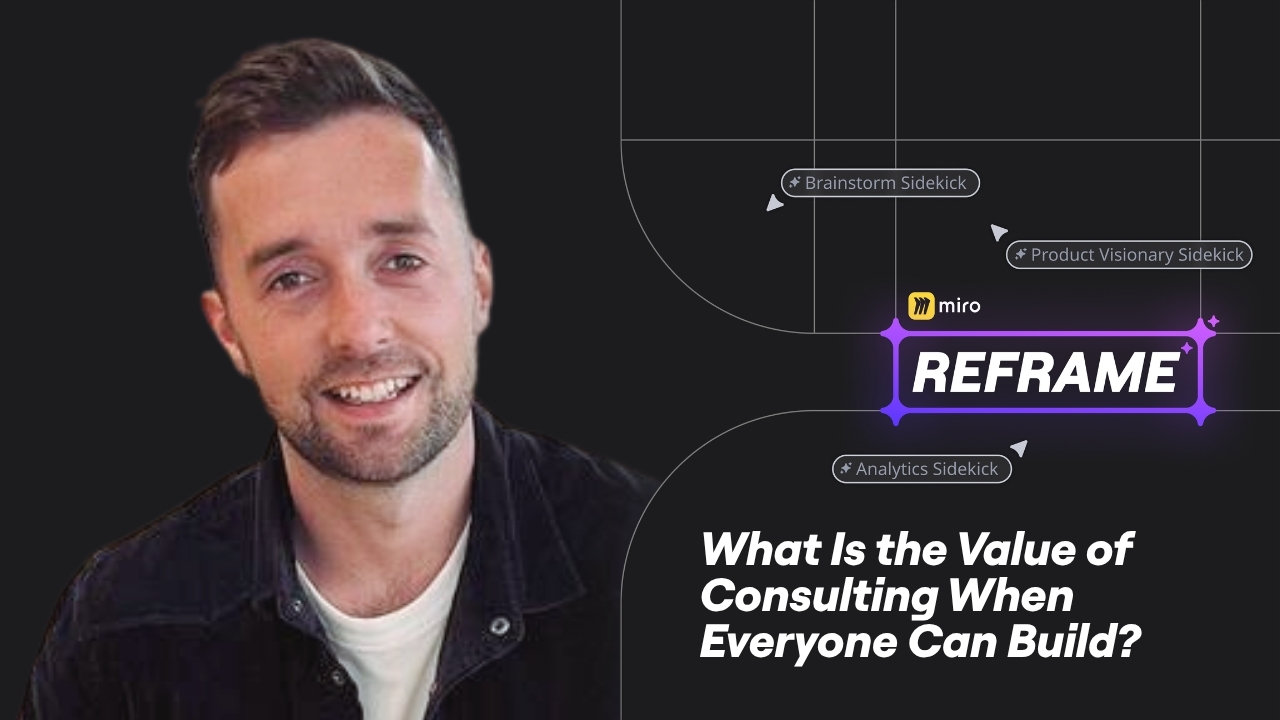
Rory Keddie has watched this shift from both sides. He spent over a decade as an innovation consultant, most recently at Magnetic, building products and propositions for clients including Condé Nast and the Guardian, before moving to Miro as Principal Product Evangelist, where he now works with enterprise clients on AI transformation. His view: AI represents an opportunity to reshape consulting from the ground up – creating more collaborative engagements, helping clients explore a broader solution space, and ultimately delivering greater value and better outcomes.
In this article Keddie walks through the 3 key shifts he’s seeing that have changed where consulting value actually lives.
The shift from scarcity to abundance
Take discovery. The old model made sense because Design Thinking and Lean Startup were built for a world where building was the expensive part. You spent weeks de-risking a decision before committing resources to it. Scarcity shaped the process.
Today – that math has flipped. A team can now generate several working prototypes in the time it used to take to draft one wireframe. The constraint has moved upstream: from making things to deciding what’s worth making.
Answering that question well takes judgment about which problem actually matters and the discipline to keep exploring after the first plausible answer shows up. AI makes it just as easy to fall in love with the wrong idea quickly as the right one. Speed does not equal alignment, and abundance without a filter produces its own kind of failure: a scatter of half-built directions with no through-line, getting dangerously close to “AI slop” territory.
The shift from delivery to co-creation
The second casualty of the old delivery relationship: brief, disappear, come back with a deliverable. When prototyping takes hours instead of weeks, there’s no good reason to work that way, and the more durable model looks like co-creation, client and consultant in the same room, building and revising together rather than handing work back and forth.
That’s a harder sell to a client used to paying for a finished artifact, but it’s a better description of where the value now sits, not in the artifact, but in the thinking behind it, and in a consultant’s willingness to make that thinking visible rather than polished.
A decision that never had to survive real debate rarely survives contact with the client’s own organization afterward, when people who nodded along in the room go back to departments that weren’t in it. The workshops holding up best right now treat AI as another participant supplying input alongside the humans in the room, not as the one deciding what the group has agreed to.
Forward-thinking consultancies have already started weaving this new AI-enabled cocreation model into their service offerings, leveraging AI workflows and custom built sidekicks to run workshops with clients. The output of this new workshop model isn’t a deck handed back next week. It’s a working prototype, built with the client, in an hour or two.
The shift from hours to outcomes
As more execution becomes compressible, consulting firms also have to rethink how they price and structure their work.
The traditional billable hours model often depended on time-intensive analysis, deck production, and layers of staffing. But if research, synthesis, prototyping, and iteration can all happen faster, clients will increasingly question why they are paying for duration instead of results.
That pushes firms toward a different model:
- Smaller teams
- More senior judgment
- More AI-enabled execution
- More emphasis on outcomes over activity
Several consultancies now let AI handle the first draft of research and analysis, the traditional home of junior billable hours, while reserving human time for judging what the AI missed and building the alignment that a synthetic summary can’t manufacture. That’s a genuine structural change. With fewer people doing more of the thinking, industry commentary has started describing a shift from a “pyramid” staffing model to something closer to an “obelisk”: a thinner base of juniors, a heavier concentration of senior judgment near the top.
This does not mean all consulting becomes faster, lighter, or easier. It means the work clients are willing to pay for becomes more concentrated around expertise, context, judgment, and trust.
Three Things to Take Into Your Practice
Stop taking briefs away to work on alone. Bring the client into the building itself, not just the kickoff and the reveal, so misalignment surfaces while it’s still cheap to fix.
Treat AI as a participant in the session, not a private research assistant. One practitioner here described inviting AI agents into strategy workshops the way his firm once invited McKinsey or BCG: a voice in the room whose input still has to survive a real human argument before anyone signs off.
Narrate your judgement calls as you build. A live prototype built in front of a client is genuinely persuasive, but its real value is in what it lets you say next: why this idea and not that one, what you’re deliberately not building yet and why. This helps the client see the expertise behind the speed, rather than just the speed itself.
The biggest opportunity isn’t to use AI to make today’s consulting model more efficient. It’s to rethink the relationship between consultants and clients altogether. As the cost of building falls, consultants can spend less time producing deliverables and more time solving problems alongside their clients – exploring more possibilities, making better decisions and focusing relentlessly on outcomes. That’s how consulting becomes more valuable, not less.