Where do you carve out space to preserve human ownership in an AI-native innovation workflow? That was the question posed to Todd Reily in his recent Reframe webinar session.
The two areas he most wants to preserve as distinctly human are finding the right problem and making the creative leap once you’ve found it.
Beyond that, AI becomes a powerful collaborator – expanding the solution space, accelerating learning, and helping teams validate ideas at a depth and scale that used to be impractical.
Reily runs RightThing.io, an AI-native innovation studio launched this year after nearly a decade leading design thinking at Bose, where his team contributed to two TIME Best Inventions of the Year. The mistake he sees played out again and again in innovation work: most companies bolt AI onto a process after discovery is finished, rather than building it in from the start.
To demonstrate his innovation process in action, Reily ran through each of his 3 core phases for an imagined company that wanted to help people achieve deep focus.
Finding the right problem: The one place AI carries the least weight
Finding the right problem is the first step in Reily’s innovation workflow and the one where AI matters least.
Large language models are anchored to existing knowledge, which is why they can’t reliably surface genuinely unmet human needs on their own. Anticipating where behavior is headed requires watching people inside the chaos of their actual lives: the messy desk, the barking dog, the schedule that never holds. LLMs can synthesize what already exists, but they can’t replace human observation in the wild.
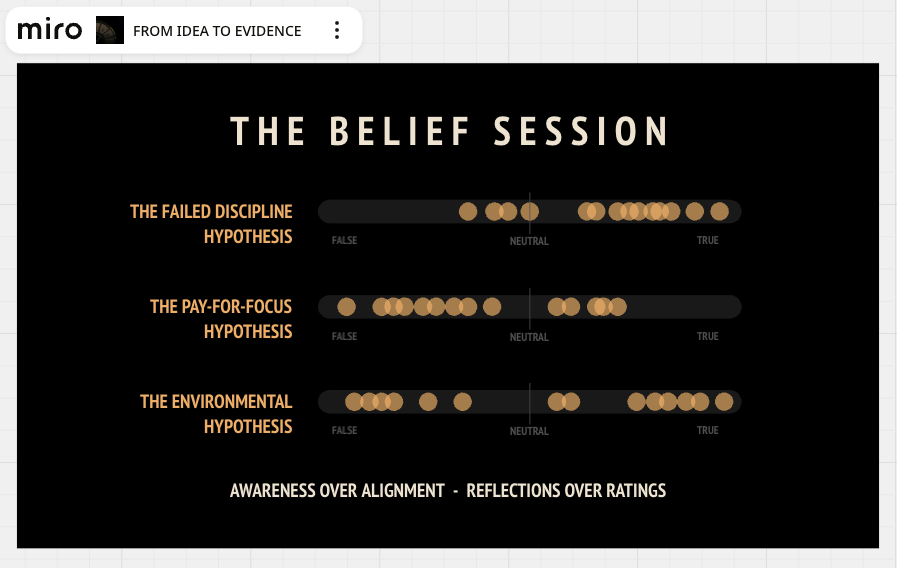
During this phase, early observations become named hypotheses, which he then tests in a “belief session.” In this team ritual, beliefs are mapped on a spectrum from certainly false to certainly true – surfaced, voted on, and discussed. The goal isn’t consensus. As Reily puts it, “the value from this isn’t the votes, it’s the reflection and debate that follows.” A room that agrees too quickly usually hasn’t said what it really thinks.
Once the problem is clear, AI becomes a collaborator
Once a hypothesis has weight behind it, AI’s role flips from peripheral to central.
Virtual researchers – like AI interviewers built with Claude Code and similar tools – run unscripted 5- to-7-minute conversations that probe more like experienced interviewers rather than static surveys. This lets teams generate rich qualitative input at a scale traditional research rarely can: hundreds of responses in days rather than weeks. Reily shared one recent example of running 185 interviews in four days.
The same shift happens on ideation. During this stage, he shared an example activity called “Find Your Idea” where teams map work across why, how, and what, with a deliberate rule against jumping straight to solutions. Instead, they first generate a dozen or more strategic directions before turning those into tactics and concepts.
A vibecoded AI tool then generates more strategies and fills in tactics – abstract enough to trigger new thinking rather and reveal blind spots, rather than hand over finished answers. As Reily put it, when it works well, “it’s kind of unclear where one starts and the other begins.”
The target is roughly 100 ideas across the full solution space, and the work doesn’t need to only happen live. A persistent Miro board lets people contribute independently between sessions, away from what Reily calls the “weird social forces” of live brainstorming. Strengthening rounds then help pull it together – two minutes per idea, no debate.
From there, concepts can be refined through tools like idea-riffing exercises, synthetic audiences, and even an “AI shark tank” – but always with human judgment layered over the top. These techniques help stress-test ideas and widen perspective; they don’t replace the team’s role in deciding what’s worth pursuing.
What human-AI innovation unlocks
While there’s no doubt that the addition of AI into typical innovation workflows creates significant efficiency gains, Reily argues that the speed isn’t really the point:
“Innovation isn’t about efficiency, it’s about finding the right thing. When you can learn quickly, you can try stranger, bolder things.”
In this framing, speed matters only because it gives teams more attempts, more variation, and more room to test ideas they might otherwise dismiss too early.
A cycle that used to take 6 months now runs in 3 to 5 weeks. The gain isn’t just faster delivery – it’s about ambitious exploration, where teams can create more attempts to shoot on goal.
As Reily succinctly puts it: “It’s not an either-or between human and AI. It’s a question of how to get the most out of AI while retaining what’s distinctly human in the process.”
3 things to take into your own practice
- Draw the line and hold firm. Decide which stage stays human-only, usually framing the problem and the creative leap, and hold that line before deadline pressure lets AI fill it in.
- Delay solutioning. Force a round of strategic directions before sketching a single idea. Push for ten or more, then let AI expand each into variants rather than jump to the obvious answer.
- Ask why, not just what. Validate at scale with AI-led interviews that probe reasoning, not preference. The real insight usually lives in why someone chose something, not what they chose.