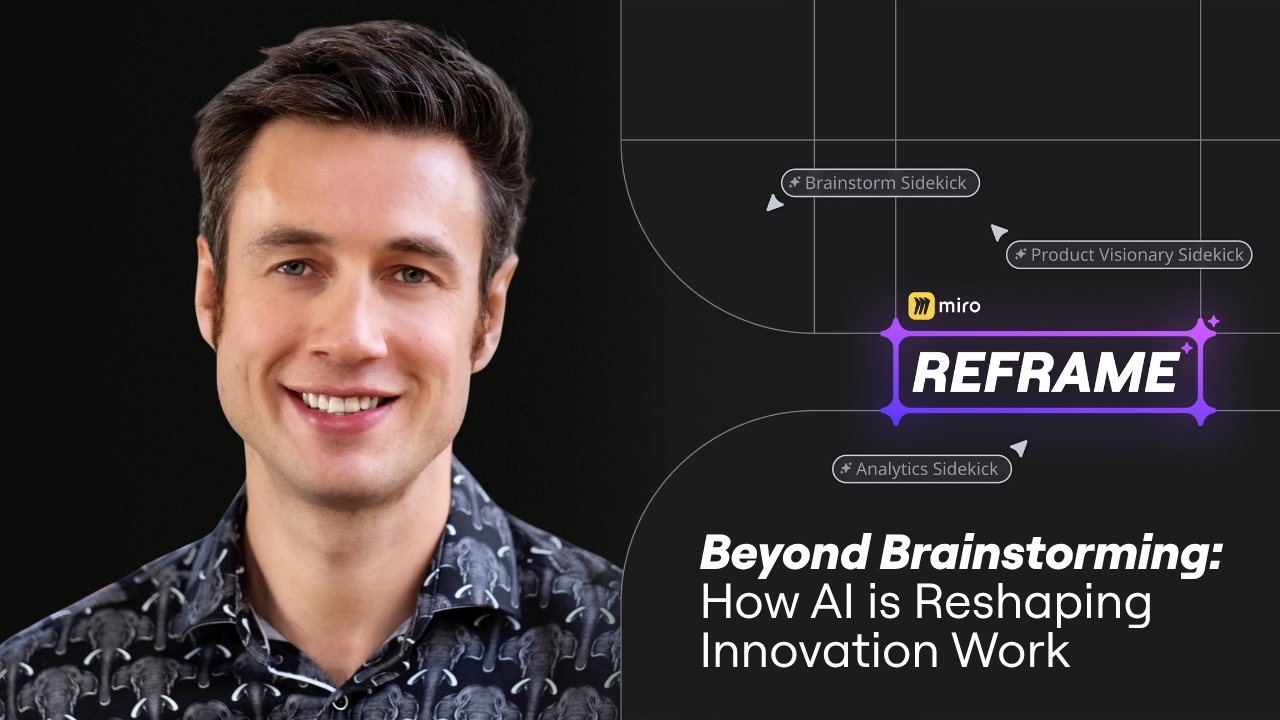
Reframe Expert Round-ups bring together some of the leading voices reshaping agency and consulting in the age of AI. Each month we tackle one of the industry’s most charged questions and ask our guest experts to give their honest, unfiltered takes. We aren’t here to give you identical, PR-polished, best practice answers. We’re here to help you navigate the messy middle – including the good, the bad and the ugly.
The billable hour model has been under pressure for a long time.
Nevermind agency and consulting, the true OG hourly billing industry has always been the legal sector, and complaints about the model highlighting where it falls short are nothing new. Way back in 2009, a Cravath litigator called the billable hour model “nuts” in Forbes, pointing out that “the billable hour makes no sense – not even for lawyers.” In the years since, an entire cottage industry of value-pricing consultants has sprung up making the same case to agencies and law firms alike.
And yet almost every invoice in the industry still counts hours…
The interesting question was never whether the model is broken – it’s what has kept something everyone dislikes standing for this long, and what will it take to put the final nail in the coffin.
Why this matters now
From hundreds of conversations we’ve had with agency founders and consulting leaders, one thing is clear: AI didn’t start this argument, but it’s forcing it into the open. When a task that used to take 20 hours now takes 5, billing by the hour cuts your revenue by 75% for the same outcome. We quickly enter a world where billable hours stops rewarding expertise, and starts rewarding whoever’s slowest.
Clients have noticed too – plenty are already asking outright for an “AI discount” which is really just the client running the same math from their side of the table.
The obvious fix – price the outcome, not the hours – is where things quickly get much harder than it sounds. Tying your fee to a client’s KPI means betting on numbers you don’t fully control, and inheriting their business risk along with your own. It also means having a conversation most engagements skip entirely: what is this actually worth to you, and who’s holding the risk if it doesn’t land? That’s a far more collaborative, more uncomfortable conversation than sending over a rate card.
As much as AI has forced the billable hours issue to the forefront, it’s also created an opportunity to define and build the value system that replaces it.
We’re seeing first hand how forward thinking consultants and agencies are redesigning their entire service offerings from the ground up, with AI woven in throughout the workflow. These new differentiated services provide a real opportunity to reframe the business model and finally embrace an approach to billing that moves beyond time as the core proxy for value.
Recent research found that 38% of U.S. digital agencies have already moved at least one service line from hourly to retainer-plus-performance or pure outcome-based pricing. And at the enterprise end of the industry, WPP – the world’s largest advertising holding company – now generates 20-25% of net sales from performance linked fees, with a public commitment to move away from time-based billing entirely in the near future.
So: what’s actually kept a system everyone calls broken alive this long? And once time stops being the proxy for value, what replaces it?
Read on to see what our experts have to say.
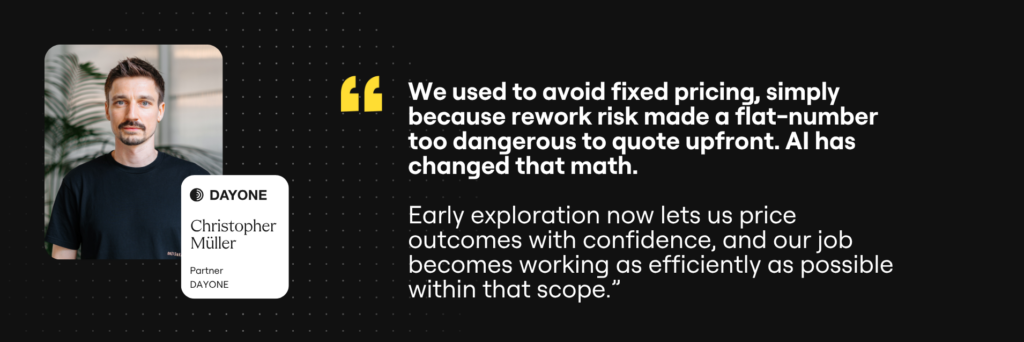
Christopher Müller, Partner at DAYONE
“At DAYONE, two patterns come up often when we propose value-based pricing instead of day rates to clients.
The first is familiarity. Day rates need no explanation, everyone from the C-suite to procurement to finance already understands them. Value-based pricing has to be explained, and anything explained gets treated as risk.
The second is measurability. We build digital products for end customers or internal use. Our core KPIs are additional revenue and cost saved, but both move for many reasons, making our contribution hard to isolate.
Our approach to value-based pricing has been to learn and collect insights rather than wait for a perfect model. On some projects, we pair day rates with variable pay tied to outcomes we help create. As one example, we built a digital tool guiding prospects through part of their journey toward an easier and informed buying decision. For the variable pay, we considered several metrics (e.g. funnel-stage conversion, registrations, drop-off points). Combining several metrics for this purpose got complicated fast, especially since other parts of the client’s organization also influenced those numbers. In the end, we committed to the one KPI that mattered most, already tracked in the client’s own reports.
Yet we see day rates with variable pay as a bridge, not the destination. Our hypothesis is that fixed pricing, one price for a defined outcome, is what real value-based pricing looks like. We used to avoid this, simply because rework risk made a flat number too dangerous to quote upfront. AI has changed that math. Early exploration now lets us price outcomes with confidence, and our job becomes working as efficiently as possible within that scope.
We think this is fairer for both sides. For the client, the price reflects the outcome’s worth and gives investment security. For us, it rewards efficiency and effectiveness.”
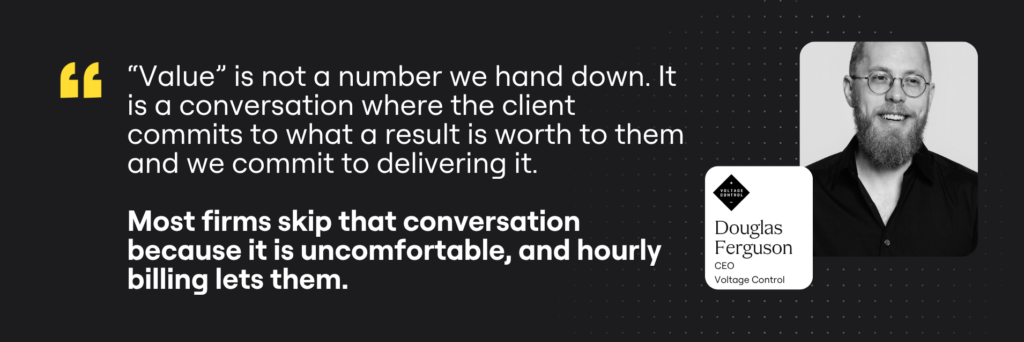
Douglas Ferguson, CEO at Voltage Control
“Long before Voltage Control, I freelanced between jobs, and I always disliked tracking hours. It felt like a strange exchange. Clients were buying my time when what they actually wanted was an outcome.
In almost eleven years at Voltage Control we have never billed by the hour, not once. We price the outcome, agreed with the client before the work starts. That agreement is the hard part. “Value” is not a number we hand down. It is a conversation where the client commits to what a result is worth to them and we commit to delivering it. Most firms skip that conversation because it is uncomfortable, and hourly billing lets them.
That is what keeps the system alive. Billable hours let the seller avoid making a promise. They transfer delivery risk onto the buyer and reward inefficiency by design: the slower you work, the more you earn.
But the deeper thing keeping it alive is not belief, it is plumbing. This year, for the first time, we billed a partner hourly, because their procurement system had no way to buy anything else. Finance teams, purchase orders, and day-rate expectations are all built around the hour. The model survives in the infrastructure long after the logic has died.
AI is what exposes the logic. In our research, we call it the ‘New Friction’: when execution collapses toward zero time, friction does not disappear, it relocates, to judgment and knowing what is worth building. The hour was only ever a proxy for value. AI severs the proxy. Time-based billing now measures the input that is collapsing, not the value that remains.
The coffin nail will not be a better argument. It will be a procurement system that can finally buy an outcome.”
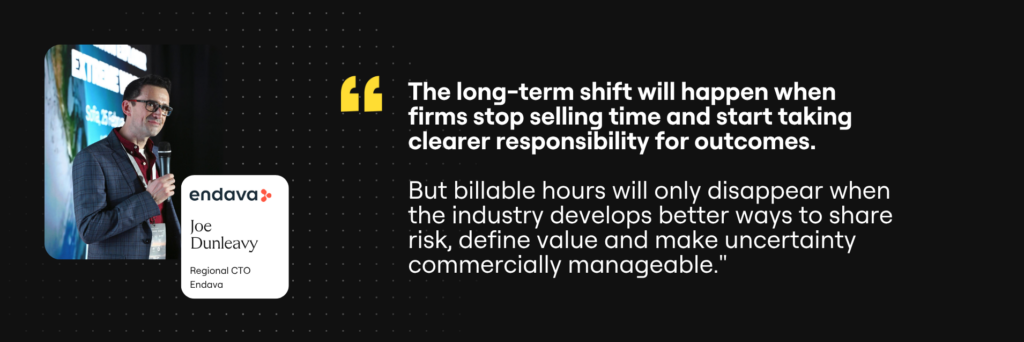
Joe Dunleavy, Regional CTO at Endava
“Billable hours are still dominant because they make uncertainty legible. They give procurement a comparable unit, finance a forecast, and consultancies a familiar way to manage utilisation, margins, and risk. The problem is that they measure effort rather than outcomes – and AI is making that distinction increasingly difficult to defend.
The answer is not simply to replace hours with “value-based pricing”. Value is rarely a single number agreed by everyone. A client may value speed, certainty, or capability transfer; a consultancy may value strategic impact, learning or the opportunity to build a longer-term relationship. Those things do not always appear in the same business case, or at the same point in time.
In practice, moving away from time-based billing works best when the commercial model is designed around a clearly defined outcome, with boundaries around scope, assumptions, and client responsibilities. That might mean a fixed fee for a defined result, a retainer for ongoing access to expertise, or milestone payments linked to measurable progress. Often the most workable model is hybrid: a value-led core engagement supported by transparent capacity or change-control mechanisms.
The messy middle is where most attempts fail. Procurement still wants a rate card, finance still needs confidence about delivery cost, and clients understandably resist paying a premium for efficiencies they believe technology should provide. AI therefore increases the need for trust and transparency, not less of it.
The long-term shift will happen when firms stop selling time and start taking clearer responsibility for outcomes. But billable hours will only disappear when the industry develops better ways to share risk, define value and make uncertainty commercially manageable.”
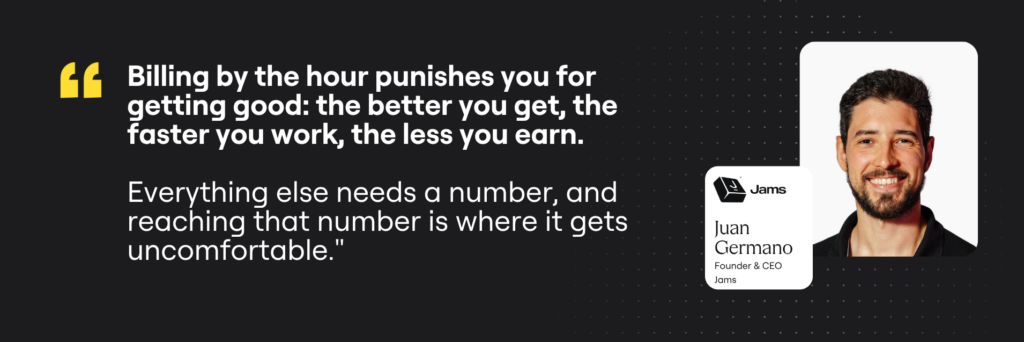
Juan Germano, Founder & CEO at Jams
“In 10 years I’ve charged for creative work every way you can. Task-based hourly. Monthly hour blocks. A fixed fee for a full team. Closed scope. Revenue share tied to a KPI.
Value has two sides.
The first is the creative’s. Ten years of practice means what you make in three hours can be worth far more than any hourly rate justifies. That’s the Picasso napkin. Billing by the hour punishes you for getting good: the better you get, the faster you work, the less you earn.
The second is the client’s. What is this worth to their business?
Sometimes the answer is nothing. Adding a team member to a website. Changing a background image. Bill those by the hour, and use your most expensive person. A senior who does it in two hours without breaking anything is cheaper than a junior who takes a week.
Everything else needs a number, and reaching it is where it gets uncomfortable.
Quick story: a hospitality client was quoting every enquiry by hand, and most of their leads were unqualified. A custom booking flow would convert far more of them. How many more, nobody could say.
Our quote came in above what they wanted to spend. So instead of arguing about our price, we argued about their conversion rate. We took a discount, in exchange for a bonus if we hit the numbers we’d both agreed were realistic. By then we’d asked enough hard questions that the numbers were clear.
That’s the trade hourly lets you avoid: nobody has to forecast, and nobody has to be wrong in public.
But AI is making the hourly tasks easier and faster. It’s the strategy that’s getting harder and harder. And strategy starts with knowing which work is worth doing.”
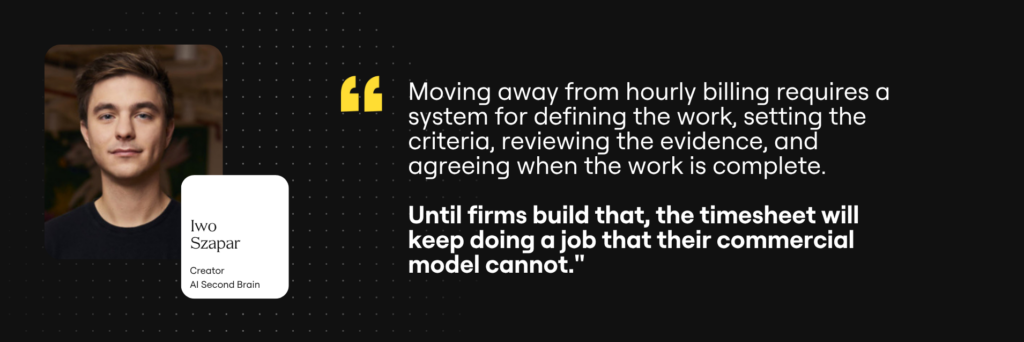
Iwo Szapar, Creator of AI Second Brain
“Clients have wanted to pay for output and value long before AI. Statements of work were meant to solve that. We wrote scopes, milestones, and deliverables. But beneath the paperwork sat the same promise: buy 100 hours, and trust that good work will emerge at the end.
AI makes this gap harder to ignore. It can now produce a first draft, analysis, or finished-looking deliverable in minutes. The obvious question follows: if the output is already here, what exactly am I paying the human for?
The honest answer is often uncomfortable. We have not defined the output well enough to buy it directly.
“Pay me €5,000 for 50 new clients” sounds clean until someone has to define a qualified client, the source of those clients, the time window, the client’s role in conversion, and what happens if the market changes. The same applies to a strategy, a brand, a transformation, or a piece of software. What does good look like? What evidence proves it? Who signs off?
Hours remain the default because they package uncertainty. They let both sides start before they have codified the work.
Moving away from them requires more than outcome-based pricing. It requires a system for defining the work, setting the criteria, reviewing the evidence, and agreeing when the work is complete. Until firms build that, the timesheet will keep doing a job that their commercial model cannot.
AI can help build that system. It can find patterns in past work, turn them into agreed criteria, test outputs, and show where a brief stays vague. But AI cannot decide what a client values or who carries the risk when conditions change. That remains human. It will still accelerate the shift, because it makes the cost of undefined work much harder to hide.”
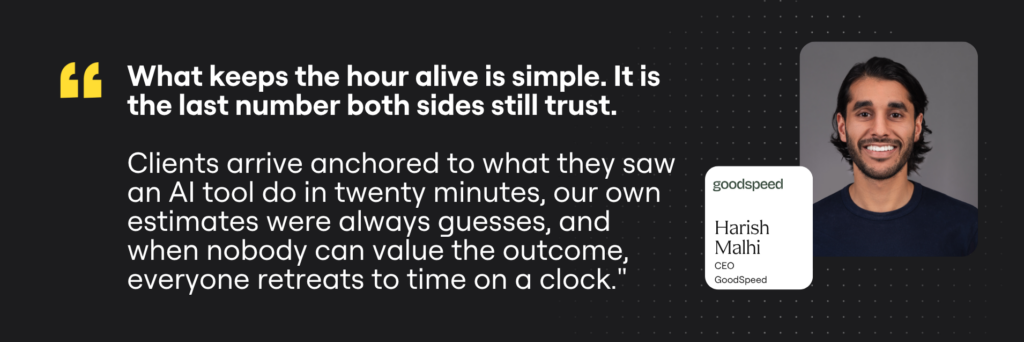
Harish Malhi, CEO at Goodspeed
“What keeps the hour alive is simple. It is the last number both sides still trust, and AI has just removed every other one.
For years, client and agency shared a rough sense of what work was worth. That shared sense is what a price rests on. AI has knocked it out from both ends. Clients arrive having watched ChatGPT, Claude or Lovable produce something in twenty minutes, so the number in their head is five hours.
What they saw is a mirage. It falls apart the moment it meets real users, real data, edge cases and the question of who maintains it next year. And our own estimates were always guesses dressed as numbers. So when nobody can value the outcome with any confidence, both sides retreat to the one unit that still feels solid: time on a clock.
That is what is really keeping the system alive. It has little to do with procurement or old habits. Time is the last honest-looking anchor in a room where AI has scrambled everyone’s judgement of value.
So the fix is not a cleverer pricing model. It is rebuilding the shared picture before anyone prices anything. We run a paid discovery sprint first: surface the real expectations, show the difference between their prototype and production version, and agree what “done” actually means. Once we are both looking at the same plan, price is the easy part.”