AI adoption doesn’t stall because teams lack access to the technology. It stalls because people don’t know where the boundaries are. Collective Next — a consultancy that co-designes solutions with Fortune 500 and nonprofit clients — saw this firsthand, both internally and with their clients.
Using Miro’s AI capabilities, specifically Flows and Sidekicks, the Collective Next team built the AI Manifesto Canvas, a template that takes teams from uncertainty to a clear, action-oriented AI manifesto in under two hours.
Story highlights
From internal need to scalable tool: Collective Next built the AI Manifesto Canvas to solve their own AI adoption challenge, then turned it into a template any team can use.
Human + AI collaboration in practice: Miro’s Flows and Sidekicks accelerate the drafting and stress-testing process while keeping humans at every critical decision point.
Challenge
Teams at Collective Next were navigating a familiar set of tensions: some people were already using AI tools on their own, others weren’t sure if it was allowed, and a third group didn’t trust it at all. Without shared ground rules, these different attitudes created friction. People held back from experimenting because they worried about overstepping. Others charged ahead without guardrails, creating inconsistency and risk.
The missing piece wasn’t an AI policy — those tend to be static, top-down documents that tell people what they can’t do. What teams actually needed was something action-oriented: a shared commitment to how they would use AI, grounded in their own values and context. That’s the difference between a policy and a manifesto.
“The manifesto is designed to help teams align around how and when they’re going to use AI in their work. It’s much more of an action-focused tool meant to help teams really get started and confidently use AI in the work that they do.”
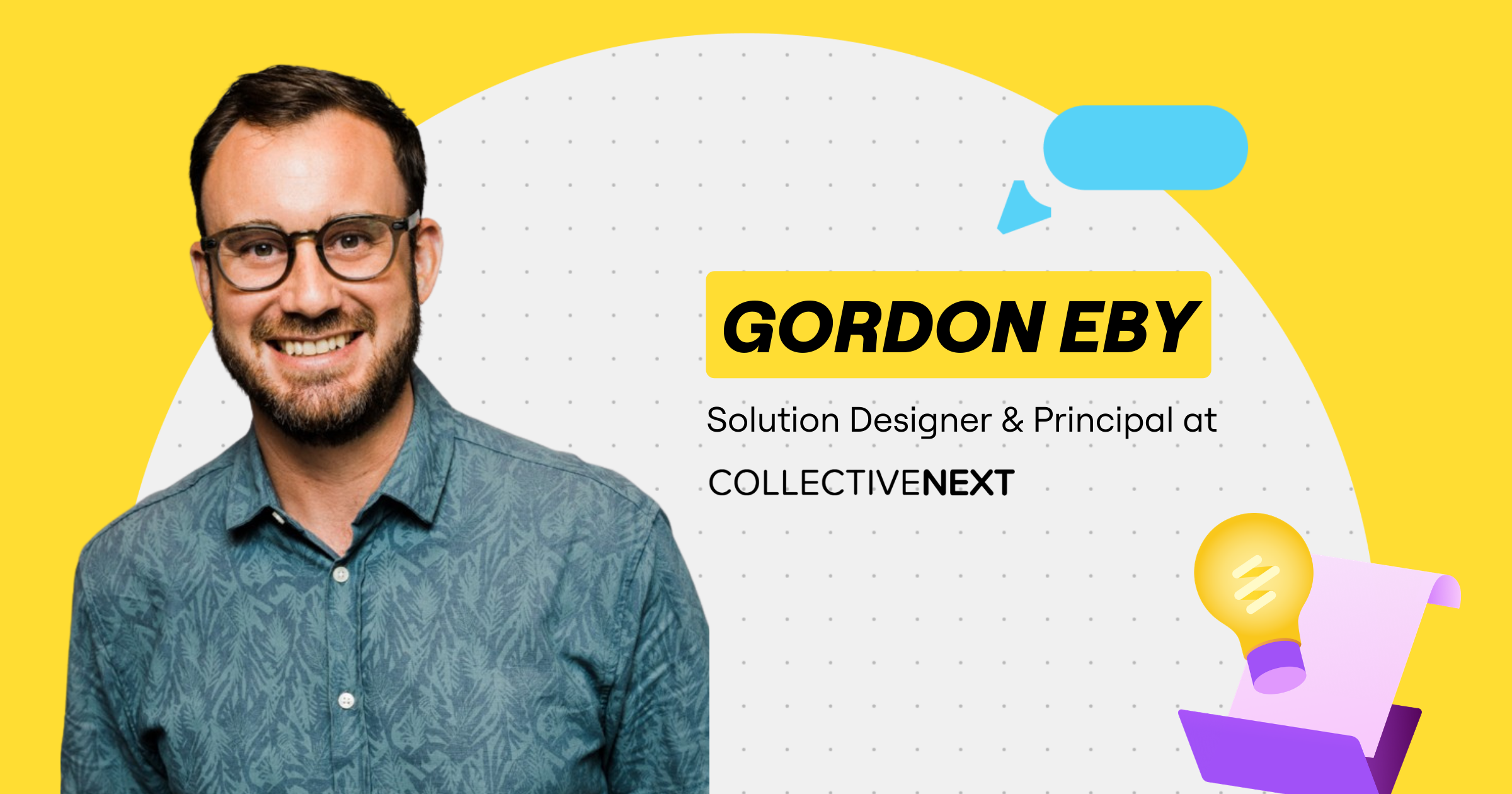
Gordon Eby, Solution Designer and Principal at Collective Next
Solution
Collective Next built their AI Manifesto Canvas in Miro, designed for groups of four to eight people to work through collaboratively in approximately 90 minutes. The template follows a five-step process — brainstorm, learn, build, test, and roll out — that mirrors Collective Next’s own facilitation methodology: learn, focus, act.
The process starts by giving people space to share their honest sentiments about AI — excitement, skepticism, concern — before moving into structured work. From there, teams collaboratively answer eight questions that map to the core components of a manifesto document.
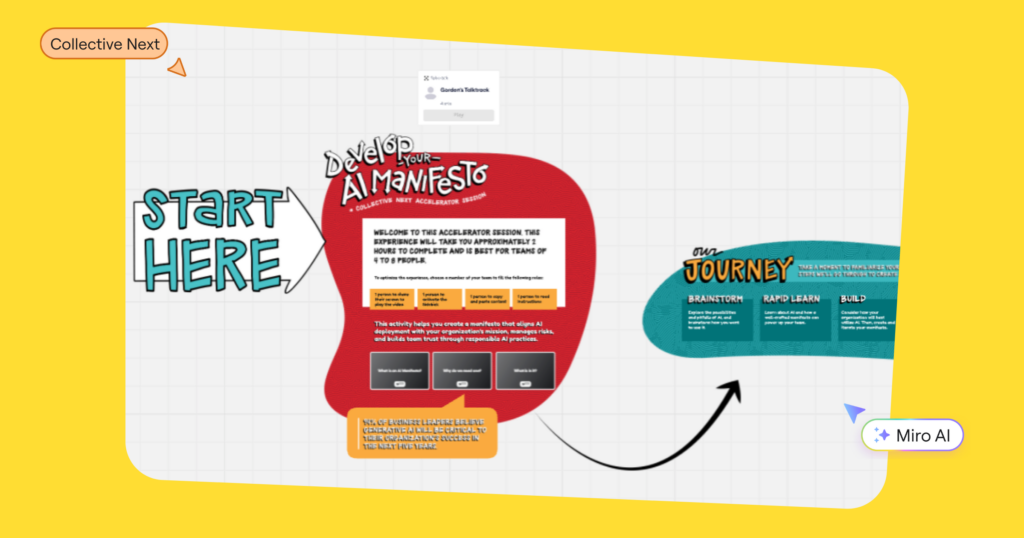
This is where Miro’s AI capabilities come in, with Flows powering the build cycle. Once teams have answered the foundational questions together, they hit “run” and the Canvas generates a manifesto outline automatically using those collaborative inputs. Teams review, iterate, and refine together, then generate the full prose version of their manifesto — a document built from their own ideas.
Sidekicks drive the test phase. The template presents four real-world stretch scenarios — situations teams are likely to encounter in the workplace, like the temptation to let AI handle a high-stakes deliverable under a tight deadline. The Sidekick evaluates the manifesto against these scenarios, surfaces gaps, and provides feedback the team can use to strengthen the document.
“Being able to have AI generate content for groups helps accelerate people through the work much more quickly than you ever could do before,” says Eby. “And then having these custom bots, the Sidekicks, jump in with specific tasks that can really help answer questions and test things — it’s a huge value add.”
The final steps produce an elevator pitch version for easy sharing and a visual frame teams can post in their workspace or distribute more broadly.
What makes the template work isn’t just the speed — it’s the deliberate balance between AI efficiency and team ownership. At every stage, people are collaborating, making decisions, and editing. AI handles synthesis and acceleration. Teams bring the critical thinking and the context that makes the output authentic to them.
“A manifesto is only as valuable as the ownership that the people who crafted it feel at the end of the day,” says Eby. “We never want to lose the positive friction that’s needed for people to go through a process like this and have the output be something they’re proud of.”
Impact
Teams who use the AI Manifesto Canvas move from ambiguity to alignment in a single working session. Instead of weeks of cross-functional debate or a top-down policy that sits in a shared drive, teams walk away with a document they built together — one that reflects their specific values, context, and working norms.
The manifesto gives teams clarity around when and how to use AI, which drives broader adoption. When people know the boundaries, they stop hesitating and start experimenting. Organizations that track AI proficiency and adoption rates can expect those numbers to increase after establishing a manifesto, because the barriers to getting started have been addressed collaboratively rather than imposed.
The template also creates downstream benefits: stronger team trust, better communication about AI use, and a shared reference point teams can revisit as their relationship with AI evolves. Because a manifesto is a living document — not a one-time exercise — teams can return to the canvas to update it as they learn, as tools change, and as their comfort level grows.
“I’m excited for the AI Manifesto Template to be used out in the world because I think it’s really going to help teams get over some of the hurdles to adopting AI in a responsible way that they feel comfortable with. And it’s really going to help people do exceptional work — things that they didn’t even think they could do before.”
Gordon Eby, Solution Designer and Principal at Collective Next
Broader value
The AI Manifesto Canvas is a practical example of what’s possible when AI capabilities are embedded directly into collaborative workflows. Rather than asking individuals to prompt a chatbot and paste the results into a document, the template keeps the entire team working together on a shared canvas — with AI accelerating the synthesis, drafting, and testing that would otherwise take hours of manual effort.
For Collective Next, the template also represents a new, repeatable model for their consulting practice. The same collaborative principles that define their client work — co-design, shared ownership, creative problem-solving — now extend into the AI-powered tools they build and deliver.