Pick an animal. Now pick the strengths you bring to your work. Combine the two, and you’ve built yourself a superhero. That was the warm-up exercise H&M Group used to open an AI Learning Day for its tech teams, and it set the tone for everything that followed: you come to the table with your superpowers, and AI handles the mundane.
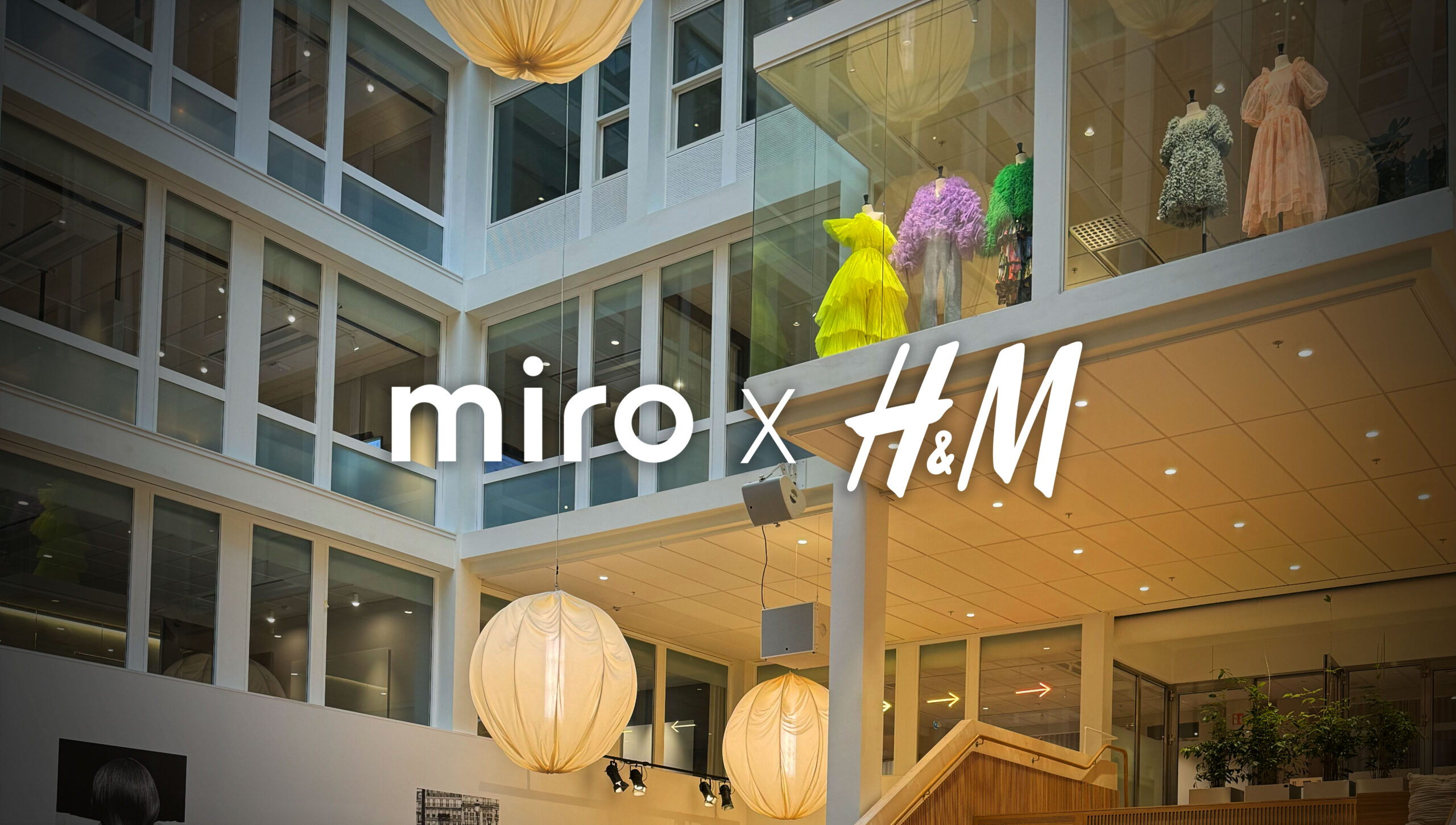
H&M Group is one of the world’s largest fashion retailers, serving customers across markets worldwide. Behind that scale sits a large tech organization split mainly between Stockholm and Bangalore, with teams across the world. Like every enterprise right now, H&M is working to build AI capability across that organization. The difference is in how they’re doing it: not with a top-down mandate, but by handing ownership of AI adoption to the people doing the work, with Miro as one of the tools helping teams collaborate as they go.
Challenge
AI is often associated with engineering-focused use cases. Ask most organizations where AI lives and the answer points straight to the groups managing the codebase and their desired outcomes (automating code, generating test cases, shipping faster, etc.).
H&M Group’s tech function knew that if AI stayed boxed inside coding, a large part of their organization would be left watching from the sidelines.
There was also a practical challenge underneath the cultural one. Nearly half of H&M’s tech organization is based in Bangalore, with most of the rest in Stockholm and smaller groups spread out globally. For teams that dispersed, meeting in person often isn’t an option, so collaborative work needs a digital home that works as well across time zones as it does across a table.
And there was the question of ownership. H&M knew that direction could come from the top of the tech function, but the adoption itself had to be owned by the teams doing the work.
“Sometimes people feel like the company needs to provide direction, but the ownership needs to live within the teams, and the change needs to live within the teams. The individual needs to know, this is what I can do.”
Eleonore Nygards, AI Capability Partner at H&M Group
Solution
To foster collaboration and improve AI fluency across its tech team, H&M Group’s Tech Academy launched an AI Learning day with two parallel tracks: one for those with engineering roles and one for those with non-engineering roles.
The track for engineering roles focused on the hands-on work of building agents and working with context. The other, named “Beyond Code,” was built for non-coding roles in the tech org such as technical product managers, program and operations people, and deliberately leaned into the softer skills and the business side of the work that AI can support. The name of the second track helped emphasize that AI is not only for the people who write the code.
The day opened with shared sessions giving everyone an outside-in view of where the industry is heading, then moved into sessions led by internal experts on the durable skills the shift demands: critical thinking, adaptability, and AI fluency. The final block turned all of that inspiration into practice, and that’s where Miro came in.
Working in Miro, participants mapped the friction in their own ways of working and used Miro’s AI capabilities to start designing around it, then left with templates they could take straight back to their teams. H&M chose Miro deliberately, and not only as a visualization tool. With a tech org spread across continents, the company needed a digital way to run the kind of collaborative sessions that are easy in a room and hard at distance. The goal, as Eleonore puts it, was to show teams a way of working together rather than just pushing information at each other across an office suite of tools.
H&M ran the same day of activities live in both Stockholm and Bangalore, adjusting only for the time zones. Same content, same tracks, one event in two places, so the largest concentrations of the tech org could take part together.
The moment that anchored the day was the opening warm-up. Picking an animal and naming your own strengths to build a personal superhero was playful on the surface and serious underneath.
“That sets the mindset of how we see working with AI,” says Eleonore. “It’s actually an amplifier. We should come there with our superpowers and automate the mundane, boring stuff. That was the aha moment for people.”
Automate the mundane, amplify the person. That framing runs straight through to how H&M’s leaders talk about the work, with AI clearing space for the thinking only people can do.
“AI can make your people superhuman. The real opportunity is to give people more time and space for strategic thinking by reducing the burden of day-to-day tasks. That allows them to focus on the uniquely human capabilities that AI cannot replicate.”
Andreas Andersson, Area Business Manager – Digital Foundation at H&M Group
The whole day was built to run bottom-up: explore AI with a clear frame of reference, come back to the larger group with what worked and what didn’t, and surface the ideas worth investing in. That belief in team-owned change, rather than a mandate handed down, is what shaped the format.
Impact
Walk into the rooms and the clearest signal was demand. In the Bangalore sessions, which were largely populated by folks in engineering roles, teams who had used Miro for PI planning and retrospectives suddenly saw how much further it could go, and started pushing for deeper integration with the tools they work in every day. In the Stockholm sessions, with more non-coding roles, the questions kept coming back to one thing: can AI help us do this for our team, exactly how we work?
For Arunima Goswami, a Senior Product Designer, the pull to AI Learning Day was personal. An experienced Miro user herself, she came to the day hoping to help her colleagues get as much from the platform as she does.
“What really drew me to the AI learning day is the exposure to collaborate and help my team and colleagues adapt to Miro and its usability,” she says. “I use Miro extensively and thought it could be really beneficial for them.”
She also put her finger on the gap the day was built to close.
“The biggest gap was consistency. Some teams were playing with tools, while others lacked shared methods, guardrails, or clarity on where AI actually adds value,” Arunima says. “The biggest takeaway is that AI impact accelerates when teams share workflows and intent, not just tools or prompts.”
That takeaway showed up as a visible shift during the sessions.
“There was a clear shift when teams started mapping AI into their existing processes instead of treating it as something extra.”
Arunima Goswami, Senior Product Designer at H&M Group
The work didn’t disappear when the day ended. The boards and artifacts teams built are becoming reference points for future projects, onboarding, and continued experimentation. Arunima says she’s already noticing tasks that used to stretch across days getting done in a fraction of the time, though H&M is candid that it’s early, and that a culture shift across a tech org this size can’t be measured in a month.
That honesty is part of the approach. H&M isn’t claiming a transformation it hasn’t measured yet. What it has is a tech organization that left the day wanting more, and a clear conviction about how the value will eventually prove out.
“The only way they can see the value is by showcasing it,” says Andreas. “Find some early adopters and take it from there.”
The bigger picture
What makes H&M’s approach distinctive isn’t the tooling; it’s the conviction that AI adoption starts with people and culture, and the technology follows from there.
“It’s about psychological safety, about being super personal, and really connecting to our brand and our values. This is about people, and everyone comes with a brilliant mind to the table. Building community for real is something we’re striving for.”
Eleonore Nygards, AI Capability Partner at H&M Group
That belief shaped how H&M worked with Miro: not as a vendor delivering a feature demo, but as a partner helping design an experience true to the company’s culture. The close collaboration, working through strategy before a single session was built, is what Eleonore credits with making the day land.
The question H&M is chasing is a simple one: whether AI can make a person better at the work that’s uniquely theirs. H&M has decided the fastest way to find out is to start with people, give every role a way in, and let the best ideas come from the teams themselves. The superheroes are already in the room, and now the work is to see what they build.