A Miro x WongDoody conversation on rebuilding collaboration for a room that now includes AI
Want more practical advice and real world snapshots of effective human-AI collaboration? Download the full playbook: ‘Beyond the human in the loop: A guide to rebuild collaboration in the age of AI’
Individual AI adoption has outpaced our ability to redesign how teams actually work together.
The numbers back it up. In Forrester’s “The Visual Era of Collaborative Intelligence”, 89% of leaders say improving collaboration is key to hitting their organization’s goals – yet 75% agree most AI tools are built for individual, not team productivity, and 39% say that individual-first bias is actively hurting their AI ROI.
Underneath all of this are three different ways collaboration now happens: human to human, human to AI, and – still emerging – AI to AI. For the purposes of this discussion, we’ll be focusing mainly on the first two.
As you’ll see below, even the people building AI-native workflows every day for clients don’t think AI-to-AI collaboration is really here yet. Ultimately it’s still a tool for people, not a peer to them (yet…).
Professional services is a knowledge-work heavy sector that has been touted as one of the most ripe for significant AI disruption. Whether the push towards AI adoption and innovation is being driven top-down by leadership within consultants and agencies, or by pressure from clients who expect tighter turnaround times and AI-enabled delivery – it’s impossible to ignore.
To dig into where this actually shows up day to day, we sat down with Ralf Gehrig, Global Chief Experience Officer at WongDoody, and Kim Abbott, Head of Experience Design EMEA, for an unusually candid conversation – not a set of scripted soundbites, but a real back-and-forth between two people who spend their working lives sitting between AI tools, human teams, and clients demanding greater output and faster delivery without a drop in quality or creativity.
The Productivity Paradox
Individuals are clearly getting faster with AI – so why hasn’t that shown up at the team or organizational level?
Ralf: “So many of the ways AI has been introduced to people have been really focused on improving my work – giving me a companion, a tool to create a better deliverable, to do better research. But the magic in big organizations, the reason they exist, is that people collaborate on really hairy, big problems to move the whole company forward and deliver things no individual can. Collaborating with AI to actually enhance the speed of that as a whole, instead of just each individual – we haven’t found the right way to do that yet. That’s where something like a shared AI canvas comes in, as a way of facilitating that outcome.”
Kim: “It’s been so much about the individual – how can I do stuff faster. I think people are actually collaborating less because of it. You can just have this little AI off to the side do a thing, look at it, tweak it a bit, and be done, instead of having that natural collaboration with other people. What we want is to enhance collaboration – have people collaborate more, whether that’s with each other, with AI, or some combination of the two. AI a lot of times just tells you it loves your idea. That tension isn’t there. I’d much rather have people, or AI, disagree with me – that’s how you get to something better than what you started with.”
Ralf: “I had this experience just yesterday, actually. Someone on my team created a strategy document for us internally. In the old world, he would have set up a little workshop, invited people in to give ideas. But because it’s so easy now to create something that looks like a finished ten-page document by yourself in two hours, that’s what he did instead. He probably wouldn’t have come up with all of that on his own before AI. He would have needed to collaborate with people, and it would have come out more balanced, and brought everyone on board with the idea. It’s not just about creating the deliverable, it’s about taking people along the journey. That gets lost, and instead you have this finished-looking document that doesn’t really invite conversation or discussion – which, again, is a nice trigger for bringing the canvas back into it in a new way.”
Ralf: “Even if people believe in it, they don’t feel like they have a stake in it. People like to see themselves reflected in the thing, to feel like they own it. That’s the whole joy of workshops – it’s not that you need everybody’s input in every case, but it’s part of the process of getting people on board and bought in.”
Where the Edge Actually Comes From
If everyone has access to the same AI, where does an edge – distinctive thinking, taste, creative craft – actually come from now?
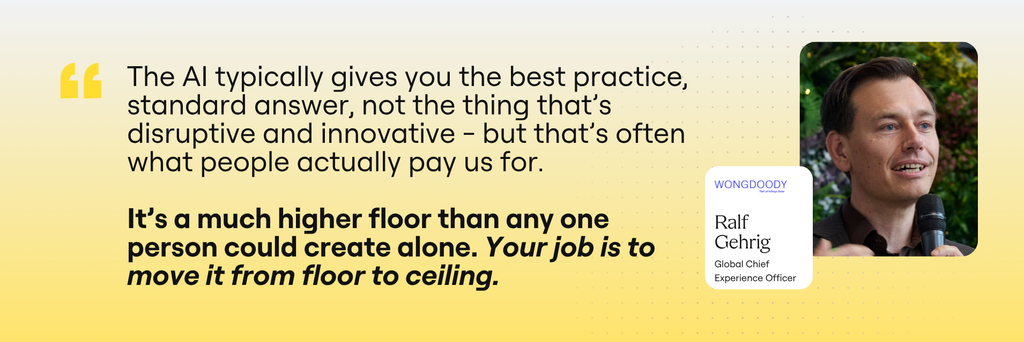
Ralf: “I tell everybody on my team: use as much AI as you want, we give everyone the same tools. But you are still responsible for the quality of the output. The AI creates based on your prompt, and you’re the editor – not the writer. Not just for documents, for designs, for campaigns, everything we do.
Kim: “It’s how you take that baseline and push it further. Get the obvious ideas out of the way so you can get to something amazing that much faster. A person is the curator, the strategist. A lot of it comes down to how you brief the AI – is it briefed with something interesting, or is it just ‘make me a website about socks’? We need to train people better on how exactly to do that, because it’s still the people on the team who make the difference between something being good and something being great. That’s where a tool like Miro comes in too – instead of just handing over a written brief and a bunch of bullet points, you bring in the collaborative sessions, the workshops, all of that as inputs, and say, show me a first draft of what this could look like. It’s taking all those different bits of creative thinking and showing how they come to life – and that becomes your baseline to evolve from.”
Have you seen a team lose its distinctiveness by over-relying on AI? What did that look like?
Kim: “You see it a lot, especially in writing. You can immediately tell when it isn’t actually that person’s own idea – the tone, everything about it, screams whatever AI tool they used. After you’ve seen it three or four times, you’re like, this isn’t you, this is clearly what you wrote with Claude. You can spot a Claude deck from a mile off – it’s the boxes, the little line down the side. Our clients don’t pay us to regurgitate anything. That’s a trap.”
Ralf: “We had this exact situation – one of our teams put together a strategy deck for a client, made with Claude. It was a good deck, and the client loved it, they told me very proudly. But I thought: if I were the client, the value-add isn’t obvious – it’s kind of what I could have prompted myself. Maybe they spent days iterating on it and did everything right, but you don’t know that. You just have the suspicion it was done in five minutes. And it falls apart at the first real question – someone asks something, and it becomes abundantly clear they don’t actually understand what’s in front of them. That’s a dangerous place to be in a client-service environment.”
Redefining What Good Collaboration Looks Like
If “human in the loop” isn’t the right model anymore, what does good collaboration actually look like, day to day, for a team using AI?
Kim: “You can’t really be human-centered if you’re only working with AI, because in the end you need to talk to and get insights from the actual people you’re designing for. I think that becomes even more of a focus for us in this world – structuring research, getting insights out of people, shadowing them in their work – and then using AI to summarize the hours of interviews and video material. That’s totally fine. But having more of that human contact in the process is what shifts the balance back.”
Ralf: “One of our colleagues built this agentic AI workflow he was really proud of – something that’s normally a three-month process in a business, done in ten minutes. And I thought: technically, yes that sounds incredible, but in reality there are twenty different people involved in that process for a reason. They all have different jobs, different things they’re assuring at each step. There’s a person from legal and compliance whose job that actually is – it’s not just a tick-box in a workflow. He’d looked at the business process but not the human side of it. That’s a case of someone using AI without being human-centric about it at all.”
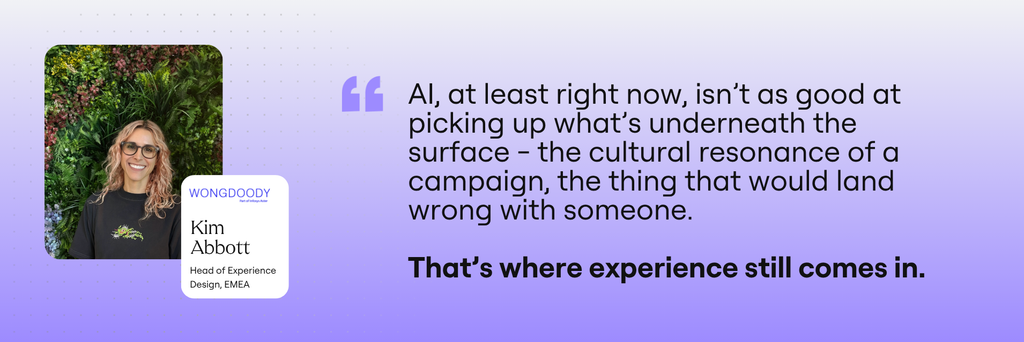
Kim: “People are good at understanding the nuance, the implicit, rather than just the explicit. Think about interviewing someone, or being in a workshop – a lot of it isn’t what people say, it’s what they don’t say, how they’re acting. It’s like an actor being given one line and having to say it fifty different ways — the same words can mean something completely different depending on how it’s delivered.
What’s one habit or ritual you’d tell a team to change first?
Ralf: “The lowest rung on that ladder is leaders who aren’t using the tools themselves. They’ve watched the keynotes, they’ve read the press releases, but they haven’t tried it hands-on – so they end up leading from a fake demo they believe is the truth.”
“It’s thrusting people from more junior roles into something closer to a leadership role – but instead of leading other people, you’re leading agents, leading pieces of AI. Normally that’s a skill set you build up over the course of a career. Now you’ve got people really early on learning to guide AI, brief it, give it feedback, help it create the thing, instead of creating the thing themselves.”
Kim: “We skipped over something important, which is that if more people are becoming managers of AI, you need good managers – and in my experience, those are rare, and most companies don’t invest in that kind of training outside a handful of big consulting firms. I’d say with almost total certainty that even our most senior creative leaders have a hard time giving direct feedback that actually gets the outcome they want from the people they manage. That’s going to be a huge deficit when you’re suddenly relying on a huge swathe of junior staff to effectively manage AI agents and their output.”
Where does the conversation go from here…
Everyone is still working out exactly what this new world of AI-enabled collaboration looks like for themselves, their team, and their business. No one has cracked the code just yet, and there certainly isn’t a one-size-fits-all silver bullet.
However, there are some practical frameworks, best practice guidance and insights grounded in real-world experience that you can take advantage of to help progress your own journey. We’re continuing the conversation with the WongDoody team and combining our expertise to produce a follow-up asset, ‘Beyond The Human in The Loop: A guide to rebuild collaboration in the age of AI’. It will be available on the Miro blog and Resource hub shortly.