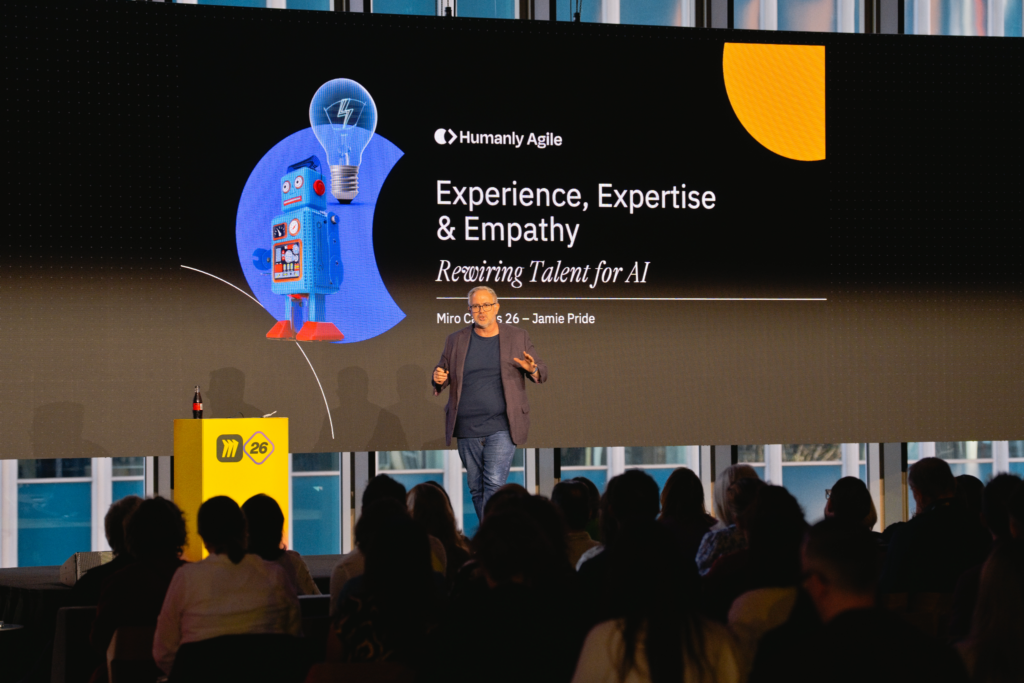
Most AI talks are about the technology. Jamie Pride opened the afternoon at Canvas 26 Sydney by promising the opposite: A session about AI without really talking about AI.
Jamie is CEO of Humanly Agile, and he’s had a front-row seat to a few technology waves as the CEO of REA Group, Partner at Deloitte, and one of the first employees at Salesforce. These days he works with boards, C-suites, and executives on the part of AI most strategies skip: People.
His argument is that there are two conversations running inside every organization right now, and leaders keep mixing them up. One is easy and fun. The other is the one that actually decides whether your AI program works. We sat down with Jamie after his keynote to explore these parallel conversations in more detail.
Why transformation is about more than technology
You’ve said that the most important conversation about AI isn’t necessarily “about” AI. Can you explain what you mean by that?
“There are two conversations going on inside organizations right now, and they get confused all the time. One is about AI as a technology. I love that one. I’m a technologist — I can geek out with the best of them. But there’s a more important conversation, and it’s about workforce transformation.
Most of the energy goes into the first conversation because it’s the exciting one. The second one is harder, quieter, and it’s where the real change has to happen. What we’ve learned working with some of the world’s largest organizations is that the companies who get AI right are the ones having the second conversation on purpose, not by accident, months after they’ve already bought the tools.”
You argue that before we transform work, we need to understand work itself. What’s your framework?
“It can be helpful to think about work through the lens of lawyers. Most people hire a lawyer for three reasons.
The first is knowledge of the law. In the professions that’s called ‘expertise asymmetry,’ also known as a big bill. I know something about tax, you don’t, and I monetize the difference. The professions have spent a hundred years monetizing expertise. That’s a problem if you’ve been keeping up with current events, because AI used to be called ‘expert systems.’
“AI is driving the price of expertise to zero. If you’re in the business of buying expertise, happy days. If you’re in the business of selling it, less so.”
Jamie Pride, AI Strategist & Workforce Transformation Expert
The second reason is experience. It’s why a junior lawyer is $50 an hour, whereas a partner is $5,000. Experience is really judgment and decision quality. Specifically, it’s judgment where there are two right answers. That’s very hard for AI to simulate. It’ll support the decision, it’ll sound confident, but as humans we constantly have to make calls where there’s no single right answer.
The third reason is the vibe, what the medical profession calls ‘bedside manner.’ That’s empathy. You hire a professional you believe will hold your hand and have your best interests at heart. A great one builds a relationship beyond the transaction.
So, all work is really made of those three things: Expertise, experience, empathy. That’s why I chose it as the title of my book. The blend just changes depending on the job.”
Consequences without accountability
If AI is driving the price of expertise to zero, what’s left for humans?
“Value migrates. As expertise gets cheap, human value concentrates in the other two: Judgment and decision quality, and relationships.
Strategy is a good example. Strategy is choosing between two right answers. Hold on to that, because it’s central to the future of human contribution at work. And we’re tribal beings — we want to build trust, so relationships stay valuable too.
When organizations fail at AI deployment, it’s usually because they fundamentally misunderstand that work is made of those three things. They automate the expertise, but they give no thought to where the critical decisions get made or which relationships they need to protect.
There’s another reason humans stay in the loop: AI suffers no consequence. I’m waiting for the day a CEO tells their board, ‘The AI told me to do it.’ Good luck with that. While our organizations are still run and governed by human boards and accountable to human shareholders …
“Humans are the ones who carry the accountability. AI can support the decision but the final call has to be human.”
Jamie Pride, AI Strategist & Workforce Transformation Expert
Which human capabilities does AI actually leave alone?
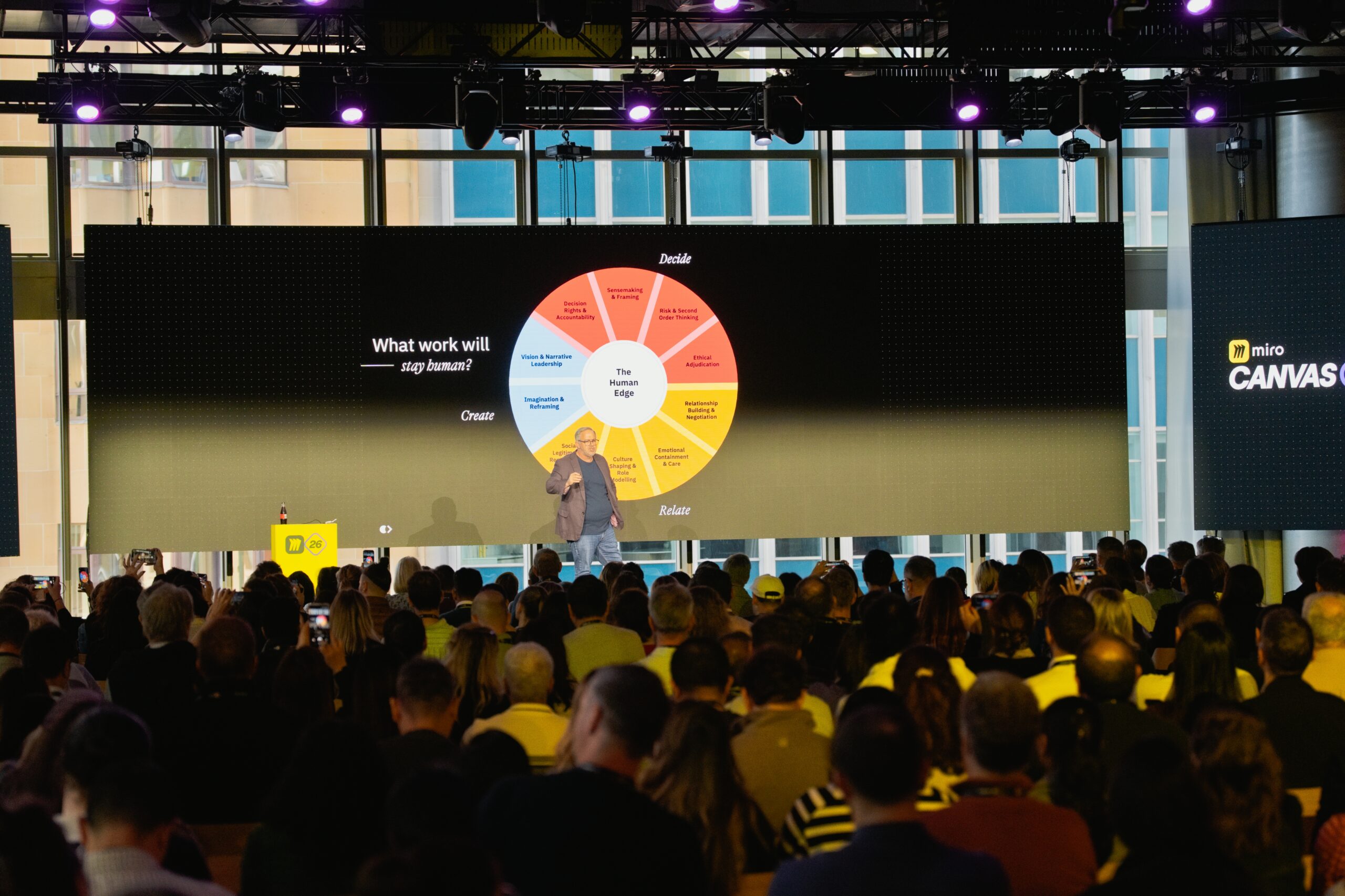
“We think there are 10 dimensions of persevering human work. As a futurist, I try never to say never, but a few of these look safe for a long time.
We’ve already talked about judgment. The next big one is culture. I used to say AI can’t build relationships, and the AI boyfriends and girlfriends out there proved me wrong on that. But it still can’t build culture, and that’s a different thing. We felt it during the pandemic when we were cut off from each other. We want role models, we want to be immersed in a culture, and AI gives us neither.
Creativity is the one I’ve moved around on most. The advances in AI video, music, and multimodal work are genuinely strong, and in parts of STEM, like protein folding, AI has produced net-new, novel things. But mostly it remixes existing human creativity. So there’s still a small but important role for the human kind.”
The automation trap hollowing out organizations
You’ve lived through several waves of disruption. What’s different about AI?
“Who uses it, and the effect it has on them. Think of it like tools. I’ve got a shed full of them and I fancy myself a bit handy. My wife says all this really does is speed up my trips to hospital and increase the rate at which I put holes in the wrong part of the wall. The same tools in the hands of a master carpenter build a house.
In previous waves, we relied on the digital natives, the juniors, to drag the dinosaurs into the new technology. That’s happening again; the junior ranks are all over the ‘magic cheating box.’ But there’s something insidious about it. AI gives inexperienced people capability beyond their experience level, and that hollows them out. Give a junior a good LLM and ask for a strategy and you’ll get something that looks fairly good, right up until you take them to a client, the client asks a question, and they get found out.
The converse is also true. If you’re an expert, you know when AI is wrong. You know when it’s hallucinating, because it’s very hard to fool you inside your own domain. You get far more out of AI in the areas you know well: you know what questions to ask, what frameworks to use. So, strangely, the benefits are greater and the risk is lower in the hands of senior people.
Which creates a real trap: The temptation to automate away the junior roles. Juniors tend to sit in the quadrant with high technical expertise but low judgment. A grad’s pay is basically 100% about what they know, and they don’t know much yet, so we don’t pay them much. But walk around a room of experienced professionals and their salary is tied to what they’ve done.”
What is “experience scarcity,” and why should leaders worry about it?
“Work has a dual nature. It delivers an output, and it develops the individual doing it. The more work I do, the more experienced I become. So when we automate away the entry-level, experience-generating work, we hollow out our own organizations. That’s experience scarcity.
Aviation has been dealing with this for decades, and it’s a great model. Every modern aircraft can taxi, take off, cruise, land and taxi again on autopilot, with zero pilot intervention. And yet nobody’s getting on a plane without a pilot any time soon.
The airlines worked out that even when the machine does most of the flying, you still need a minimum credible level of expertise in the business: Someone who can actually fly the plane. More importantly, they monitor minimum viable experience, measured in thousands of hours flown by aircraft type. If you fall below that threshold as an organization, you break succession and career architecture.
“If we’re all working in an apprenticed profession and we break the apprenticeship, we’ve got no one to inherit the organization from us. That, to me, is the real problem most leaders aren’t looking at.”
Jamie Pride, AI Strategist & Workforce Transformation Expert
There’s a trust dimension too. I’m genuinely frightened of flying so I pay attention. I was landing in Sydney once, full landing configuration, gear down, about 400 feet off the ground, when suddenly: Full power, gear up, climb out. A go-around.
I was waiting to hear the pilot’s voice: ‘Don’t worry, ladies and gentlemen, just a go-around.’ The crew could have made that call. But airlines know there’s a bond of trust between passenger and pilot. Organizations that automate without asking which relationships and trust barriers matter, whether in the customer experience or the employee experience, are missing something crucial.”
What it takes to build an AI-native organization
What does an AI-native org structure actually look like in practice?
“We’ve been experimenting on ourselves, so I’ll show you ours. It’s close to the Jack Dorsey model, though I’d argue I got there first.
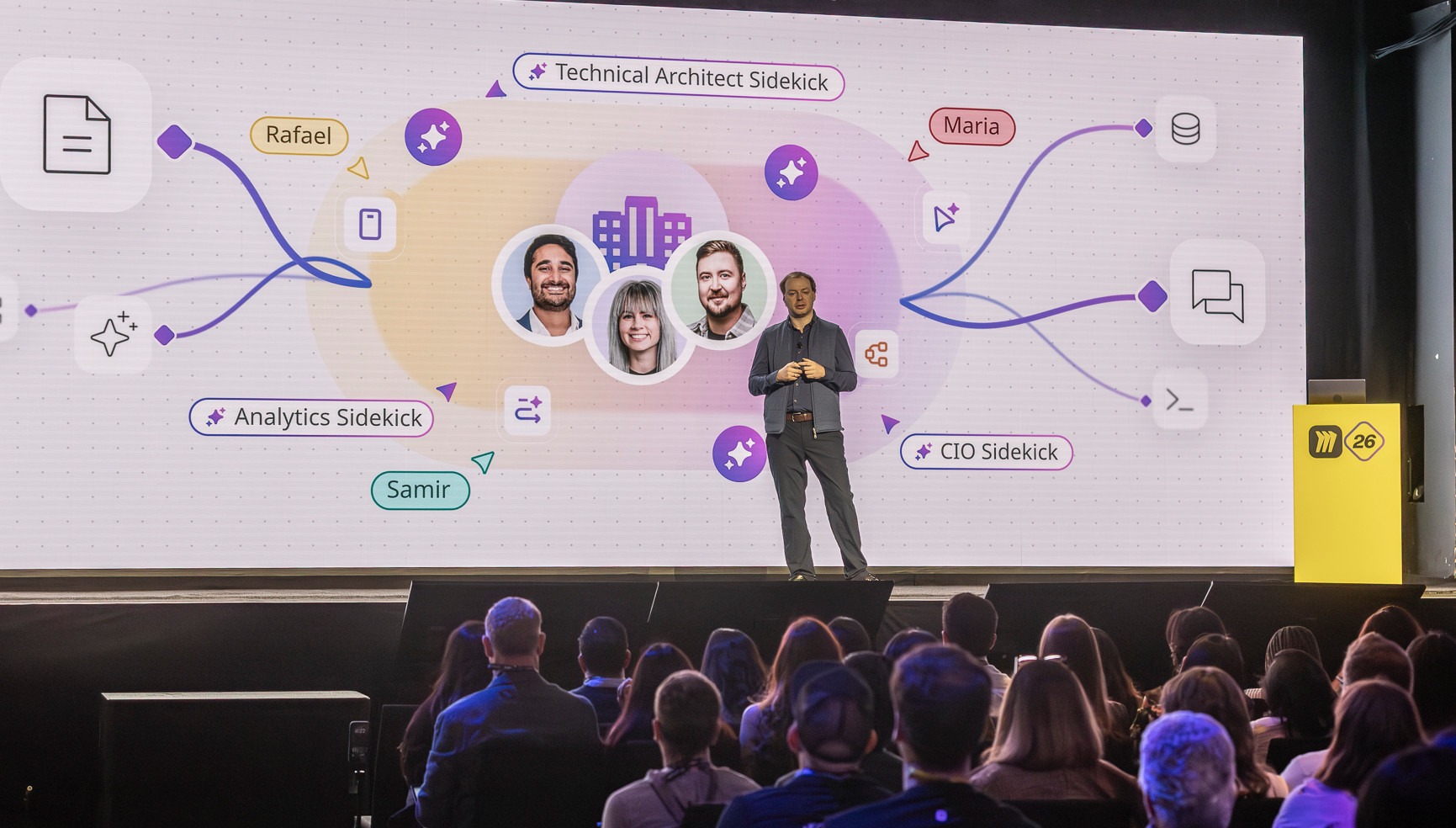
At the center is a big AI knowledge core: A vector database that’s ingested everything we’ve produced over the past 18 months. Around it sit nine agents that do the bulk of the expertise-based work. Then there’s an interaction surface, which includes Miro, email, and a few other things. And around the edge, a small cohort of humans.
We practice what we preach. The AI does the expertise; the humans own the judgment. Our agents have personas, personalities, even email addresses, and they do real work. It’s a bit of a show home.
But we deliberately reserve the customer-facing work, the surface that touches the physical world, for our most experienced humans. Judgment, strategy, and decisions stay with people. The expertise-based work goes to the agentic core. That’s a big part of what we think future org design looks like.”
What can leaders do to build AI-native organizations?
“Four provocations.
First: are you redesigning old work, or reimagining it? A lot of clients just bolt AI onto existing workflows. The opportunity is to rethink the work entirely, with humans on the decisions and judgment, and AI on the expertise.
Second: which capabilities become critical when expertise is abundant? If anyone can get expertise for free from ChatGPT, what’s left for humans? I’d say high-quality decisions.
Third, and the one I care about most: Work builds experience. So how do we build experience in a world where we’re automating away the experience-generating work? I’ve got kids. How do we build a career architecture where people can still learn, grow, and develop inside highly automated environments? That’s the question leaders need to answer.
And finally, don’t get lazy. For a long time we let the organization do our developing for us. Now we need to use AI to build our own productivity, and then reinvest that productivity into mentoring and developing the people coming up behind us.”