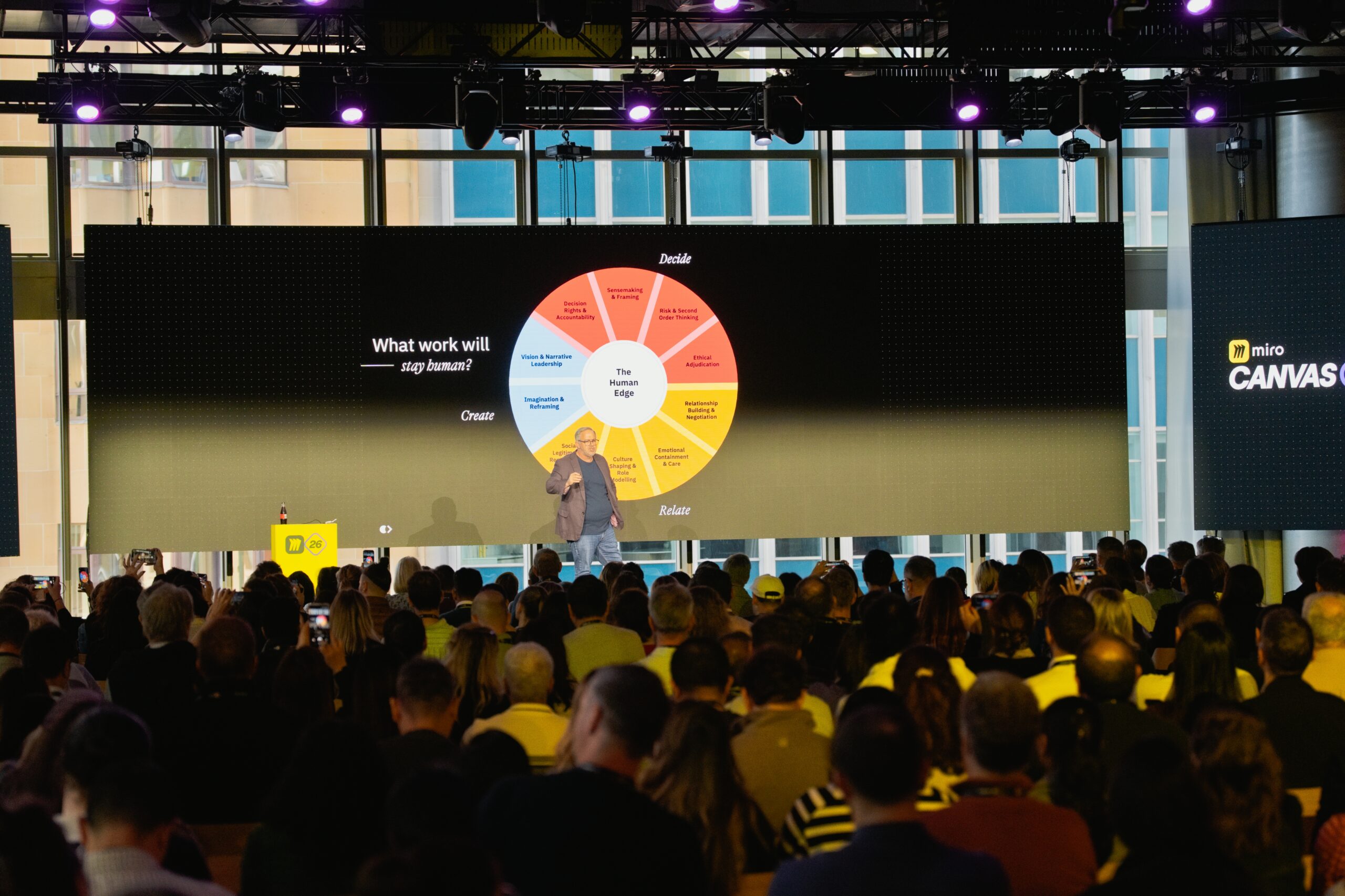

AI has made every individual faster. The harder question — one we spent the day discussing at Canvas 26 Sydney — is whether it’s made teams faster. Those aren’t the same thing, and confusing them is where a lot of organizations’ AI ambitions get stuck.
Jacky Koh has watched it happen up close. As founder and co-CEO of Relevance AI, an AI workforce platform used by Canva, Databricks, and Uber among many others, he spends his days helping companies put agents to work. His provocation to the room was blunt: raw speed isn’t the goal.
“AI is making people much faster, but it’s also creating much more chaos,” he told the product, IT, and AI leaders in the room.
What organizations need, Jacky argues, is velocity — speed with direction. It’s an important idea; one I was delighted to unpack with him onstage as we explored what it takes for teams to achieve velocity and the impact it can have. That conversation kept returning to three questions: What gets in the way, how you fix it, and what changes when you do.
When misalignment derails team velocity
The thing slowing teams down usually isn’t the technology they’re using.
“The biggest blocker is alignment,” Jacky said. “Often there’s an executive order, like, ‘We need AI agents,’ but no direction on what for or which use cases matter. You can deploy an agent for literally anything. I’ve got one running my calendar. But what’s the ROI of that for the company as a whole?”
You can feel the absence of that direction the moment a team starts building. “You ask your team for one thing, come back, and they’ve built a ton. But they’ve also taken your one sentence in completely the wrong direction. So you spend more time pulling the team back than you saved.”
Jacky has a sharp test for when the conversation hasn’t happened:
“The number one signal your strategy isn’t there? You turn your head and someone’s built a lot, but it’s completely irrelevant.”
Jacky Koh, Founder and co-CEO at Relevance AI
How to point your team in the same direction
Once you acknowledge that alignment is the bottleneck, the fixes are refreshingly low-tech. Three of them in particular stood out to me.
1. Get in a room and talk it out
What’s striking about Jacky’s approach is how little of it is about AI. He might be the founder of a fast-moving AI-native company, but Relevance solves its alignment problem by talking. Before teams build anything, they get in a room and argue it out.
“We run pitching and reverse-pitching sessions to get everyone pointed the same way. We pull up a Miro board and talk it through: What do we want to build, what should customers get value from?”
Jacky Koh, Founder and co-CEO at Relevance AI
It sounds almost old-fashioned next to the agent demos that filled the rest of the day at Canvas. But it’s the thing that makes the agents pay off. His prescription is to slow down for one honest hour before speeding up: “Come at it with purpose. Spend time with your team first.”
2. Map priorities with a 2×2
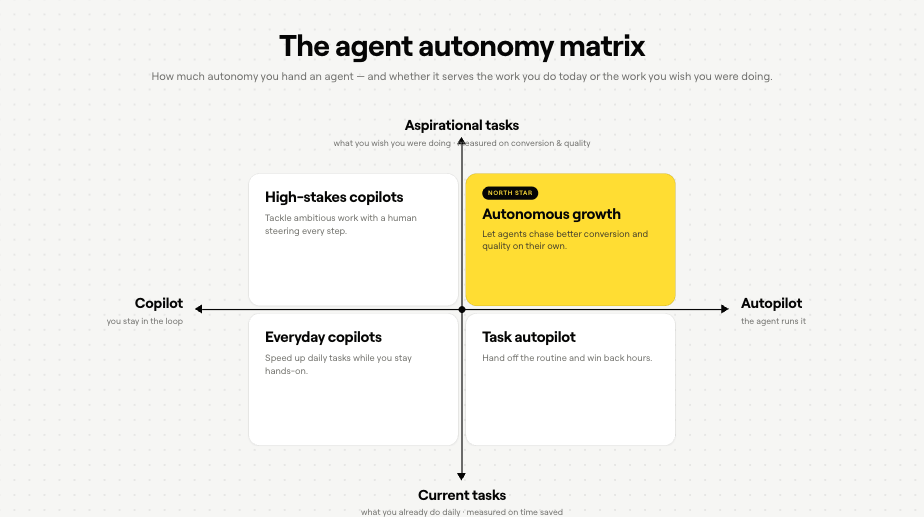
At Relevance, Jacky uses a practical tool his team first developed for customers. It’s a 2×2 matrix: One axis runs from copilot to autopilot, to determine how much autonomy you hand an agent. The other splits current tasks (what you already do daily, measured on time saved) from aspirational tasks (what you wish you were doing, measured on conversion and quality).
This, he said, is something any organization can start doing immediately. “Pull up a Miro board, lay out the two-by-two, drop in every use case across your company, then map it.”
3. Shift your mindset
When an agent underperforms, the reflex is to blame the model. Jacky flips it: “Junk in, junk out. So when it’s not working, the question isn’t, ‘Can AI even do this?’ It’s, ‘Have I described it well enough? Am I giving it enough to work with?’”
What changes when you get it right
Point a team in the same direction and the payoff compounds in ways that have little to do with the tools.
You can afford to experiment. Once a team is genuinely pointed the same way, something counterintuitive becomes possible: You can afford to delete things. “We rebuilt the same mobile app two or three times, about a day each,” Jacky said. “That used to take months.” When building is cheap, attachment to your first draft is expensive.
You unlock your team’s ceiling. Jacky’s most pointed observation was about people, not products: A team that’s truly aligned doesn’t just move faster, it raises its own ceiling.
“When you work with people who are genuinely on the same page, the 100x and 1,000x engineers and designers really do exist. They don’t just use AI to design the thing; they use it to build it. A lot of teams obsess over the floor. We care about the ceiling.”
Jacky Koh, Founder and co-CEO at Relevance AI
You can finally prove the ROI. This closes the loop on the executive-order problem from the start. Once everyone’s pointed the same way, velocity becomes something you can actually measure.
For Jacky, the customer is the signal he trusts most. “The main thing I look at is feedback from customers. That’s where the biggest and most important ROI comes from: Customer-focused metrics. How many features have we shipped, and how many are actually being used?”
Relevance even loops that feedback back into LLMs to read the trend — is it positive, is it negative, is there an anomaly? The “what’s the ROI of that for the company as a whole?” question finally has an answer.
You don’t need a transformation program or a new budget line to start. You need a Miro board, your team, and an hour to decide what actually matters. Because the teams that win with AI won’t be the ones moving fastest. They’ll be the ones moving fastest in the same direction.