Miro has been included among the notable vendors in Forrester’s Strategic Portfolio Management Tools Landscape, Q4 2025 report.¹ According to the Forrester report, Strategic Portfolio Management (SPM) tools are “technologies that automate the translation of enterprise strategic plans into product and service plans that deliver business value through the prioritization and delivery of work initiatives.” The report explains that tech leaders and strategic value office (SVO) leaders use SPM to “establish a planning and delivery ecosystem that provides visibility and structure for strategic planning and prioritization of initiatives.”
This recognition arrives at a moment when, we believe, organizations face a critical inflection point. The challenge isn’t setting strategy — it’s ensuring teams’ work connects to it so it can actually be executed. And right now, that’s harder than it should be.
Many leaders tell us what keeps them up at night is not knowing if their teams are focused on the right business priorities. Meanwhile, teams inherit fragments — and once work begins, context dilutes further. The further you get from strategic conversations, the harder it becomes to translate objectives into day-to-day decisions.
The strategy-to-execution gap Is widening
Here’s the paradox leaders face today: AI is accelerating execution velocity while strategic planning processes remain stuck in an earlier, slower era.
As a leader, do you let teams run at AI speed and watch strategic alignment evaporate — taking business objectives with it? Or do you maintain traditional governance and watch AI-empowered competitors move faster while you’re still in planning meetings?
Neither option is sustainable. When strategy is disconnected from execution, the outcomes are predictable: slower time to market, wasted resources, and products that miss the mark.
The organizations that will win in the AI era will transform their strategy-to-execution process into a continuous, intelligent flow — where strategic intent guides every sprint, and execution insights inform strategy in real time.
How Miro Portfolios connects strategy to delivery
When strategy, prioritization, roadmapping, and execution are spread across tools and teams, it’s nearly impossible to have full visibility across the entire product portfolio. Leaders lack a single, trusted view of which initiatives are on track, where risks are forming, or where resources are misaligned. Dependencies and duplication are often discovered only after they’ve slowed teams down.
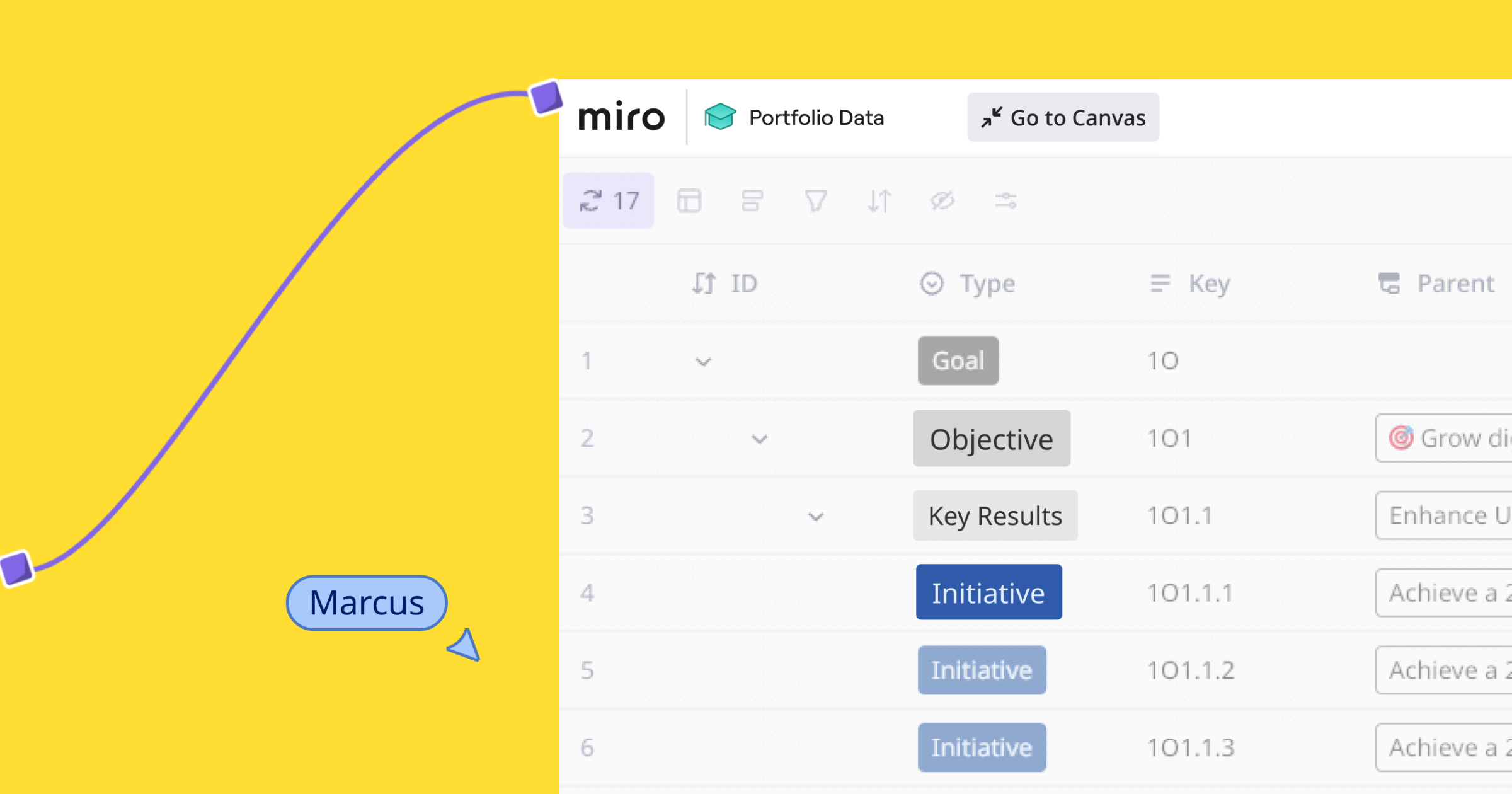
Miro Portfolios gives leaders visibility across the product development process.1 It provides a single view of initiatives and their connection to goals and key results, enabling teams to:
- Evaluate alignment
- Understand dependencies across workstreams
- Track progress in a way that’s both lightweight and grounded in real execution data
But visibility alone isn’t enough. The power of Miro Portfolios comes from where it lives: on the same AI-first canvas where initiatives are defined, roadmaps are built, and delivery plans take shape. Strategic context doesn’t get lost in translation between tools. Goals stay connected to daily work instead of living in slides and spreadsheets. And when priorities shift — as they often do — changes flow naturally through the system rather than getting lost in email threads or stale documents.
As noted above, in its Landscape report, Forrester states that leaders “utilize SPM to establish a planning and delivery ecosystem that provides visibility and structure for strategic planning and prioritization of initiatives”. With Miro Portfolios, we deliver this by bringing the entire product lifecycle into one collaborative workspace where AI helps teams move faster without losing alignment.
Built for how product teams actually work
What sets Miro apart in the SPM space is that it’s purpose-built for how organizations actually operate. Rather than forcing teams to adapt to rigid project management structures, Miro meets teams where they are — in the collaborative, visual workspace they already use for product discovery, planning, and problem-solving.
When strategy travels with the work, teams move with intention at every step. The result is a product organization that advances quickly and stays aligned, even as priorities shift and new information surfaces — turning strategic ambition into value, delivered at AI speed.
¹ Forrester does not endorse any company, product, brand, or service included in its research publications and does not advise any person to select the products or services of any company or brand based on the ratings included in such publications. Information is based on the best available resources. Opinions reflect judgment at the time and are subject to change. For more information, read about Forrester’s objectivity here.