AI has become part of how product teams think, plan, and create. But too often, these experiments happen in isolation — outside the tools and rituals where work actually gets done. The result is acceleration that looks promising in one corner of the organization but stalls when it needs to scale. In fact, 44% of cross-functional product leaders say implementing AI for individual productivity — versus collaboration within and across teams — is the biggest barrier to realizing ROI from AI.¹
Engineering, product, and design leaders are starting to change their approach: 80% want AI solutions built on shared, canvas-based workspaces.¹ As a result, they’re shifting their focus from adding more AI tools to designing better systems where AI and cross-functional teams work together, in context.
The shift looks different in every organization, but the goal is the same: make AI part of how work flows, not a disconnected piece off to the side. Here’s how three very different companies are doing it.
GitHub: Making “AI for Everyone” real
GitHub’s “AI for Everyone” initiative was designed to bring AI into daily workflows across disciplines — overcoming people’s uncertainty about whether and how to use AI for work — so that everyone can move faster and stay aligned.
To make this happen, they use Miro early in the product development lifecycle and transition to GitHub’s own tools for the later stages. Product managers, program managers, business architects, and engineers run strategy workshops in Miro, map personas and journeys, synthesize insights, define requirements, and sketch early roadmaps on the canvas. From there:
- Miro AI turns piles of stickies into themed summaries and concise workshop readouts in minutes — work that historically took hours after a session.
- Those summaries then seed GitHub Spark, which uses the Miro output as prompt context to generate a working app scaffold (including data inputs, logic, and a simple dashboard) that non-coders can iterate on.
- GitHub teams also drop Miro AI’s workshop theme write-ups into GitHub Copilot, which converts them into a structured backlog and publishes directly to the chosen repo and project boards.
The net effect: tasks that used to be manual and time-consuming now take minutes, and the path from ideation to a prioritized backlog happens in under a day instead of weeks.
By embedding AI into the spaces where collaboration already happens, GitHub turned a big idea — AI for Everyone — into something practical and scalable.
“One of the most powerful things is leadership modeling. So executives didn’t just talk about the use of AI; they were actually modeling and using it in town halls, in meetings. It helped replace that hesitation of users internally with curiosity — that permission to explore, fail, and learn.”
Alexandra Yanes, Senior Product Manager for People Systems at GitHub
Proximie: Taking the fast path from ideas to impact
When health technology company Proximie set out to build their new Intelligence Suite, they needed to move quickly without compromising security or quality of care.
By using Miro AI to prototype, test, and refine ideas, Proximie went from concept to production in just nine months — an unusually fast timeline for a product that handles sensitive healthcare data across global infrastructure.
And by feeding their live dashboard designs into Miro AI with different contextual requirements, they could generate multiple views in less than a minute — transforming a scheduler’s perspective into a nurse’s view, or adapting layouts for different user needs.
“Being able to then take that live dashboard and stick it into the Miro AI tools with new data sets — and within seconds it spins out new potential views, new dashboards, new contextual elements within the data — has been fascinating. And I think we’re just at the beginning of what we can do with it.”
Dr. Nadine Hachach-Haram, Founder and CEO at Proximie
The impact extends beyond faster development cycles. According to Victoria Hatcher, Proximies’s VP of Global Marketing and Sales, using Miro to align cross-functional teams ensures that “everyone has access to a view of what’s happening. They can add, they can annotate — keeping people on track together.”
Red Hat: Scaling AI collaboration
Red Hat set out to make AI part of how the whole company works every day, moving from promising AI pilots to sustainable, organization-wide adoption. They knew lasting transformation would depend as much on culture as on infrastructure: pairing strong data foundations with ways of working that help people move faster together.
“Culture is super important. Bring the people along who are doubters who might belittle AI and also the people who feel they’re left out. … ‘Oh, I’m not part of the cool kids who get to do AI.’… Encourage them to look at their opportunities to apply AI even to things they haven’t thought about.”
Jan Mark Holzer, Distinguished Engineer at Red Hat
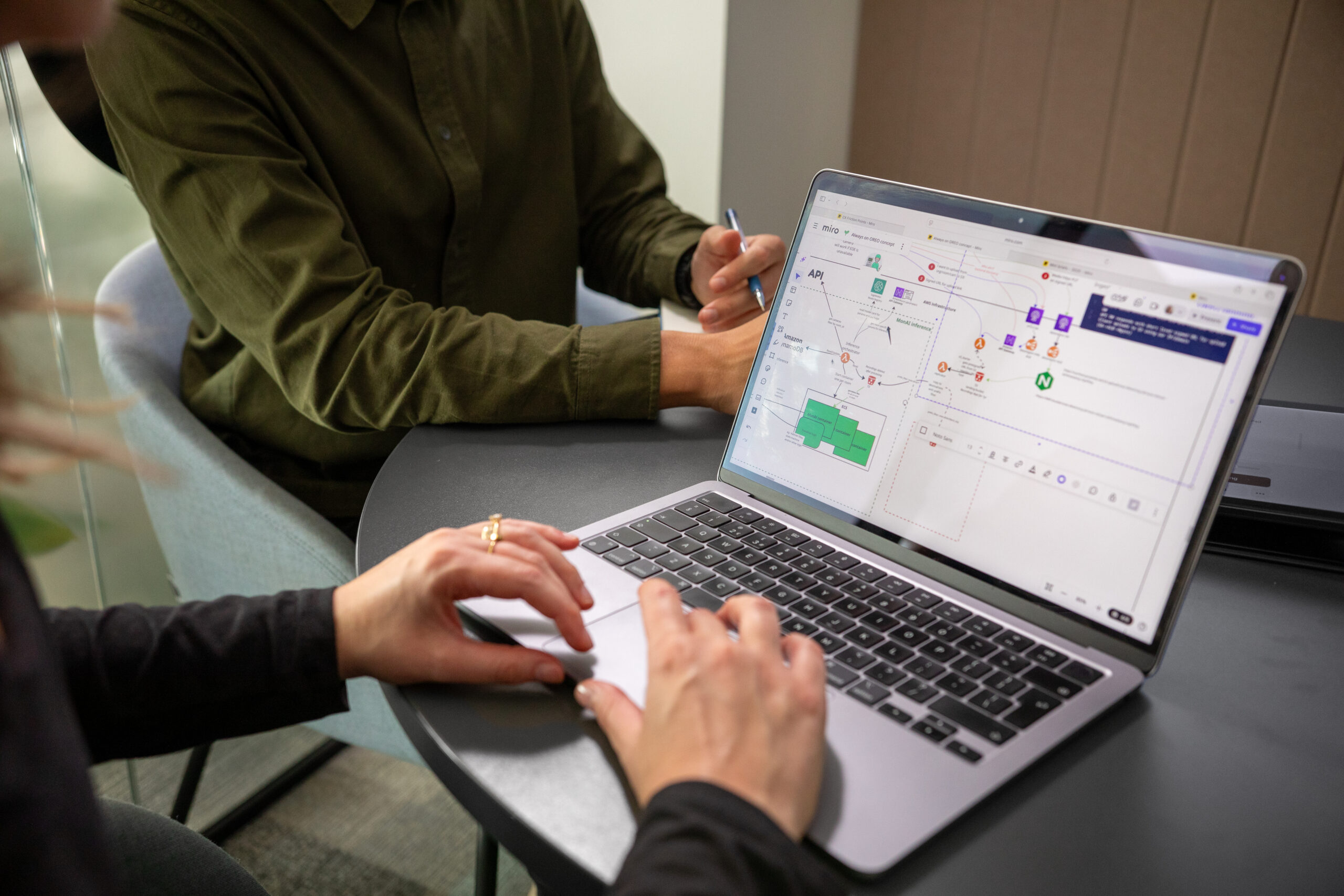
They rely on Miro as an AI-powered workspace where cross-functional teams could work together on a shared canvas to make sense of complexity, design better systems, and turn ideas into action. Product and engineering groups used Miro’s collaborative canvas to visualize how their “Dataverse” would unify data sources, ensuring AI models could draw from consistent, high-quality inputs.
The same environment has become a hub for scoping and refining custom applications — where stakeholders from design to engineering can work together and with AI in context before development begins.
The impact is tangible. Red Hat has:
- Consolidated data pipelines from more than 2,000 to just 200, giving AI initiatives a single source of truth
- Cut privacy review timelines from weeks or months to days by using AI to screen requests and automatically generate follow-up questions
- Enabled both technical and non-technical teams to use AI without complex prompting — broadening adoption across the company — by embedding AI in familiar, collaborative workflows
A new model for AI transformation
These teams share a common mindset: AI transformation works when it’s built into the fabric of how people work together.
Leaders are realizing that the value of AI is augmentation, not just automation. And they’re starting to measure success differently. Nearly half (47%) of leaders now evaluate the impact of AI not by financial ROI alone, but by how it increases creativity, teamwork, and employee engagement.¹
When AI and teams come together across the software development lifecycle, the impact compounds:
- Throughout the entire loop, AI helps connect strategy to execution so teams focus on the right problems.
- In discovery and definition, it helps teams align and prototype faster — turning early thinking into shared clarity.
- In delivery, it gives code-generation tools the context they need to produce the right thing, not just something fast.
That’s what it means to move from silos to systems — to bring AI into the flow of work where it’s already happening and let it amplify and accelerate what teams do best.
¹ Forrester’s AI Workflows For Team Innovation Survey, Q3 2025.
Base: 170 EPD leaders in organizations across USA, EMEA, and APAC currently integrating or planning to integrate AI into workflows.