
At its recent Digital Workplace Summit in London, Gartner revealed that by 2027, at least 60% of AI initiatives will fail to meet expectations with change resistance, not technology, the primary cause.
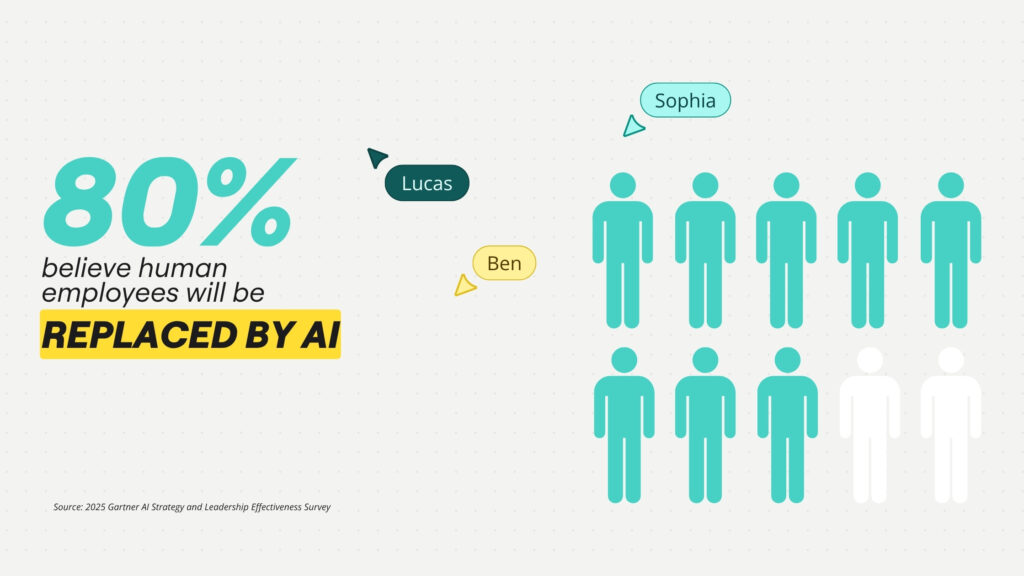
The source of that resistance is well documented. The 2025 Gartner AI Strategy and Leadership Effectiveness Survey found that “eight out of 10 employees believe that their organization is trying to replace human employees with AI.” And according to the 2025 Gartner HR Symposium Employee Survey also cited at the Summit, only 12% of employees think their organization is involving them in decisions around the best way to use AI.
Dig deeper and the picture gets worse. Separate Gartner research found that “only 32% of employees feel safe taking risks [at work]” (2024 Gartner Employee Perspective of L&D Survey), while “only 20% of organizations provide persona and/or role-based guidance when training employees on GenAI” (2025 Gartner Generative and Agentic AI in Enterprise Applications Survey).
And yet most organizations continue to characterize the problem as employee readiness rather than their complete absence from the conversation.
Why enterprise AI adoption efforts keep failing
At the Summit, Christy Nelson, SVP and Global Head of Digital Workplace at AIG, put it this way: “[Transformation] doesn’t fail because IT lacks capability. It fails because we don’t start with the human problem, and we don’t evolve as we learn.”
That last phrase matters. AI transformation isn’t a project with an end date. It’s an ongoing negotiation between the technology and the people using it. Organizations that treat it like a standard software deployment are learning that adoption doesn’t follow automatically — and when it doesn’t, the instinct is to blame the workforce rather than the approach.
The takeaway: The gap between AI spend and AI value is a listening problem, not a technology problem. The organizations closing that gap stopped diagnosing employee readiness and started asking what employees actually need.
AI transformation strategy starts with employees
David Fletcher, VP of Workplace Experience at AppSpace, cited McKinsey research that reframes where AI programmes should focus: “AI is 80% business transformation and 20% technology. But most organizations bought the tool and just expected the value to follow.”
If transformation is where most of the value lives, then the people doing the transforming matter more than the tools they’re given. Digital transformation employee engagement — whether your workforce is genuinely part of the process or just on the receiving end of it — is where AI ROI is actually won or lost.
Gartner’s 2024 Impact of GenAI in the Digital Workplace Survey makes the pattern clear: Among digital workplace leaders who are generating real AI value, 87% had received frequent, ongoing engagement, training, and education. That’s a sustained, structured conversation about what’s working, what isn’t, and where AI could actually be useful.
Nicolas Bonvin, CTO at Pictet Alternative Advisors, shared how he spent nearly two years building AI literacy across his 160-person business, starting with live demos to the executive committee rather than strategy decks. The result: 30 use cases developed internally, with an average ROI of 8x over one year. More importantly, the nature of what people were asking for changed entirely.
“You get great ideas from the users because they understand what they can do and what they cannot do,” he said during his Summit presentation. “They come to you with real needs that have the potential to be delivered.”
When people understand the technology and feel safe using it, they stop making abstract requests and start making actionable ones. That’s a use-case quality outcome, not a communications one, and it only happens when employees are genuinely in the conversation.
The takeaway: Employee input doesn’t just improve adoption, it improves the quality of what gets built. The organizations generating the best AI use cases are the ones that made their employees capable of proposing them.
What successful AI change management actually looks like
The organizations getting this right have something in common: They’ve redefined what IT’s job actually is.
For most, IT’s relationship with the business is transactional — requests come in, solutions go out. AI changes that equation. The technology doesn’t come with instructions for how to use it well across a business; that has to be built, collectively, with the people who’ll use it. The IT leaders who recognize that are the ones seeing results.
Denis Trudeau, Director of Digital Solutions and Information Governance at the International Development Research Centre (IDRC), described the outcome at the Summit: “If you asked our employees who led the digital transformation, they wouldn’t say we did it, they would say they did it.”
That’s the goal line. Getting there requires a different kind of relationship with the workforce — what the best digital workplace leaders describe as a “trusted advisor dynamic.” The aim is to become a partner helping the business figure out what it actually needs.
It also means governance that employees helped create. The most effective AI governance frameworks aren’t handed down from security and architecture teams — they’re built with input from the people who’ll use them, which is exactly why they get followed.
The takeaway: The shift from top-down deployment to collaborative development isn’t a culture question on the side. Organizations that build AI programmes with their employees consistently outperform those that build programmes for them.
How to involve employees in your AI transformation
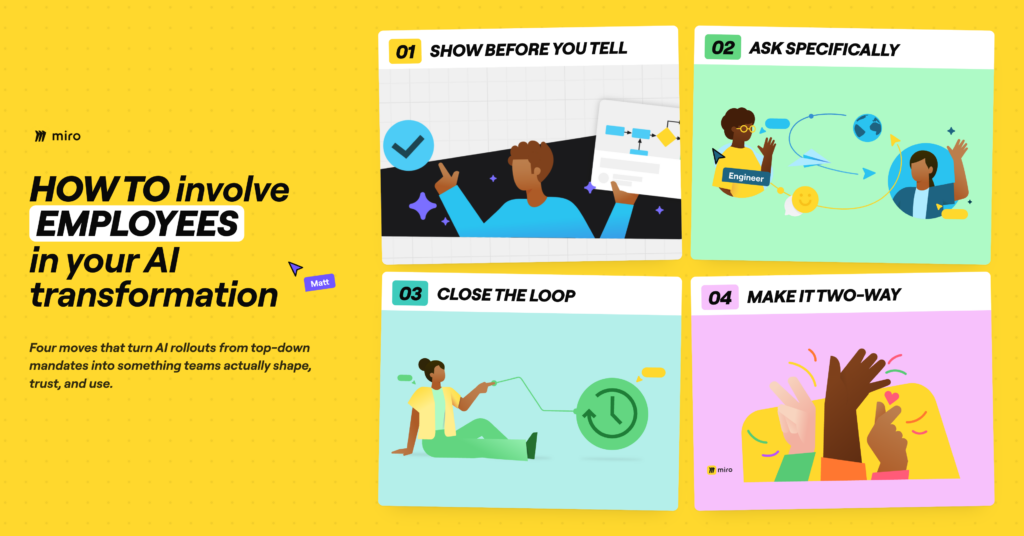
Involving employees in AI transformation comes down to four things: Showing rather than telling, asking specific questions, closing the feedback loop visibly, and making the exchange genuinely two-way. Here’s what each of those looks like in practice.
Show before you tell. Bonvin didn’t present AI strategy to his executive committee — he demonstrated it. Hands-on exposure changes the quality of the conversation. When people see what the technology can do in their actual context, they stop making abstract requests and start asking the right questions. It’s also the most effective way to build psychological safety around AI experimentation because people are less afraid of tools they’ve already seen work.
Ask specifically, not generally. “What do you think about AI?” gets you nowhere useful. “Where does this process break down, and where do you think AI could help?” gives you a use-case backlog. The specificity of the question determines the usefulness of the answer, and it signals that you’re asking because you intend to act.
Close the loop visibly. One of the fastest ways to destroy trust in an AI change management program is to ask for input and then do nothing visible with it. When employees see their feedback reflected in the tools and processes they use, participation compounds. When they don’t, they stop engaging. Closing the loop is the mechanism that keeps the conversation going.
Make it genuinely two-way. Gartner describes the most effective AI programs as operating on a “clear two-way deal”: Transparency and openness from the organization; continuous learning and experimentation from employees. Both sides have to show up. The right digital employee experience tools — like Miro — give distributed teams a shared space to surface ideas, map workflows, and co-create the frameworks they’ll actually use. That’s how you make this conversation possible at scale, not just for whoever’s in the room.
Think of these four moves as your structured conversation rather than a “program.” And unlike most of what AI transformation demands, they can start this week.