
Two recent data points sum up the story of AI deployment so far. First: Enterprise AI spend is predicted to hit almost $115B in 2026, signalling the urgency with which the technology is being adopted.
Second: Only 15% of AI decision-makers reported a revenue lift for their organization in the past 12 months, meaning the reality is yet to match the hype.
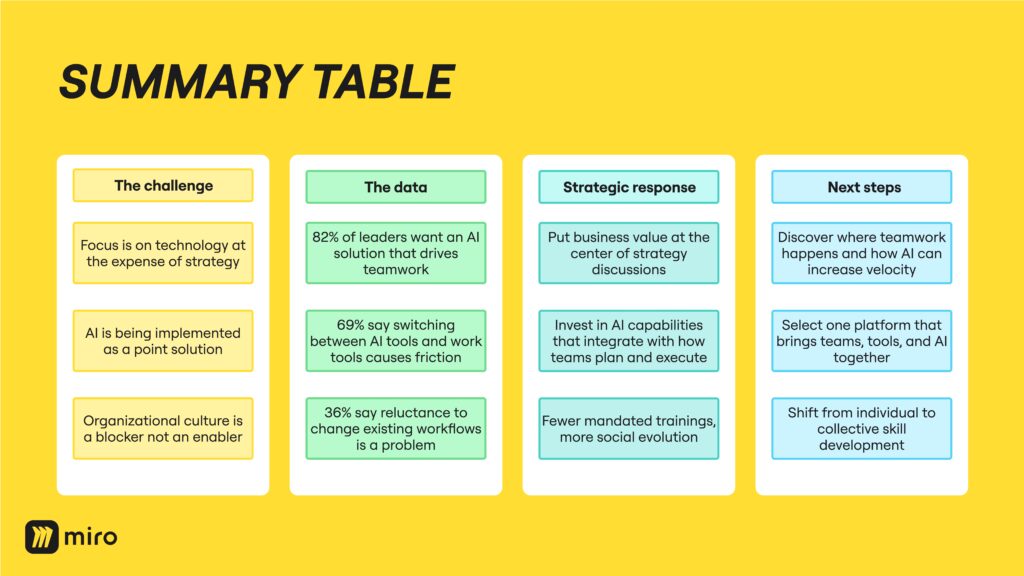
To understand how to bridge the gap, Miro commissioned Forrester Consulting to conduct a new study, “Collaboration Is AI’s Biggest Opportunity.” The most important finding: AI is currently being rolled out to optimize individual tasks, while team collaboration and alignment are lagging behind.
This is creating what our webinar guest speaker, Forrester VP & Principal Analyst J.P. Gownder calls the “silo tax.” Avoiding this tax requires more than just a software upgrade; it requires a shift in how we measure value, select our tools, and empower our people.
J.P. discussed the Forrester study findings in a recent webinar with Miro’s own Head of Product for AI, Tony Beltramelli. These are the three lessons they shared.
Lesson one: Everything starts with strategy
As a leading voice on the “Future of Work,” J.P. has spent time with hundreds of enterprise leaders. His conclusion? Many organizations are so focused on the technology that they’ve stopped asking how work actually happens.
“We’ve spent a lot of time talking about technology but we forgot to address the strategy,” he noted. “We forgot that work is a team sport. It is much more like a football match than it is just an individual activity.”
“We’ve spent a lot of time talking about technology but we forgot to address the strategy. We forgot that work is a team sport.” — J.P. Gownder, VP & Principal Analyst, Forrester
The most effective leaders aren’t just asking how to get more people to use a tool; they’re asking how AI can make their entire business more effective. The answer is collaboration.
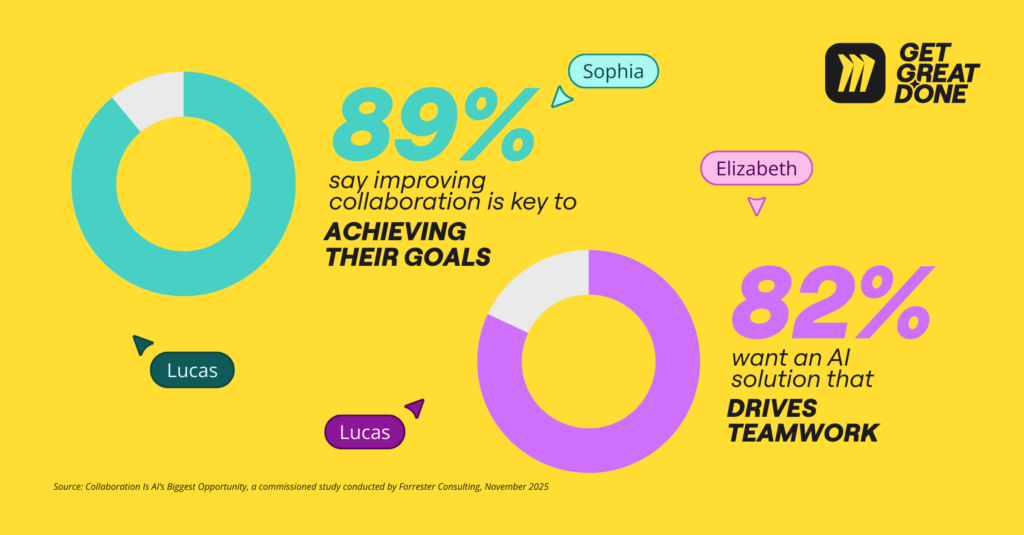
J.P. revealed that in the survey conducted for the Forrester study, 89% of decision makers say improving collaboration is key to achieving their goals, while 82% want an AI solution that drives teamwork. But all that gets set aside when organizations prioritize volume and velocity over thoughtful procurement strategies.
Lesson two: Teamwork is the key to AI success
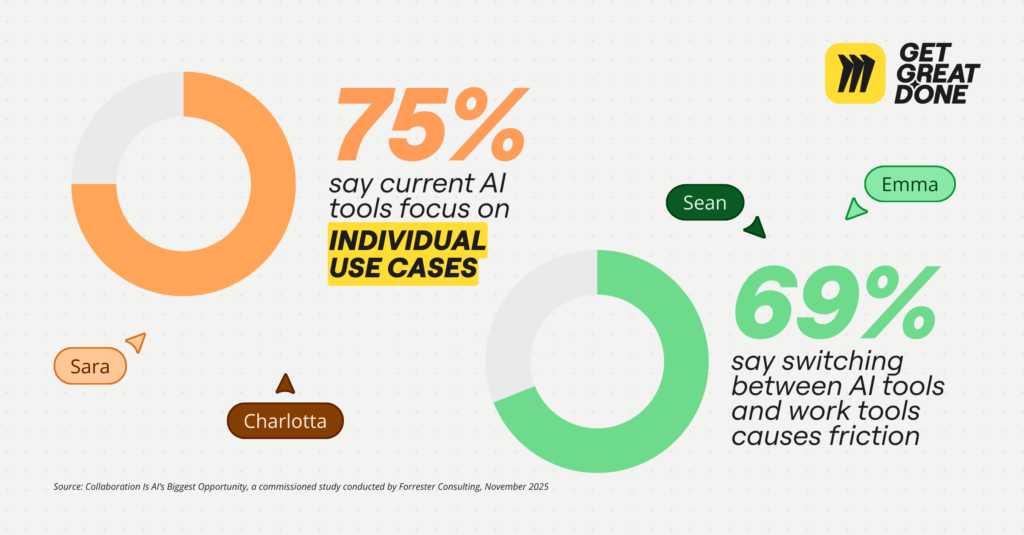
According to the 2025 study, which surveyed 500+ decision-makers, 75% of leaders admit current AI tools focus almost exclusively on individual productivity. This creates the “silo tax,” the hidden cost of friction and context-switching.
“Decision makers believe [AI] is being implemented as a point solution,” J.P. explained on the webinar. “There’s a lack of discoverability and visibility from colleagues… We’re leaving a lot on the table with this silo tax when everything is happening in these really distinct areas.”
The survey found that over a third of leaders (39%) believe the focus on individual use cases is the top factor impacting ROI, and IT leaders feel it more than most. They’re 1.3x more likely to say this is the case.
Agreement that it has a serious effect on productivity is even more widespread, with 69% admitting that switching between AI tools and work tools causes friction.
“There’s a lack of discoverability and visibility from colleagues… We’re leaving a lot on the table with this silo tax when everything is happening in these really distinct areas.” — J.P. Gownder, VP & Principal Analyst, Forrester
Organizations are prioritizing the wrong kind of AI tools. Instead of a dozen different apps for isolated tasks, teams need an environment where AI capabilities naturally integrate with how they already plan and execute.
Tony Beltramelli illustrated this by demonstrating how a Canvas-based workspace serves as more of a strategic partner rather than yet another silo.
On a canvas, the AI has access to the entire project history from sketches and stickies to data, decisions, and more. “Everything on my board… becomes my context,” Tony explains. “I don’t need to re-add or rewrite any of these things to my AI. The context of the board is readily available to my AI assistant.”
It’s an approach that’s resonating with leaders. Eighty-three percent say they’re interested in using canvas-based workspaces with AI to improve collaboration.
Lesson three: Leaders must walk the walk
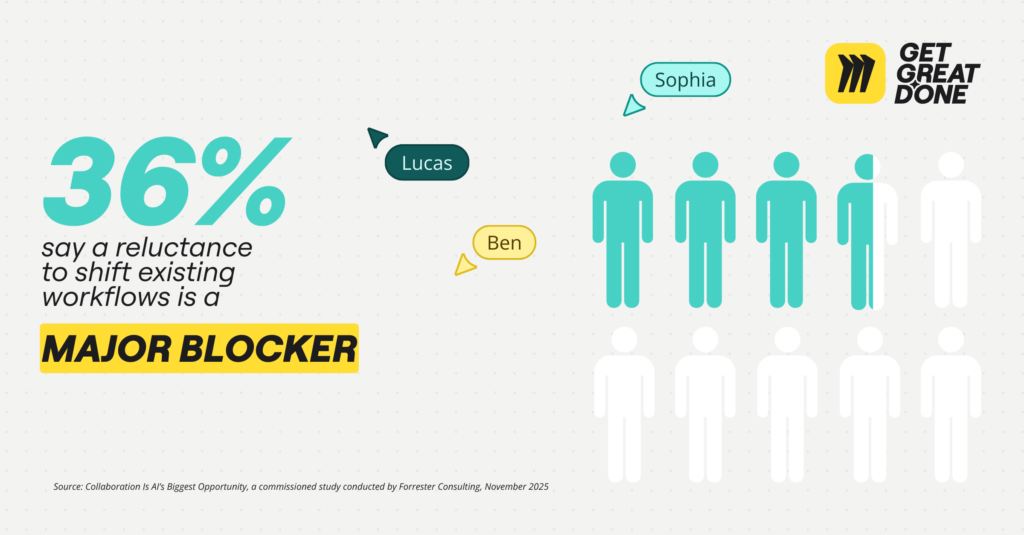
Ultimately, the bottleneck for AI isn’t the code; it’s the culture. According to the study, 36% of leaders cite a reluctance to shift existing workflows as a major blocker.
True transformation happens when we stop treating AI training as a dry, mandated exercise and start treating it as a social evolution. It’s about moving from solo “prompting” to a collective fluency where teams learn to structure thinking together.
“The irony of AI is you have to invest in humans, and humans working together, to be successful.” — J.P. Gownder, VP & Principal Analyst, Forrester
“The organizations that are succeeding with AI in the workforce rely on social learning rather than individual learning methods,” J.P. said. “You need to connect people together in a social fashion. People bring their best practices, their failures, their successes… and they discuss them with each other.”
J.P. argues that leaders must “walk the walk” to help their teams evolve. When people, not just the technology, are put at the center of the strategy, they learn where AI can be trusted and where the human-in-the-loop is most vital.
“You have to be able to let people fail a little bit,” he concludes. “AI doesn’t always give you the right answer… The irony of AI is you have to invest in humans, and humans working together, to be successful.”
What happens next?
Use this summary to align on the next steps for your organization.