Every product team knows the feeling: You’ve built something technically impressive. The code is clean. The design is polished. The only problem? Nobody wants it.
Just 6% of product features generate 80% of click volume on average. That means the vast majority of what teams build — despite months of effort, countless meetings, and significant investment — ends up as digital dust.
Teams are building faster than ever before. But speed alone creates a costly problem: the further you get into development before validating your ideas, the more expensive mistakes become.
That’s why product leaders are using AI-powered prototyping early rather than waiting until the delivery phase of the product development lifecycle. This radically reduces the cost of experimentation — exploring more ideas across teams and validating concepts with customers before anything goes into development.
With 88% of product leaders ranking accelerated prototyping as important or critical to their company’s goals, the teams highlighted here show what’s possible when you embrace this new early, AI-assisted prototyping approach.¹
EPAM Systems: 99% time reduction in getting from concept to reviewable prototypes
Digital transformation services company EPAM Systems needed to build an internal database interface for a global client. The catch: Mariana Carril, Director of Product Management at EPAM, didn’t have any UX designers on her engineering team.
The traditional playbook would have had her submitting resource requests, securing approvals from account managers and clients, sourcing designers, conducting interviews, and waiting. And waiting. Six weeks minimum before any design work could even begin.
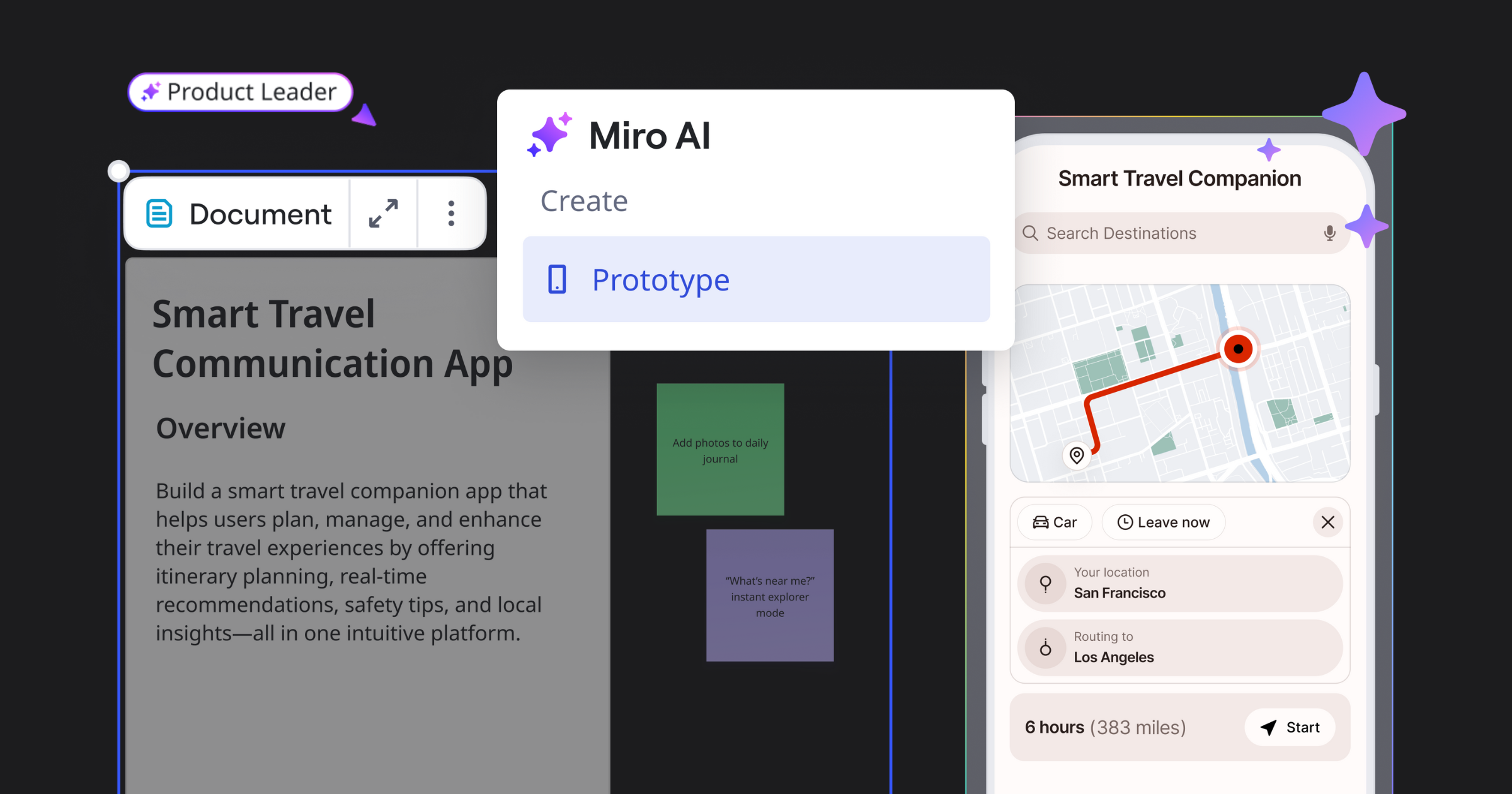
Faced with the prospect of tackling the project without design resources, Mariana discovered Miro Prototypes, which transformed her product development process with AI-powered prototyping.
Starting with text prompts and uploading screenshots of the client’s existing interfaces to maintain brand consistency, Mariana generated initial wireframes. She iterated by feeding client feedback directly back to the AI on Miro’s canvas. She refined designs conversationally, asking questions like, “What if this looked more like Nike?” to explore different directions.
In less than 30 minutes, Mariana had all the screens needed for the product. But beyond saving time, this approach unlocked new capabilities:
- Mariana now uses this approach for pre-sales conversations, creating tangible mockups during client meetings.
- Real-time collaboration replaces asynchronous feedback cycles.
- Different design directions get explored in seconds, not weeks.
“I have a thousand use cases for Miro Prototypes…. I can share my screen and start showing them, ‘you can have this and you can put the buttons here,’ and get feedback instantly.”
Mariana Carril, Director of Product Management at EPAM Systems
Lufthansa Group’s Miles & More: Accelerating product iteration by empowering PMs to prototype
At Lufthansa Group’s Miles & More loyalty program, product managers faced a familiar challenge: They had to mock up user journeys and gather feedback, but with severely limited design resources, they didn’t have any way of visualizing flows, concepts, and ideas for early alignment.
So alignment took weeks. Solutions went into development without visual validation. And with development cycles stretching up to six months, discovering changes were needed late in the game meant expensive rework — both in cost and lost opportunity.
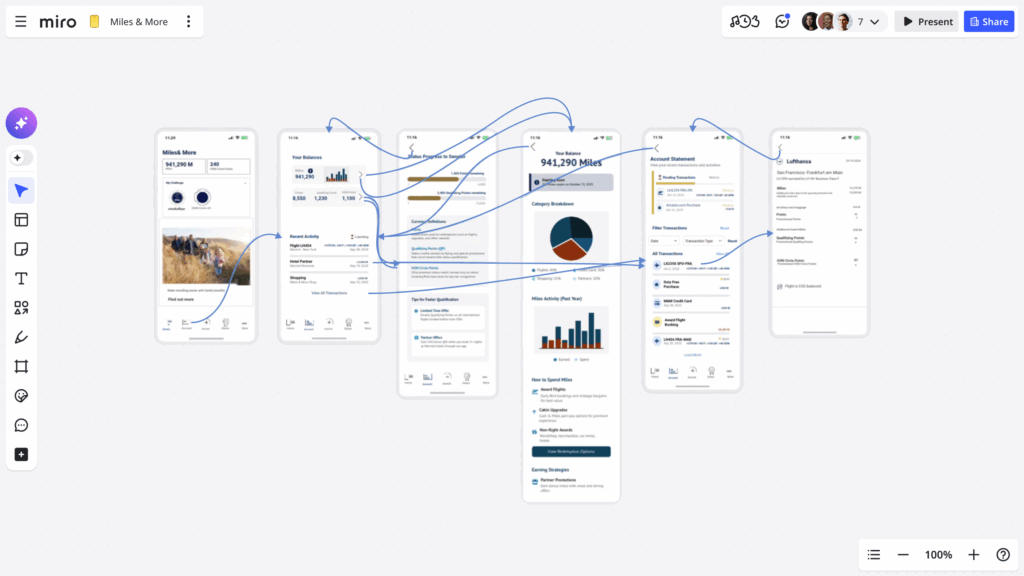
Now the Miles & More team uses Miro Prototypes to create, validate, and align on the right solution before development. They:
- Generate mockups directly from website screenshots, implementing feedback and validating solutions with end users in real time.
- Use the validated solutions to enable deeper discussions with engineers about implementation trade-offs before any code is written.
- Take one day to accomplish what used to take more than two weeks.
But the real transformation goes beyond speed — the confidence factor changes everything.
“Before using Miro Prototypes, there were no prototypes from the discovery phase. The product team just had ideas. I’m way more confident that the things we are implementing for the product are really the right things. And I’m way more confident to bring that also in front of management.”
Björn Ehrlinspiel, Product Owner at Miles & More
Medibank: Cutting innovation speed from 6 months to 6 weeks while aligning 80+ stakeholders
The Digital Labs team at Medibank, Australia’s largest health insurer, had a scant six weeks to reimagine Medibank.com.au, the company’s primary digital front door and one of its most visible customer experiences. The challenge wasn’t only the scope of the project, but also the number of people involved: more than 80 stakeholders across the business, including senior leaders with limited time to weigh in.
To make it work, the team knew they needed to create a conceptual UX vision that could align teams heading into discovery — by bringing everyone into the same visual space. They centered their work around early visual prototypes on Miro’s collaborative, AI-enhanced canvas. Instead of waiting for pixel-perfect design assets, they used the canvas to:
- Transform research inputs and pain points into simple, visual representations of how key flows could work.
- Explore early UX directions together and compare them in context.
- Give stakeholders something concrete to react to — not slide decks, but clickable or visualized paths that made tradeoffs clear.
This approach turned alignment into a working session instead of a sequence of meetings. And using early prototypes as the shared artifact, the team stuck to their aggressive six-week schedule — a feat that would have been impossible with traditional workflows.
“When everyone’s solving the same problem, in the same space, at the same time — that’s when the magic happens.”
Ben Abbott, Product Leader at Medibank Digital Labs
Proximie: From prototype to production in record time for a highly regulated field
Healthtech company Proximie works with surgical teams worldwide, where accuracy, clarity, and speed directly impact patient care. As they developed new capabilities for their Intelligence Suite, they needed a way to explore different data visualizations and workflow concepts before investing in high-fidelity design.
The team used early, AI-generated prototypes to experiment quickly — without slowing down clinical subject-matter experts or design and engineering teams. They could:
- Drop a live dashboard concept into the canvas and ask AI to generate alternate layouts.
- Instantly adapt the same view for different clinical roles — showing, for example, how a scheduler, a nurse, or a surgeon might interpret the same data.
Early prototypes gave Proximie a safer, faster path to the right ideas, helping them pressure-test ideas in minutes.
“Being able to then take that live dashboard and stick it into the Miro AI tools with new data sets — and within seconds it spins out new potential views, new dashboards, new contextual elements within the data — has been fascinating.”
Dr. Nadine Hachach-Haram, Founder and CEO at Proximie
The Intelligence Suite went from concept to production launch in just nine months — remarkably fast for a product handling sensitive healthcare data across global infrastructure.
“Everyone has access to a view of what’s happening. They can add, they can annotate — keeping people on track together.”
Victoria Hatcher, VP of Global Marketing and Sales at Proximie
The shift toward early prototyping for alignment and validation
EPAM, Lufthansa, Medibank, and Proximie demonstrate why 79% of cross-functional product leaders are currently integrating AI for prototyping, or plan to within the next two years.¹ Building the right thing requires cross-functional team members driving different parts of the development process while moving toward the same goal.
Miro Prototypes, part of Miro for Product Acceleration end-to-end solution helps teams:
- Democratize prototyping by enabling product managers and non-designers to create visuals without waiting on design resources.
- Accelerate discovery as cross-functional teams move from ideas to aligned designs in one shared space.
- Supercharge ideation so teams can explore more directions in less time and validate concepts earlier.
The result: Teams know they’re building the right thing — and they’re able to get it across the finish line faster.
¹ Forrester’s AI Workflows For Team Innovation Survey, Q3 2025.
Base: 170 EPD leaders in organizations across USA, EMEA, and APAC currently integrating or planning to integrate AI into workflows.