Over the past year, one of our senior engineers at AND Digital has transformed how she works. Where an engineer would traditionally take one ticket at a time, writing the code line by line, testing it, and sending it for review before starting the next, she now works on six complex tickets at once. On each one, she runs a small team of specialized AI agents: one drafts the code, another runs the unit tests, and a third checks the work against compliance and syntax standards.
The agents supply the speed, and she decides where it goes. What our clients pay us for is her judgment. She can tell when a feature is starting to drift from the client’s long-term strategy, and when an AI agent’s solution works today but carries technical debt that could break the platform two years from now.
This new way of working raises a big question that I’ve been talking about a lot:
Five years from now, when every company you compete with can subscribe to the same agents, what will set your company apart?
When every bank has an agent that can build the same risk model, and every retailer has one that can run the same automated campaign, those agents become table stakes for staying in business rather than a competitive advantage.
That’s why I’m wary of the easy conclusion: that all this ends in a company that runs itself, with agents in every function and nobody at the wheel. I think that’s an expensive illusion, and that lasting advantage comes from people and agents working closely together.
Agents provide three things in abundance: speed, scale, and predictions. Each of those becomes far more valuable when it’s paired with something your people bring.
Speed needs direction
An agentic system can run thousands of financial scenarios overnight, draft iteration after iteration of code, optimize logistics routes across three continents at once, and work through more customer feedback than any team can read.
Speed without direction, though, is just motion. Think of an agent as a 1,000-horsepower engine: it will take you a long way very fast, but it can’t choose the destination. Deciding where your company ought to go takes purpose, values, and a feel for your market, and that’s work for your people to do. That human direction isn’t a bottleneck to eliminate, but rather the compass ensuring all that velocity takes you somewhere worth going.
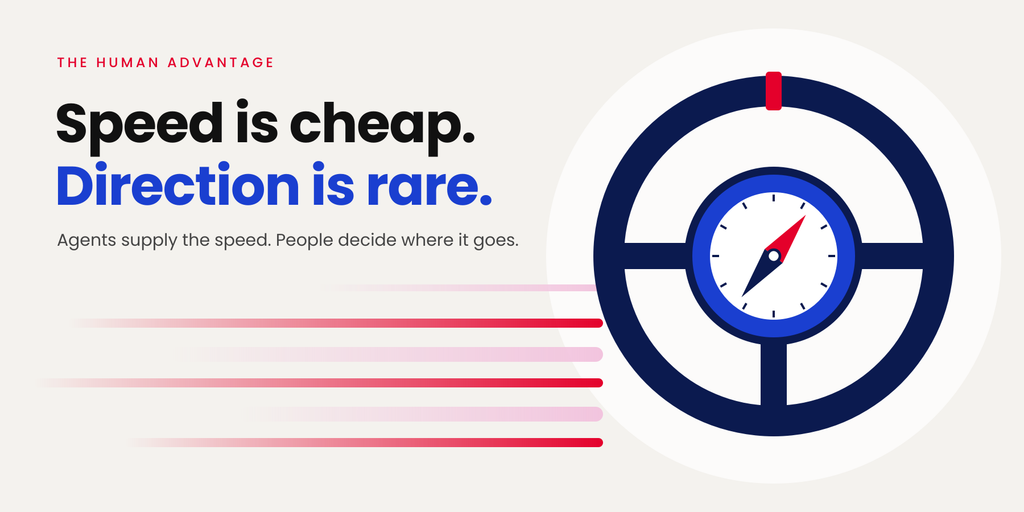
If our engineer’s agents were left to run on their own, without her oversight, they would keep producing thousands of lines of clean, working code for a product that maybe nobody wants. The rework would show up long after the team could have changed course inexpensively. Speed is getting cheaper all the time, and a clear sense of where to point it is getting rarer.
Scale needs trust
It’s a similar story with scale. When agents can generate content or code and synthesize customer conversations at huge volume for next to nothing, trust becomes one of the scarcest resources a company has.
Picture a hospital developing an AI tool that scans anonymized records of past patients with similar symptoms and surfaces their treatment outcomes to a newly diagnosed patient. It would be easy to automate the whole experience: enter your symptoms, get a recommended care path. But a decision like this calls for a physician who can sit with the patient, understand the fear and uncertainty in the room, and weigh the options against what that patient values. The AI handles the data at scale, and the clinician earns the trust. But if you replace that conversation with an automated portal to protect throughput, the trust goes with it.
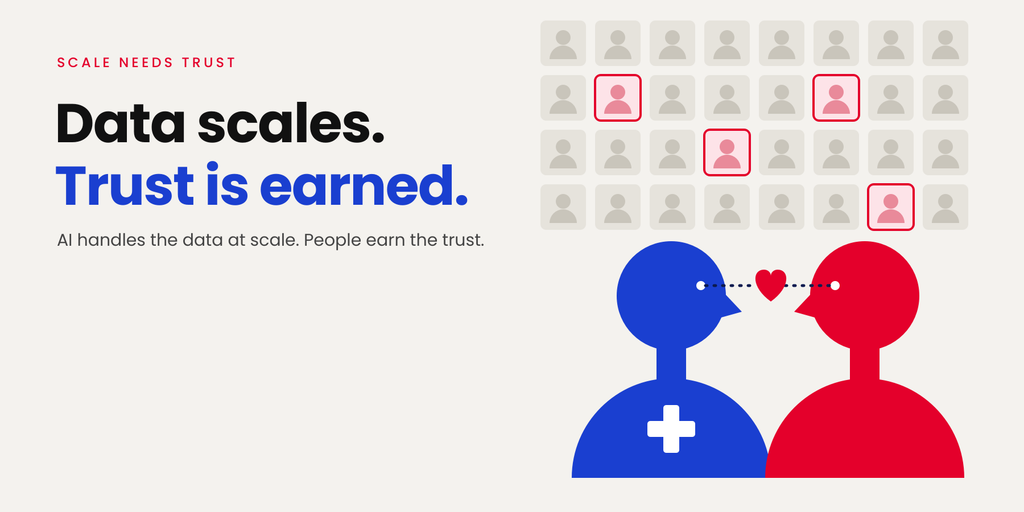
Trust rests on accountability. When an agent gets something wrong, makes a biased call, or causes an outage, a person has to stand behind it. My AND colleague Andrew Smith puts it this way:
“Management was never the supply of intelligence. It was always the ownership of consequence. AI supplies the first at scale. It cannot carry the second at all.”
Predictions need judgment
AI models are superb at pattern recognition. They work through vast amounts of historical data to tell us what’s most likely to happen next, on the assumption that the future will follow the patterns of the past. That makes them least reliable when it matters most: when a market turns, or a culture changes faster than the training data can follow. Data and predictions tell you where the world has been. Judgment is what lets someone look at a dashboard and say, “The data says X, but we should do Y.”
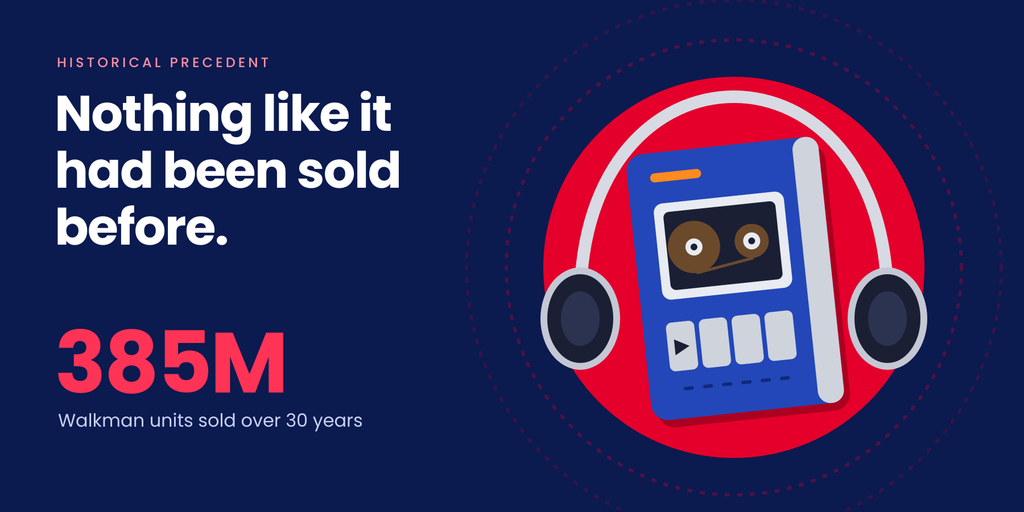
Think about the Sony Walkman. In 1979, nobody had tried selling a cassette player that couldn’t record and delivered music only through headphones, and people inside Sony doubted there was demand for one. “They said it wouldn’t sell,” Sony co-founder Akio Morita later recalled.
But Morita had watched his children and their friends listening to music all day, and he’d noticed people carrying large stereos to the beach and the park. His judgment told him people wanted to take their music everywhere, so he took personal responsibility for the project and put the Walkman in stores without a day of test marketing. It went on to sell ~385 million units over a 30-year period.
Any model trained on the market of 1979 would have forecast weak demand for the Walkman, because nothing like it had been sold before. Which decision in front of your team right now depends on seeing a market that doesn’t exist yet?
What to hire for and cultivate now
All of this means your decisions about hiring and talent management are more crucial than ever. Your people will set your company apart through their collective taste, institutional context, appetite for creative risk, ethical framework, and capacity for deep collaboration. At AND, we’re increasingly hiring, training, rewarding, and retaining for five core capabilities:
- Curiosity: When an agent can answer almost any question in seconds, the value is in asking the right ones, and in reframing a challenge and probing hidden problems before sending an agent down the wrong path.
- Contextual taste: Agents can generate hundreds of design concepts, strategic proposals, or software features in minutes, but they don’t have taste. Your people provide the critical filter: knowing the difference between an output that’s merely technically correct or plausible and one that’s emotionally resonant, culturally aligned, and truly extraordinary.
- Critical judgment: The analytical and moral courage to challenge the algorithm when the data feels wrong or a recommendation conflicts with your organization’s ethics or long-term vision. It’s the ability to say “stop” when the machine says “go.”
- Creativity: Coming up with something genuinely new, something that hasn’t been done before. Agents simply cannot do this.
- Collaboration: The ability of diverse minds to come together, debate passionately, and synthesize disparate ideas into breakthrough innovations that no individual or machine could conceive in isolation.
These qualities make the difference between AI slop and something outstanding. But that doesn’t mean they have to be divorced from AI. Great AI tools can dramatically amplify and elevate these innately human traits when integrated thoughtfully into daily work.
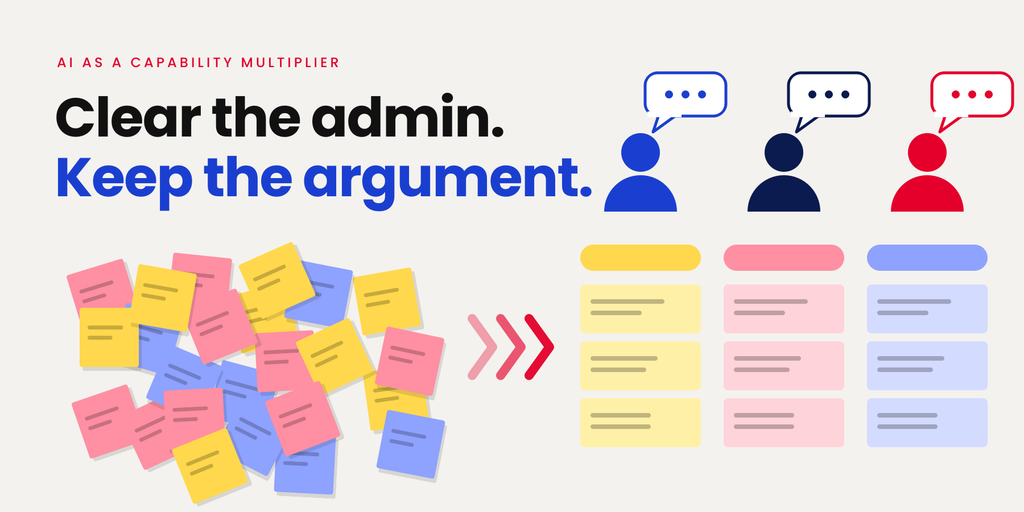
Think about the hours that traditionally go into sorting the physical or digital sticky notes from a strategy workshop: categorizing ideas, finding themes, and pulling out the key takeaways. When you use Miro’s Intelligent Canvas™, for example, AI workflows on your board can synthesize all those notes into themes in minutes, with each insight linked back to its source. Crucially, the AI doesn’t make the strategic decision; it simply clears away the administrative friction and frees people to spend their energy on more valuable things: intense debate, creative refinement, and agreement on what to do next.
The choice in front of us
Adopting AI isn’t optional; the market will see to that. How you use it, though, is up to you. When you pair an exceptional, highly curious workforce with agentic systems, you amplify your team’s capability, trust, and judgment — all of which will help you build something your competitors can’t.