5 ways to help employees upskill for AI

Forty-one percent of employees are struggling to fit AI into their daily workflows. It’s got nothing to do with technology and everything to do with management.

That’s the finding of a recent Gartner® report, The Human-AI Workforce Journey: 5 Steps for CIOs to Accelerate AI-Readiness, which you can download now for free.

The most surprising stat? Only 6% of individual contributors have received guidance on the AI skills they need to develop. In other words, 94% of organisations aren’t providing clear expectations to their employees about how to take advantage of this once-in-a-generation opportunity.

And it’s not like younger, more qualified applicants are queuing up to replace them: Half of CIOs report that demand for AI-ready skills outpaces talent supply.

Organisations are over-investing in technology and under-investing in the people expected to use it. That’s a strategy that almost seems intentionally designed to hurt productivity while burning money.

Your managers are the missing activation layer. They’re the people who can translate strategy into daily behavior. But they need help.

Why traditional L&D approaches need to change

Traditional L&D strategies aren’t working for AI. We keep seeing organizations running into the same brick walls.

Sending managers to AI training, then expecting them to figure out the rest. Training teaches concepts. It doesn’t give managers a framework for guiding 8-10 people with different roles through skill development.

Buying AI tools and hoping people use them. 73% of IT workers already use personal AI tools for work. The problem isn’t know-how. It’s creating structured paths from experimenting alone to building capability together.

Treating AI skill development as separate from daily work. People won’t carve out extra time for AI learning. It has to happen inside the work they’re already doing.

We all know that technology moves fast while people change much more slowly. But they do change. Gartner found that 90% of employees are willing to adapt the way they work, but only if they’ve built trust based on past experiences. The cultural barrier companies face right now is that only 20% of them have developed that trust.

How to activate your AI culture shift

AI transformation is 20% technology and 80% psychology. That means driving adoption is only tangentially about the tools. The bigger piece is about creating an environment in which AI skills can flourish. Here’s five things you can do right now.

Build trust before you roll out a single tool

AI is an amplifier of both the good and the bad in your organization. If decision making is already difficult, AI will make it harder. If there’s low trust in the organisation, AI adoption will suffer. However, if there is trust, people will respond a lot more positively to change.

Start by auditing your change-management track record.

  • When was the last time you rolled out a major initiative?
  • Did you explain the why, or just the what?
  • Did you ask for feedback, or announce a decision?

Set up a monthly AI adoption check-in using a simple 3-question survey: What did you try? What worked? What blocked you? Use these responses to spot patterns and address concerns before they become resistance.

Activate managers as AI role models

Managers bridge your AI strategy and your team’s daily reality. They’re who employees turn to when something doesn’t make sense.

Equip managers to facilitate AI skills conversations during one-on-ones. Ask: “Which parts of your work could benefit from AI?” and “What’s stopping you from trying it?” Connect those answers to real resources and training.

Then go further. Managers also need to demonstrate curiosity, which means being willing to change workflows or experiment with new technology. If they don’t understand and feel the change, they won’t be able to lead their teams through it.

Embed AI into existing workflows

The 41% of AI users struggling to integrate AI into daily routines aren’t failing because they lack technical skills. They’re failing because most AI tools live in a separate ecosystem from where work actually gets done

Map out your current processes visually. Where do bottlenecks happen? Where do handoffs fail? Those are your integration points. AI shouldn’t be “something we also do.” It should be invisible infrastructure. Make the work people already do faster and less painful.

Forget about mandated trainings. Or at least, don’t lead with them. The technology is changing so fast that the best learning is actually peer-to-peer.

Find your internal champions and experts, and make their contributions visible. Share how they redesigned their workflows, reduced busy work, and how they set it up. Peer-to-peer learning is often more effective than structured learning paths, and much faster to evolve.

Scale skills development through visibility

Most employees don’t know what “AI skills” even means for their specific role. A product manager needs different AI capabilities than a customer success rep.

Here’s how to be explicit about what “AI-ready” looks like for each function:

  1. Define clear, organization-wide AI fluency expectations and break them down into specific major use cases per function
  2. Use a skills matrix as an opportunity for growth conversations between managers and ICs. And to hire for cognitive agility rather than tool proficiency.
  3. Track tool adoption (for example as tokens spent) only as a leading indicator, and impact (like time saved on a specific workflow) as a lagging indicator

Treat AI readiness as a continuous evolution

According to Gartner, 59% of leaders think human/AI hybrid teams is their most likely future scenario. But that isn’t the end point. You’re entering a continuous state of adaptation as AI capabilities change and your business needs shift.

Set up mechanisms for ongoing learning. Create internal communities where early AI adopters share what’s working. Run quarterly reviews of your AI tool stack to identify redundancies or gaps. Make space for experimentation without demanding immediate ROI on every pilot.

Your platform shapes your culture

One last thought: Your tech stack reflects your culture better than any training program. Unified platforms reduce cognitive load and signal organizational coherence. Tool sprawl sends the opposite message.

Consider how visual, collaborative AI workflows change adoption dynamics. When teams can see multi-step AI processes, understand each decision point, and modify prompts together, AI becomes a shared capability rather than an individual exercise.

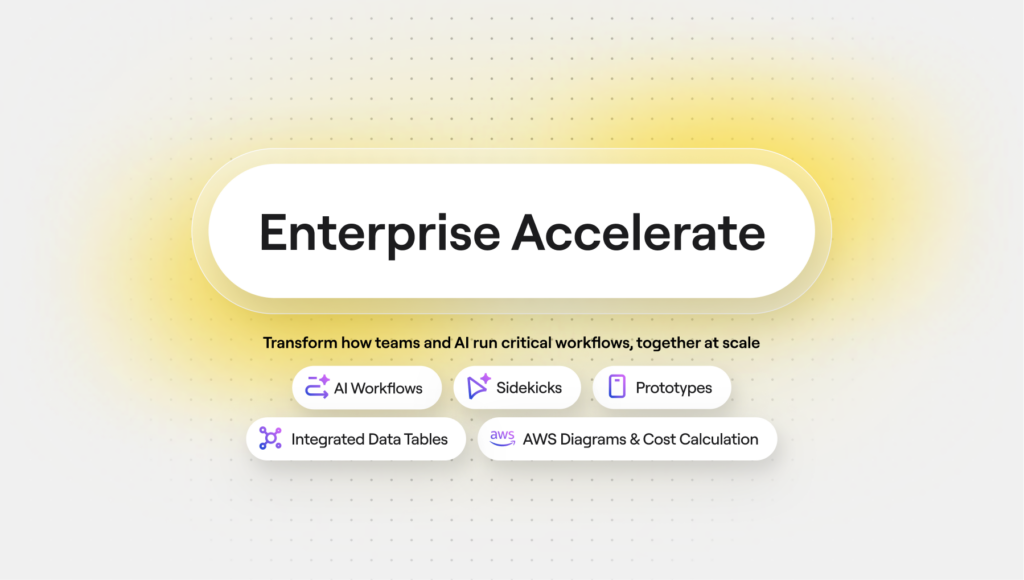
Solutions like Miro’s Flows and Sidekicks exemplify this approach. AI workflows operate transparently within existing collaboration spaces, letting teams understand and shape how AI supports their work.

When AI lives in collaboration platforms, adoption becomes a natural workflow evolution rather than a forced behavior change. Teams don’t need to remember to use AI. It’s available when and where they need it, with full context about their projects, decisions, and progress.

Take the next step

The organizations building AI capability fastest aren’t deploying better tools. They’re building better relationships between people, systems, and collaborative processes. They empower managers to lead skill development as a strategic responsibility, not a nice-to-have initiative.

Your teams are ready. The technology exists. The question is whether you’ll invest in the human infrastructure that turns AI potential into measurable business acceleration.

Get the free Gartner report

Download "The Human-AI Workforce Journey: 5 Steps for CIOs to Accelerate AI-Readiness," and get the blueprint your managers and employees need to deliver AI impact.

Get your copy